Showing posts with label Postmodernism. Show all posts

Thursday, 27 July 2017

Review: Writing Medieval History Edited by Nancy Parker

'Writing Medieval History' is a collection of essays aiming to survey how theories developed from the 'linguistic turn' and Postmodernism have and can be used in Medieval studies. It does this by concentrating on three key themes: the self, the use of literary techniques in history and sex and gender. This approach is useful by allowing in-depth accounts of  particular 'new' methods, but does this at the expense at of having less breadth.


The range of authors employed in the 9 essays allows some differentiation in the way each chapter is approached and structured. But they all fundamentally are made up of two key parts, the theory and an example of how this can be applied practically. This is helpful as it allows the reader to identify instances where they could similarly apply the techniques offered. Each chapter concludes with detailed footnotes and a guide to further reading. The latter is useful in guiding the reader to broader works in the humanities and social sciences, while at the same time pointing towards further Medieval studies using postmodern methods. 

The first section of 'Writing Medieval History' is entitled 'Recognizing People in Medieval Society: The Self'. As implied by the title, the chapters here focus on the interaction between the 'self' and wider society and forms through which the 'self' is represented. 'Social Selves in Medieval England: The Worshipful Ferrour and Kempe' by David Shaw looks at social networks in the towns of Wells and Lynn and how individuals interactions with these shaped their identity. Richard Ferrour and John Kempe (wife of the the mystic Margery Kempe) were shaped not only by the wider assumptions of society, such as gender and urbanity, but also were affected by the cultural impact unique to their communities. Shaw suggests this was based on characteristics such as honour and fidelity and their pursuit of an identity was based on achieving status through these means. The chapter is useful in showing how documentary evidence can be used to not only show social networks, but how these relate to the individuals interaction with society.

'Biography and Autobiography in the Middle Ages' by Jay Rubenstein by looking at these literary genres suggests that the often cited 'discovery of the individual' was did not spontaneously occur in the 12th century.  Instead, what occurred was that writers in the late 11th century began to formulate new ideas about the 'self', therefore instead of a 'discovery' of the individual there were developments and in how to think and write about it. Rubenstein also suggests that elements of Medieval autobiography can be detected in biographical works- which often contain details relating the author to the subject of the text.  Medieval biographies also come with an agenda or theoretical apparatus that differ from the modern versions of these genres, for example Vitae may offer a model for how life ought to be led.

The final chapter in the section about the 'self' is 'The Hidden Self: Psychoanalysis and the Textual Unconscious'. Focusing on the use of the basic Freudian principles for psychoanalysis it also dips into the works of some later writers, such as Marshall Edelson, but at the same time lacks space to go into the works of other important psychoanalysts, such as Jacques Lacan. By taking into account how the mind symbolises what lays beneath its surface, Nancy Partner looks at accounts of Medieval dreams and looks for hidden meanings. She concludes that psychoanalytic theory can be used to show individuals 'pushing back' against a conformity-demanding culture and that it respects the individual psyche's fundamental activity of informing the world with meaning.
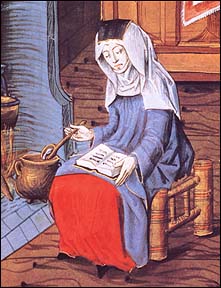

                                                            Margery Kempe


The second section 'Literary Techniques for Reading Historical Texts' begins with a chapter by Robert M.Stein on 'Literary Criticism and the Evidence for History'. Stein uses 'deconstructive' methods (in the weak sense, not directly related to the works of Derrida) to understand the operations that construct a text as a meaningful object. Written evidence should not be solely mined for clear facts and should not be just understood on the surface. The way in which text is composed can reveal further meaning. Using the example of the Hyde Chronicle, Stein shows how syntax and tense ere employed to show specific narratives. The Hyde Chronicle (detailing the Norman Conquest) changes form with the transition from Harold to William. William's accession to the throne is wrote as passive, maintaining Harold's legitimacy to the last moment while placing importance on divine intervention on the outcome of the change in Kingship.

Sarah Foot in 'Finding the Meaning of Form: Narrative in Annals and Chronicles' continues the section on literary techniques. Annals and chronicles are not simply chronological recordings of events they convey specific narratives and often wrote with purpose. The Royal Frankish Annals focuses on the Franks as a people and the idea they have a shared destiny with the Carolingians. Notable omissions include the Merovingian era, the history starts with Charles Martel. The annals are also intentionally tied around the liturgical calendar, placing the Frankish people and their Kings into a linear and Christian notion of time. The Anglo-Saxon Chronicle is used as another example, composed with the purpose of promoting the idea of Angelcynn in line with Alfred's political ideals in his conflict with the Vikings. Chronicles and annals must not be taken at face value.

'Functions of Fiction in Historical Writing' looks at how Medieval genres including fiction and non-fiction were more permeable. Fantastical elements can appear in texts which may otherwise appear to be more historical for the modern reade. The works of Geoffrey of Monmouth and William of Newburgh are used to show 'creative history-making' with a purpose. This can be seen when William uses Gerbert of Aurrilac and an Aqutainian monk's experience in an 'underground frozen world' with 'automata' as metaphor for the the past not being fully retrievable. Gerbert and the monk cannot touch anything in the underground realm as it would result in their deaths, despite the former's 'magic'. The 'magic' symbolic for the historian's interaction with the past. Fictionality was not simply accepted as fact, it was a means of conveying specific narratives. Geoffrey of Monmouth was criticised for being a 'liar', but at the same time the way he uses fictionality (i.e Brutus being the legendary founder of Britannia) was adopted in later histories for use in ancestral claims. Therefore, in this essay, Monika Otter shows that fiction and non-fiction were mixed and combined in some Medieval writings.
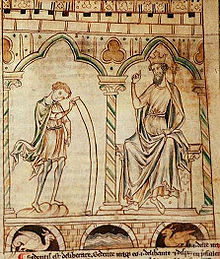

                              Merlin and Vortigern from Monmouth's 'History of the Kings of Britain'

The third part is called 'Historicising Sex and Gender'. The first chapter 'Historicising Sex, Sexualising History' takes into account that despite the human body being biologically similar, it does not mean that the Medieval period understood it in the same way. Firstly, medical knowledge at the time shaped the way in which it was understood. However, cultural regulation occurs through laws and taboos. Sexuality in Medieval Europe was heavily restricted by canon law. For example, the 'conjugal debt' expressed spouse's sexual commitment to each other, but as always it is always difficult to identify how far canon law was followed. In the instance of conjugal debt, the husband and wife both technically had equal status, yet at the same time it would appear this often did not happen in practice. Jacqueline Murray's chapter therefore explores how biolgogical and cultural understandings influenced the Medieval notion of 'sex'.

Cordelia Beattie's chapter on 'Gender and Femininity in Medieval England' using the theory of Judith Butler shows how gender in the Medieval Period could be performative and not simply related to the wider assumptions of society. Some actions were 'feminine' while others were 'masculine' and yet at the same there were multiple 'feminities'. The 'Good Wife' archetype was chaste, modest and obedient to her husband, whereas the archetype of the 'Evil Wife' had characteristics such as extravagance and gossiping. Beattie's point is that there were multiple ways in the Medieval Period for woman to be seen acting as feminine, regardless if these different forms were valued on the same 'moral' level. The example of Margery Kempe is used to show how the idea of a woman being in control of the household economy, was yet another discourse in competition for the idea of 'femininity'.

The final chapter of the book 'Masculine Identity in Late Medieval English Society and Culture' by Derek Neal looks at some of forms through which Medieval masculinity was expressed. One of these is language and how it relates to the competitive nature of masculinity in the era. 'Boy' did not refer to a 'Male Child' before the 15th century, instead referring to 'servant' or 'person in a menial position'. When applied it was a derogatory term meant to undermine someone's masculinity, showing how gender could be related to hierarchies of power. Masculinity could be measured by how one used property- misabuse and greediness could be aligned with a lack of masculinity, once again showing a range of masculinities in discourse. Neal also focuses on how masculinity was realigned with the clerical and therefore celibate world. Expressions of sexuality, especially with a lack of self-control, could demasculinise and could take away from a man's reputation in gendered hierarchies. The chapter therefore adds to the debate on nor only the construction of masculinity in the Medieval Period, but how different ideas about it fought each other.

To summarise, 'Writing Medieval History' is mostly successful in providing an insight into some of the methods associated with Postmodernism and how the Medievalist can apply these. The focus on three key themes allows the text to go in-depth on specific theories, while avoding other potential areas of focus, such as Medieval postcolonialism, queer theory and cultural studies. As a result of this, each section is more than a simple snapshot of a particular method than may have appeared in a more general book on Medieval writing or Postmodern techniques, allowing the reader to gain more valuable in-sight and placing them in a better condition to carry out further reading or apply theory. Therefore, while not comprehensive, 'Writing Medieval History' is an accessible and well-written introduction to the use of Postmodern techniques in the Medieval discipline.


Image credit goes to:

Wikicommons

http://www.luminarium.org/medlit/margery.htm


Wednesday, 22 March 2017

Review: Postmodernism for Historians by Callum Brown

 Callum G. Brown, in his 2005 book 'Postmodernism for Historians', aims to provide the first dedicated primer on Postmodern theory for  History students. So to what extent is he successful to doing this?  And does he do this in a clear and accessible way?  Brown's account is also sympathetic to Postmodernism as a whole. With himself being a practitioner of many of the techniques associated with it. Because of this, the book is not just an introductory guide, but an argument for application of Postmodernism in History as a whole, as we shall see.

 Each chapter of the book is split into three main sections: 'Theory', 'Application in History' and 'For the student to do'. The first, as the name suggests concentrates on  the main aspects of 'Postmodern' theory relevant to History and forms the largest part of most chapters. The second draws from a variety of historians' works, exploring how they  have applied this theory while carrying out research. The third section concentrates on how a student could apply Postmodern techniques while studying. This format for the most part works well, but the final section is always the smallest- which is a disappointment considering the book's target audience.


In the introduction, Brown lays out the key tenets of Postmodernism. Firstly, that reality is unrepresentative in human forms of culture (such as textual and visual material). The second tenet then is that because of this no authoritative account can exist of anything. This of course causes conflict with a 'scientific' or 'empiricist' view of history- which would argue that one of the purposes of history is to reveal what actually happened in the past. He takes this idea forward in the first chapter in the first chapter 'Empiricism' which explains the reasons behind these principles. Firstly, by explaining the difference between a 'fact' and an 'event'. An 'event' is something that happened in the past, a 'fact' is a human construction- it is a record and expression of the 'event'. Because of the processes that go into trying to reconstruct the 'event'- such as consulting historical documents- an array of problems arise that obscure the truth, such as biases, accuracy and editing. This problem of being unable to represent reality becomes worse when the historian tries to make something meaningful out of their research. As Brown notes, it may be possible to objectively say 'the Bastille was overrun by people on 14 July 1789' but as soon as you develop this point it becomes a 'narrative-statement', For example, to say the storming of the Bastille marked the beginning of the French Revolution is to make a judgement based on the importance of an event. And as the historian's job involves more than a simple statement of an event- their work inevitably becomes a reflection of reality based  rather than a proven 'truth', as they develop narratives.

Brown is keen to point out that Postmodernist critique does not extend to the empirical method- in fact it as ever remains a key part of a historians toolkit to verify their work. Instead, it is a critique of the empiricist philosophy of knowledge. Brown also importantly refutes a common criticism of Postmodernism- that it denies the existence of reality. A Postmodernist does not deny the existence of reality, but simply the ability to reflect it fully and objectively.


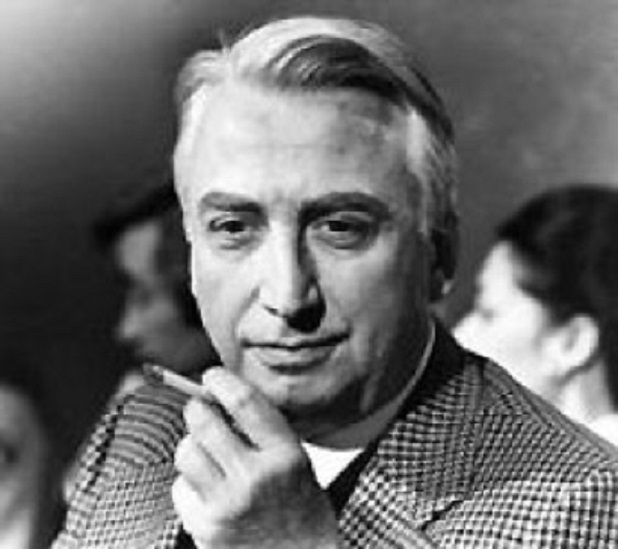
                                                          Roland Barthes

The  chapters 'Sign' and 'Discourse' are mainly concerned with theory. The first of these deals with 'semiotics', one of the cornerstones of Postmodern theory. One way it does this is by engaging with the theorist Ferdinand de Saussure, engaging with theorists is a  recurring feature of Brown's exposition of Postmodernism. Which he often makes this easier through 'boxes' set aside from the main text, which is simple but effective. Semiotics is constituted of the study of 'signs', 'signs' are the constituent parts of any form of communication. These are often words, but can appear in other forms ,for example the word 'mouse' conveys the same meaning as the drawing of a mouse. A sign has two parts the signifier (the sign's physical form, such as a sound, printed word or image) and the signified (the mental conception of the idea expressed by the sign).The signifier is quite arbitrary and bears no resemblance to the signified. Crucially, each 'sign' is part of a 'sign system' through which it gains its meaning via similar or opposing signs. So how is this relevant for the historian? Brown refers to the work of Roland Barthes- who took the concept of sign-systems to cultural studies. He argued that everyday forms of culture have hidden languages with political meanings- using the example of a wrestling match. As such a historian can decode these languages or sign-systems within societies in the past. Semiotics also allows the historian to take more notice of the words they use in their work and what hidden meanings they may have.

The second of these chapters deals with 'Discourse'. Discourse can be loosely defined as something that is embedded in the 'signs' and is a result of a collection of statements based on these signs that form a narrative that conveys its meaning across society. This is perhaps, best understand through an example, something Brown uses to his advantage to help in understanding theory. For example, Michel Foucault in Madness and Civilisation explored the social construction of the idea of 'madness' throughout different eras. For example, in the Medieval era and the Renaissance madness was seen in a positive light, having a 'holy quality' in the former and representing 'high knowledge' in the former. From 1650 onwards, Foucault noticed a dramatic reconstruction of the idea of madness towards it resembling pure illogicality and lack of reason. Brown then argues that this- discourse analysis- is one of the easier tools sometimes associated with Postmodernism that one can pick up.

                                   The Libirare Plon edition of Madness and Civilisation

'Post-structuralism' explores the movement of the same name. In Post-structuralism, all knowledge is socially constructed- structures such as class, gender and race are not concrete and are the fabrications of society. For the historian, Brown suggests, this means instead of structures being used to study history (for example, a Marxist using class) they themselves should be studied, including how they originated and how the meaning and language has changed over time. Therefore, a post-structuralist would examine how a structure was understood within a period, rather than applying one to the whole of history. 'Text' dissects how the Postmodernist would look a text. Instead, of a simple piece of literature, for the Postmodernist 'text' is the material manifestation of signs, discourse and structures. This manifestation is not always written, in fact a 'text' can also be 'visual' or 'audible', such as an image or music. 'Texts' form 'stories' or 'narratives' and in turn 'metanarratives', which influence the former. The Postmodernist deconstructs these 'texts' in various ways, including identifying its intertexuality (how it borrows from other texts) and the signs, discourses and structures within the text. These are only some of the methods of deconstruction that Brown discusses. He also points towards the work of Hayden White, whom saw history as more of literary exercise than a science- they have to make the same decisions as any writer and they do these on poetic grounds.

The chapter 'Self'' is about Postmodernist ideas regarding the construction of our own identity. We construct the 'self' through how we perceive ourselves and our reaction to how others perceive us. In exploring this theme in relation to History, Brown mainly focuses on the 'Application in History' section of this chapter. One notable aspect historians have noticed is how people draw from society in the construction of their identities. For example, Alistair Thomson interviewed Anzac veterans and noticed overwhelmingly their recall of serving in the military was not based on their own experiences, but on the reconstruction of their memories based on Australian national culture. This chapter also deals with the agency of the individual in history and the practice of reflexivity. Whereas, Morality deals with perhaps one of the most controversial aspects of Postmodernism in History- the fact that morality should not be based on empiricism. Brown argues this through the idea that morality changes throughout societies and time, but also through the fact Postmodernism denies an authoritative account of the past and thus anything is up to debate. However, as Brown suggests,  Ermarth has already noted that the lack of an authoritative account can actually have positive moral implications. Modernist and empiricist history has tended to led to authoritative and immoral stances (such as racist and sexist stances) to be held across society.According to Brown, Postmodernist history, with its endless debate, would not allow this to happen.

The final chapter 'Criticism of Postmodernism in History' is the only section completely dedicated towards negative views of the school of thought. Brown could have expanded on this, but then as points out there are plenty of works already out there that provide a thorough exposition of the supposed faults of Postmodernism. This section mostly acts as a refutation of these criticisms and these vary in strength. Nevertheless, this chapter is a welcome, if underweight, concluding chapter.

                               Hayden White discussed the literary nature of writing history


In summary, Callum Brown is mostly successful in providing an accessible introduction for students to Postmodernism and its relationship to history. It fills a large gap in the market, while also introducing the reader to a wide-range of theorists and further reading, which they may wish to follow. It also has some practical advice for students and how they can begin to apply these to their studies. The format of the book works well, but sometimes the large amount of theory could be balanced out with more practical advice of how to implement Postmodern techniques. Nevertheless, 'Postmodernism for Historians' overall is an enjoyable and useful introduction.