Showing posts with label Book Review. Show all posts

Monday, 2 April 2018

Review: People and Identity in Ostrogothic Italy, 489-554 by Patrick Amory

The 1997 book 'People and Identity in Ostrogothic Italy' by Patrick Amory  is one of many books to tackle the issue of identity, especially ethnicity,  in the 'transition' from the late Roman west to the early medieval period. Amory attempts to tackle this issue through two main lens: by looking at the relationship of individuals to a given community and by examining the often poltically motivated ideological tools that could be used to shape these ties. Amory's approach is ultimately insightful and at times highly nuanced, coming to the conclusion that the boundaries between 'Roman' and 'Goth' were far from static. however there a number of gaps left by the scope of his work.


The first chapters, as of reading now, discuss many themes and issues that will be familiar to those who have studied early medieval ethnicity before. The historiography of ethnic interpretations, the complexity of  labels such as 'Roman' and 'barbarian', are all issues you expect to be present and they certainly are. Therefore, while not always covering new ground, the beginning of the book acts as a useful preamble to the rest of Amory's arguments. The opening section of the book is also aided by a list of vocabulary, which is of a great benefit in what can often be a highly theoretical work.

Amory's initial argument is that Theodoric tried to perpetuate different ideologies on ethnography. Using sources, such as Cassiodorus' Variae and the Edictum Theoderici, he shows that this often over time. Theodoric's civilitas ideology consisted of promoting the idea of  the 'Romans' and the 'Goths' as two harmonious peoples. The 'Goths' being defined by military status, the 'Romans' being civilians. However, in the 520s this changed to an ideology of Gothic superiority, based on strength and the legitimacy of the Amal dynasty. He argues this may have been a a result of the the political upheaval in this part of his reign, such as his actions against Albinus, Pope John and Boethius. Under Theodoric's successors, ethnographic propaganda varied between these two ideas.

The argument here is made better by the point that the promotion of an ideology does not necessarily reflect reality. The changes shown in the texts show an attempt to change ethnic thought, but do not actually represent it in reality. This approach avoids any problematic assumptions with the sources. However, Amory could have made it more clear how these texts with ethnographic connotations were disseminated. Only throwaway references to studies on early medieval literacy, such as those by Rosamond Mckitterick, tackle this problem. It would have been good to see more space dedicated to this, particularly within the context of sixth-century Italy, when it forms an important part of his argument.

Amory also shows how the ideologies of the Gothic kings was only one of many competing discourses in sixth-century Italy. One was the idea of renovatio, the idea of a return to to a golden past, as promoted by the Emperor Justinian. Naturally, this took on the most importance during Justinian's attempt to reconquer the Italian peninsular and it aimed to appeal to the sensibilities of conservative Roman aristocrats. These competing ethnographic ideas could used be used politically by both sides in the context of the Gothic Wars.

                                          Theodoric the Great, as depicated in a medallion.

The other dichotomy tackled by Amory in this book is that of the Arian-Catholic divide. The traditional assumption is that Arianism was inherently 'Gothic', whereas 'Catholicism' was 'Roman'. A large amount of space is dedicated to undermining  the idea that these divisions were anything as simple as the labels suggest. For example, although some Popes may have been driven by an idea of a universal Christian Empire, the day-to-day practical implications of this were often affected by the working relationship the Papacy had with the Arian Ostrogothic Kings. Amory also suggests that individuals could change and adopt their 'faith' to suit political circumstances, as such the 'Arian' and 'Christian' divide were as fluid as other ethnographic ideologies in sixth-century Italy.

One of the other major parts of the book, and perhaps the most impressive, is the massive prosopography attached to the appendix. This is a study of all people who can possibly be identified as a Goth in sixth-century Italy- 379. Outside the work of Procopius, there are only a few people directly named as 'Goth'. Therefore, Amory approaches this section with the flexible criteria found in the rest of the book. This could be problematic for those wishing to use it as a simple factual resource, however as Amory suggests it is reflective of the numerous meanings 'Goth' actually had for various people and groups.

The prosopography also must be understood in the wider content of Amory's work. As a study of 'Gothic' individuals, it cleverly connects to the wider arguments of the book about identity and community by showing the wide range of individuals that can be classed under the aforementioned label. 

There are also a range of other articles attached to the appendix, which all relate to the wider theme of identity in Ostrogothic Italy. Including an inquiry into Gundila's property, which swapped hands during the Gothic Wars. An essay that expands on the 'Germanic' culture as a scholarly construct adds to some of the discussion found earlier in the book. The rest of the appendix covers some of the evidence that is noticeably absent in the main section of the book, such as archaeology and dress. All of these are insightful and well placed here as they are relevant, but not critical to the main thrust of Amory's arguments. 

                                        The mausoleum of Theodoric in Ravenna

To conclude, People and Identity in Ostrogothic Italy is a valuable contribution to discussion about early medieval identity. Its argument that identities such as 'Gothic' and 'Arian' were more complex in reality than how they were portrayed in ethnographic propaganda is persuasive. However, the scope of the work also leaves a couple of unanswered questions, for example how were ethnographic texts disseminated and is it possible to measure their effectivness? Such issues are critical to some of the points made in the book and it would have been good to see more time spent on them. Nevertheless, the book is a nuanced addition to the wide range of scholarly works on early medieval identity.




Wednesday, 9 August 2017

Review: The Merovingian Kingdoms 450-751 by Ian N.Wood

The 1994 book 'The Merovingian Kingdoms 450-751' by Ian Wood aims to address the period of the eponymous dynasty's rule and influence over significant parts of Western Europe up until its usurpation by the Carolingians. Wood approaches this task in a manner which combines chronology with thematic analysis allowing the reader to understand continuity and change on a number of important topics. However, the inconsistent way in which this is done raises questions about the target audience of the book.


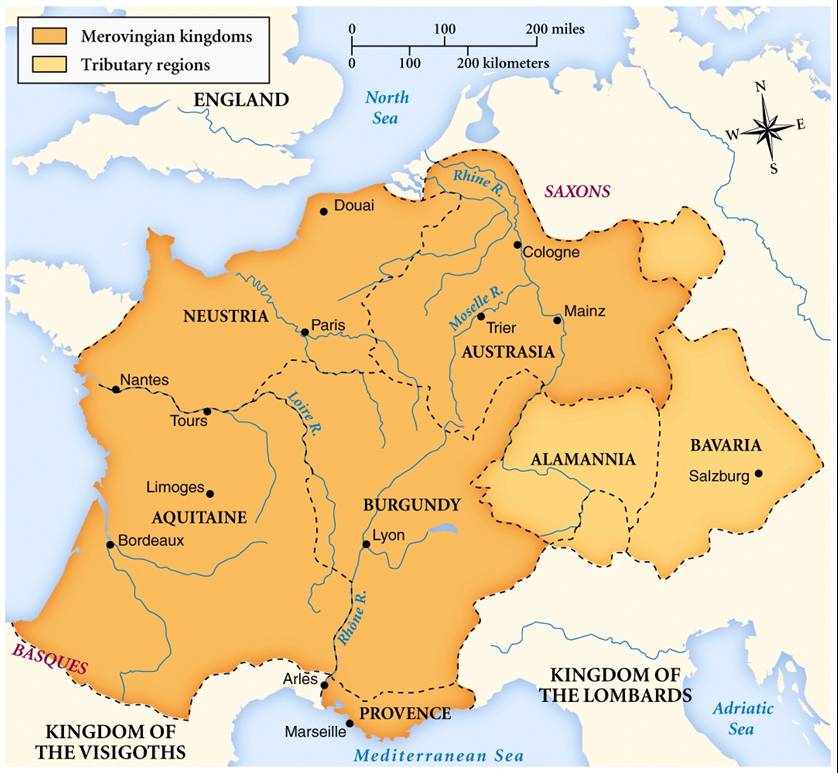
Chapters on the political context are the most frequent and form the backbone of the chronological narrative. Starting from early barbarian settlement in Gaul the chapters describe the main events up to the deposition of the last Merovingian King, Childeric III, by Pippin. These chapters attempt to analyse any changes in the conduct of politics throughout the covered centuries. However, in some instances they fall short, especially in the early chapters which can be overly descriptive and short of analysis. Later on, with the rise of the Mayors of the Palace, the political side of the book becomes more in-depth. This is mainly in part due to the increased level of insightful analysis of primary sources, especially when facing the challenge of texts which may possibly considered as Carolingian propaganda. The book tends to focus on the Kingdom of Neustria, while at the same time Austrasia is noticeably covered to a much lesser degree. However, Wood is successful in describing what can be known about periphery territories. For example, we learn when Frisia and Alamania fall in and out of the Frankish sphere of influence. Likewise, the complex political situation in Aquitaine is described in detail.  Nevertheless, it remains clear that the focus of the book is on the Kingdom of Neustria.

The narrative of events is  dispersed with more analytical chapters. These are mainly on the Church, including its production of culture, and the economy. Other topics are assigned individual chapters, such as Merovingian Law and the role of royal women (most notably Brunhild). Nevertheless, Wood manages to place these chapters alongside the more politically oriented ones in a way that maintains the chronology. This is useful in showing economic and social changes over time, but means an opportunity to connect them more closely to the main narrative is missed.


Wood mainly relies on textual sources for the book and is  aware of the limitations of what he uses. Understandably, his early chapters are heavily reliant on Gregory of Tour's History, a pivotal source for the early Merovingian era. The Chronicle of Fredegar and its continuators are frequently used later in the book. However, Wood also uses a range of other sources, even if they are consulted less. Archaeological evidence is noticeably slim, when present it is only used in the context of the economy. The excavations of the emporia Dorestad are particularly used well. Numisatic evidence is also used to describe the economy. While, Wood could have perhaps used more forms of material evidence, this is often in part due to the nature of the evidence available rather than  a fault attributable to the author. Indeed, his shrewd use of textual evidence in situations which may be unexpected helps to fill in some of the gaps. For example, in the chapter 'Land, Wealth and the Economy' he manages to infer from hagiography more details regarding the economic structure of the Frankish Kingdoms.

One of Wood's main arguments is that the transition between the Merovingian and Carolingian dynasties was one of continuity. He argues against the idea of a Merovingian decline. His emphasis on cultural continuity,  including the production of manuscripts at Luxeuil and Corbie, implies that the Carolingians built on the achievements of the Merovingians, reliant on them for later developments. The same can be applied to the development of the emporia and also law. The political transition from the Merovingians to the Carolingians was also steady, featuring continuities on top of changes.

The book is also heavily footnoted and features a detailed bibliography. Wood states that citations of secondary material are aimed at students whose primary language is English. Works in French and German are only provided where no English alternative is available. This is prioritised over the inclusion of the latest scholarly research. The book also contains genealogies of the Merovingian dynasty. These are useful in particular when used in conjunction with the political narrative, due to the brevity of which some monarchs are dealt with. However, placing them to the front of the book or alongside the narrative may have made them more prominent for the reader. A number of maps are also included and these are helpful in providing a general overview of boundaries, but naturally are limited in the complexity they can show. These similarly could have been included earlier in the book to help the student or general reader.


                                             Seal of Chilperic II from a letter dated 716


To conclude, 'The Merovingian Kingdoms 450-751' by Ian N.Wood is an attempt to offer an account of the entire Merovignian period, while at the same time maintaining thematic analysis by combining it with the chronological narrative. Wood is successful in doing this, however the chapters vary in depth and quality. Some political chapters are heavily descriptive and could have benefited from more analysis of textual sources or the means of implementing power itself. Chapters that tend to be focused on a particular issue, such as different aspects of the Church and economy tend to be more insightful. Nevertheless, Wood's approach both shows change and continuity in a mostly clear way and his argument that the Carolingians owe a lot to the Merovingians is persuasive.


Thursday, 27 July 2017

Review: Writing Medieval History Edited by Nancy Parker

'Writing Medieval History' is a collection of essays aiming to survey how theories developed from the 'linguistic turn' and Postmodernism have and can be used in Medieval studies. It does this by concentrating on three key themes: the self, the use of literary techniques in history and sex and gender. This approach is useful by allowing in-depth accounts of  particular 'new' methods, but does this at the expense at of having less breadth.


The range of authors employed in the 9 essays allows some differentiation in the way each chapter is approached and structured. But they all fundamentally are made up of two key parts, the theory and an example of how this can be applied practically. This is helpful as it allows the reader to identify instances where they could similarly apply the techniques offered. Each chapter concludes with detailed footnotes and a guide to further reading. The latter is useful in guiding the reader to broader works in the humanities and social sciences, while at the same time pointing towards further Medieval studies using postmodern methods. 

The first section of 'Writing Medieval History' is entitled 'Recognizing People in Medieval Society: The Self'. As implied by the title, the chapters here focus on the interaction between the 'self' and wider society and forms through which the 'self' is represented. 'Social Selves in Medieval England: The Worshipful Ferrour and Kempe' by David Shaw looks at social networks in the towns of Wells and Lynn and how individuals interactions with these shaped their identity. Richard Ferrour and John Kempe (wife of the the mystic Margery Kempe) were shaped not only by the wider assumptions of society, such as gender and urbanity, but also were affected by the cultural impact unique to their communities. Shaw suggests this was based on characteristics such as honour and fidelity and their pursuit of an identity was based on achieving status through these means. The chapter is useful in showing how documentary evidence can be used to not only show social networks, but how these relate to the individuals interaction with society.

'Biography and Autobiography in the Middle Ages' by Jay Rubenstein by looking at these literary genres suggests that the often cited 'discovery of the individual' was did not spontaneously occur in the 12th century.  Instead, what occurred was that writers in the late 11th century began to formulate new ideas about the 'self', therefore instead of a 'discovery' of the individual there were developments and in how to think and write about it. Rubenstein also suggests that elements of Medieval autobiography can be detected in biographical works- which often contain details relating the author to the subject of the text.  Medieval biographies also come with an agenda or theoretical apparatus that differ from the modern versions of these genres, for example Vitae may offer a model for how life ought to be led.

The final chapter in the section about the 'self' is 'The Hidden Self: Psychoanalysis and the Textual Unconscious'. Focusing on the use of the basic Freudian principles for psychoanalysis it also dips into the works of some later writers, such as Marshall Edelson, but at the same time lacks space to go into the works of other important psychoanalysts, such as Jacques Lacan. By taking into account how the mind symbolises what lays beneath its surface, Nancy Partner looks at accounts of Medieval dreams and looks for hidden meanings. She concludes that psychoanalytic theory can be used to show individuals 'pushing back' against a conformity-demanding culture and that it respects the individual psyche's fundamental activity of informing the world with meaning.


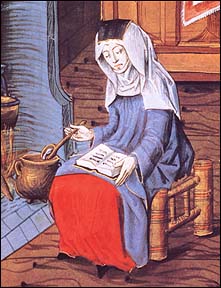
                                                            Margery Kempe


The second section 'Literary Techniques for Reading Historical Texts' begins with a chapter by Robert M.Stein on 'Literary Criticism and the Evidence for History'. Stein uses 'deconstructive' methods (in the weak sense, not directly related to the works of Derrida) to understand the operations that construct a text as a meaningful object. Written evidence should not be solely mined for clear facts and should not be just understood on the surface. The way in which text is composed can reveal further meaning. Using the example of the Hyde Chronicle, Stein shows how syntax and tense ere employed to show specific narratives. The Hyde Chronicle (detailing the Norman Conquest) changes form with the transition from Harold to William. William's accession to the throne is wrote as passive, maintaining Harold's legitimacy to the last moment while placing importance on divine intervention on the outcome of the change in Kingship.

Sarah Foot in 'Finding the Meaning of Form: Narrative in Annals and Chronicles' continues the section on literary techniques. Annals and chronicles are not simply chronological recordings of events they convey specific narratives and often wrote with purpose. The Royal Frankish Annals focuses on the Franks as a people and the idea they have a shared destiny with the Carolingians. Notable omissions include the Merovingian era, the history starts with Charles Martel. The annals are also intentionally tied around the liturgical calendar, placing the Frankish people and their Kings into a linear and Christian notion of time. The Anglo-Saxon Chronicle is used as another example, composed with the purpose of promoting the idea of Angelcynn in line with Alfred's political ideals in his conflict with the Vikings. Chronicles and annals must not be taken at face value.

'Functions of Fiction in Historical Writing' looks at how Medieval genres including fiction and non-fiction were more permeable. Fantastical elements can appear in texts which may otherwise appear to be more historical for the modern reade. The works of Geoffrey of Monmouth and William of Newburgh are used to show 'creative history-making' with a purpose. This can be seen when William uses Gerbert of Aurrilac and an Aqutainian monk's experience in an 'underground frozen world' with 'automata' as metaphor for the the past not being fully retrievable. Gerbert and the monk cannot touch anything in the underground realm as it would result in their deaths, despite the former's 'magic'. The 'magic' symbolic for the historian's interaction with the past. Fictionality was not simply accepted as fact, it was a means of conveying specific narratives. Geoffrey of Monmouth was criticised for being a 'liar', but at the same time the way he uses fictionality (i.e Brutus being the legendary founder of Britannia) was adopted in later histories for use in ancestral claims. Therefore, in this essay, Monika Otter shows that fiction and non-fiction were mixed and combined in some Medieval writings.


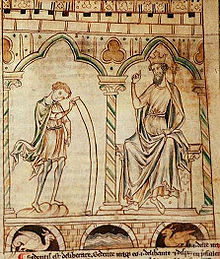
                              Merlin and Vortigern from Monmouth's 'History of the Kings of Britain'

The third part is called 'Historicising Sex and Gender'. The first chapter 'Historicising Sex, Sexualising History' takes into account that despite the human body being biologically similar, it does not mean that the Medieval period understood it in the same way. Firstly, medical knowledge at the time shaped the way in which it was understood. However, cultural regulation occurs through laws and taboos. Sexuality in Medieval Europe was heavily restricted by canon law. For example, the 'conjugal debt' expressed spouse's sexual commitment to each other, but as always it is always difficult to identify how far canon law was followed. In the instance of conjugal debt, the husband and wife both technically had equal status, yet at the same time it would appear this often did not happen in practice. Jacqueline Murray's chapter therefore explores how biolgogical and cultural understandings influenced the Medieval notion of 'sex'.

Cordelia Beattie's chapter on 'Gender and Femininity in Medieval England' using the theory of Judith Butler shows how gender in the Medieval Period could be performative and not simply related to the wider assumptions of society. Some actions were 'feminine' while others were 'masculine' and yet at the same there were multiple 'feminities'. The 'Good Wife' archetype was chaste, modest and obedient to her husband, whereas the archetype of the 'Evil Wife' had characteristics such as extravagance and gossiping. Beattie's point is that there were multiple ways in the Medieval Period for woman to be seen acting as feminine, regardless if these different forms were valued on the same 'moral' level. The example of Margery Kempe is used to show how the idea of a woman being in control of the household economy, was yet another discourse in competition for the idea of 'femininity'.

The final chapter of the book 'Masculine Identity in Late Medieval English Society and Culture' by Derek Neal looks at some of forms through which Medieval masculinity was expressed. One of these is language and how it relates to the competitive nature of masculinity in the era. 'Boy' did not refer to a 'Male Child' before the 15th century, instead referring to 'servant' or 'person in a menial position'. When applied it was a derogatory term meant to undermine someone's masculinity, showing how gender could be related to hierarchies of power. Masculinity could be measured by how one used property- misabuse and greediness could be aligned with a lack of masculinity, once again showing a range of masculinities in discourse. Neal also focuses on how masculinity was realigned with the clerical and therefore celibate world. Expressions of sexuality, especially with a lack of self-control, could demasculinise and could take away from a man's reputation in gendered hierarchies. The chapter therefore adds to the debate on nor only the construction of masculinity in the Medieval Period, but how different ideas about it fought each other.

To summarise, 'Writing Medieval History' is mostly successful in providing an insight into some of the methods associated with Postmodernism and how the Medievalist can apply these. The focus on three key themes allows the text to go in-depth on specific theories, while avoding other potential areas of focus, such as Medieval postcolonialism, queer theory and cultural studies. As a result of this, each section is more than a simple snapshot of a particular method than may have appeared in a more general book on Medieval writing or Postmodern techniques, allowing the reader to gain more valuable in-sight and placing them in a better condition to carry out further reading or apply theory. Therefore, while not comprehensive, 'Writing Medieval History' is an accessible and well-written introduction to the use of Postmodern techniques in the Medieval discipline.


Image credit goes to:

Wikicommons

http://www.luminarium.org/medlit/margery.htm


Thursday, 17 July 2014

Historical Book Review : Aspects of the Crusades by J.J Saunders

As I enjoy reading History books, I thought it would be a good idea to start to review some of the books I have read. The first book I shall review is J.J Saunders' Aspects of the Crusades. 


.

Introduction

Essentially, the book is a collection of essays regarding, as the title suggests, various aspects of the crusades, many of these aspects not frequently covered and so an interesting read is created. However, it is also short at only 80 pages, with around 60 of these being part of the main content and over 10 of these being notes. Saunders makes a point in the book itself that it is not just from a Western viewpoint and takes into account material regarding the Arab point of view. In order to display the wide range of topics covered to a worthy level, I shall list the chapters below:


  1. The Literature of the Crusades
  2. The Idea of a Holy War
  3. The Role of the Assassins
  4. The Significance of Egypt
  5. The Armenian Ally
  6. The Franks and the Mongols
  7. The Passing of the Near Eastern Civilisation
Positives

Many of the topics covered are interesting, but also it is often difficult to find information on these topics and so the book is indeed enlightening in rarely covered areas. For the common reader, it may be difficult to find material anywhere else in such detail on these 'aspects' and so if you have a particular interest in several or perhaps one of these topics I would strongly recommend it. The book is also highly readable and should not be difficult to swallow, although a basic knowledge of the Crusades is probably required due to the specific nature of the essays. My favourite essays were probably, the ones relating to Egypt, the Assassins, the Armenians and The Franks and the Mongols. In particular, the chapter on the Armenians was very insightful. I must profess that I discovered this book through a sample chapter on the significance of Egypt, which was most helpful  for writing an essay for my AS History course. This sample is legitimately available at http://web.archive.org/web/20110605033053/http://www.deremilitari.org/resources/pdfs/saunders.pdf , as you may have inferred it was this sample that also encouraged me to purchase the full book. I will not spoil the sample chapter's theory on Egypt, as you will be amazed by how significant Egypt was in terms of the Crusades.

Negatives
 
Alas, as with any book some parts do not match the greatness of others, though in this instance I suggest it is down to personal opinion. Although, some of the other chapters are indeed good, they are not as interesting as the others. As I have mentioned this no fault of the author, it is just down to my personal tastes. For some reason, when I bought the book ( having looked at the essay titles beforehand) I thought the essay on The Literature of the Crusades would be somewhat different for some reason ( possibly just expecting information on fiction, such as poetry).

Conclusion

I would thoroughly recommend this book, but I should note that it is not the simplest book to receive. I personally, bought it on AbeBooks and I would suggest it would be very hard if not impossible to gain a new copy of the book. As you may have noticed the image of the book is not to a great standard for a review, this is due to the difficulty of finding an image of the book on the internet. You should also consider that you are buying a very short book, that will probably be second hand, for a price which is quite hefty for the quanitity. In this instance, I would suggest that it is quality not quantity that matters and if you are really interested in purchasing the book, then you should buy it. However, look around for the best price, it was quite a lot cheaper on AbeBooks compared to Amazon, despite both offering only used copies.