I have decided to start a new blog at https://philosophicalostrogoth.home.blog, as I am about to begin postgraduate studies. I will no longer update this site.
Showing posts with label Medieval. Show all posts
Showing posts with label Medieval. Show all posts
Friday, 19 July 2019

Thursday, 20 September 2018
Constructing Outer Space?: The Politics of Astronomy in Carolingian Europe
Traditionally, early medieval and Carolingian astronomy has often been dismissed as a period of little or no progress in the history of science. However, over the last several decades a number of scholars have sought to engage with the astronomy of this era on its own terms; viewing it within its own cultural context and and seeking to prove that this still worthy studying. Paul E. Dutton has argued for an understanding of Carolingian astronomy based on the divinatory and historical meanings it sought to find in the stars. Meanwhile, Stephen C. McCluskey has emphasised the textual aspect of Carolingian astronomy and the way it was often based on the elaboration and interpretation of classical treatises, much more than natural observation. The cultural aspect of early medieval astronomy is therefore a theme prominent in the relevant historiography. This post aims to build on these studies by suggesting that the cultural influence on astronomy was not only present, but that it was often manipulated for political purposes. Astronomy in Carolingian Europe was therefore not a single discipline or methodology, but was something that always adapted, often consciously, for different purposes and circumstances. I will show this political use of astronomy by looking at three examples; the illuminated manuscript entitled the Leiden Aratea, the relationship between the Irish scholar Dungal and Charlemagne and finally the passing of Halley's Comet during the reign of Louis the Pious in 837.
However, first it is necessary to outline some of the traditions that influenced Carolingian astronomy, in order to understand the 'cultural repository' from which those gazing at the stars could take from. Mccluskey has done a large amount of work outlining the strands of thought concerning astronomy in early medieval Europe. He argues that traditions regarding astronomy can be put into a number of groups. Firstly, the Roman heritage of astronomy as one of the mathematical disciplines within the seven liberal arts. Next, the tradition of computus- used for determining the date of Easter. These traditions also went alongside the monastic practice of using the stars for timekeeping, in order to determine times for praying, and finally the various astrological techniques used to try and predict future events. This division, as Mccluskey admits, was not always clear cut and in some instances we find in the sources a blend of these different traditions Alongside these instruments used to view the sky, we must also take Dutton's timely reminder that the medieval sky was not as empty as the modern one. In contrast, to the tendency of science today to see outer space as mostly a void between different celestial objects, the sky for medieval observers was full of movement and meaning. It was often also a way through one could try and determine the will of God through signs and omens. With these points in mind we are in a better position to understand the way in which astronomy could be manipulated and the power and influence it could hold.
The Leiden Aratea and the use of the Classical tradition.
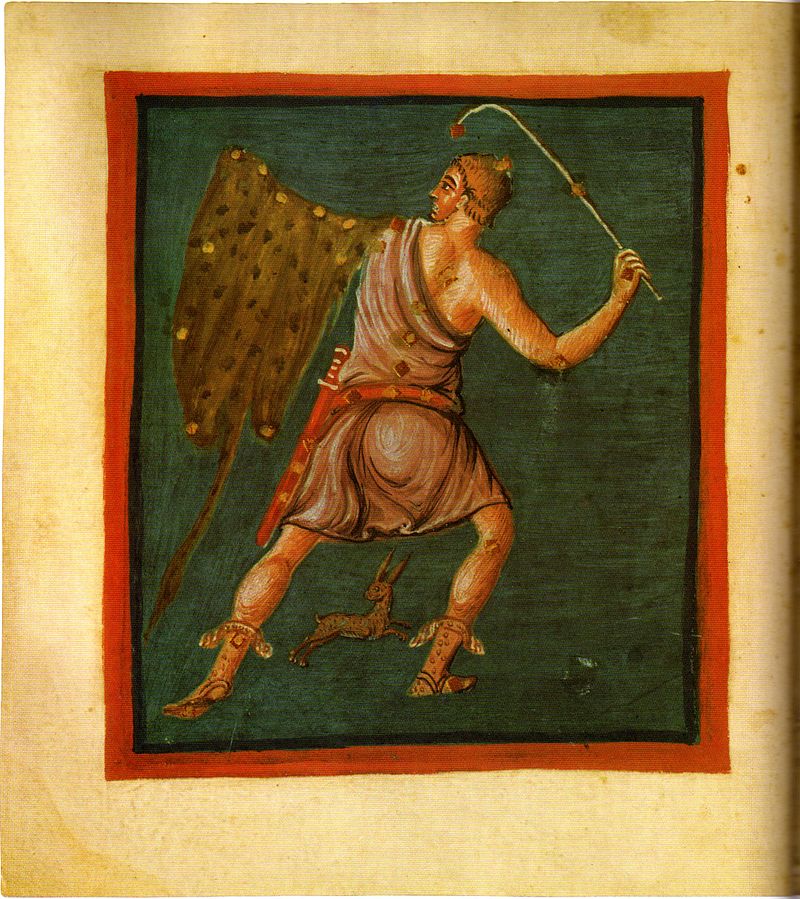 Orion the Hunter from the Leiden Aratea
The Leiden Aratea is a ninth century copy of an astronomical and meteorlogical treatise written by the Greek writer Aratus (315-240/39 BCE) and is our first example of the political use of astronomy in Carolingian Europe. However, the Carolingian version does not originate from the original text, a long tradition of copying the treatise existed before the ninth century. The Carolingian version of the Aratea mainly consists of Claudius Caesar Germanicus' first century Latin translation and is supplemented by portions of a second Latin translation by Rufius Festus Avienus in the fourth century. The Leiden Aratea also contains 39 illustrated miniatures depicting the seasons, planets and constellations. These borrow from Classical symbolism with each miniature being a god, hero, object or animal. For example, the image above shows Orion the Hunter overlying the synonymous constellation. The Leiden Aratea was therefore closely not only connected to classical ideas regarding astronomy, but also the textual tradition of copying astronomical treatises.
While this may at first seem innocent enough at first, the Leiden Aratea must be put into the wider context of the Carolingian Renaissance. This term has been has been highly debated, but it can be broadly defined as a revival of intellectual learning during the reign of Charlemagne and the Emperor Louis. Part of this renaissance involved correcting classical texts, such as the Leiden Aratea, that had been passed down. Katzenstein comments that this interest in classical texts was not simply a nostalgia for a past however, but that it was closely tied to an interest at the Carolingian Court to acquire worldly knowledge which would enable Christians to understand theological truths better. This fact can also be seen in the predominant role clerics played during the Carolingian Renaissance. Understandably, all this means that there was also a political benefit to correcting classical texts, as it provided rulers such as Charlemagne with the prestige of supposedly holding greater knowledge of religious truths.
So how does the Leiden Aratea fit into into this wider context? The Leiden Aratea was not a practical text, it would have been hard for anyone to use it to accurately gaze at the stars. Instead, we must connect to the aforementioned tradition Roman astronomy as part of the seven liberal arts. In many of the extant libraries of Carolingian monasteries we find that texts associated with the liberal arts were kept separate to those that focused on other methods of astronomy, such as the much more practical methodology of computus. From this it is clear to see that classical texts such as the Leiden Aratea were not seen to have the same use as other astronomical texts. Instead, the Aratea can be said to have an ideological rather than practical purpose. Texts such as this were often more or less directly copied from their classical counterparts. Even the miniatures in the Leiden Aratea, while adapted to norms of Carolingian illumination, would have likely been derived from preexisting manuscripts. The Aratea was therefore meant to draw a direct connection to the liberal tradition of Roman astronomy. As mentioned above, an education in the classical tradition was one of the key components of the Carolingian Renaissance. The Aratea was therefore one of the individual texts used during the renaissance to try and boost the prestige of the Carolingian Court, showing us the political power that astronomical treatises could hold, especially when drawing from the classical tradition.
The Politics in Dungal's letter to Charlemagne in 811
If the Leiden Aratea shows us how classical astronomical texts could be used for political benefit, Dungal's letter to Charlemagne in 811 can also reveal to us how an individual could use his personal knowledge of the sky for personal gain at he Carolingian Court. However, to understand why may have used his knowledge for political purposes, it is first necessary to provide the relevant context. In 810/811, Charlemagne contacted the Irish scholar, one of many insular intellectuals within the Carolingian Empire, regarding two recent solar eclipses. However, only two extant letters survive from this exchange. While this would suggest that Charlemagne considered Dungal an authority on astronomy, we should not presume this means he was a prominent political figure at the Carolingian Court. The lack of evidence on Dungal in contrast to scholars such as Alcuin means it is difficult to ascertain his level of influence at court. This can be seen by the fact that Dungal was once thought to be four separate people before the unity of his surviving texts was established. In fact, Garrison has argued that Dungal may have been a peripheral figure in the intellectual hierarchy within the Carolingian Empire. A letter to Theodrada, the daughter of Charlemagne, suggests he is barely acquainted with her. Furthermore, a letter to an abbot suggests he was actively seeking patronage and that he did not have the direct support of the court. With this in mind, we can understand that when Charlemagne contacted Dungal regarding the solar eclipses, he was provided with an opportunity to display his astronomical knowledge and ultimately how he could contribute to the intellectual culture at court.
Dungal's letter to Charlemagne in 811 about the two recent solar eclipses shows this political motivation in action. While writing his reply, Dungal heavily quoted from Macrobius' Commentary on the Dream of Scipio, interspersing it with commentary from Pliny. Macrobius' text itself emerges from the fifth century. While mentioning all of this regarding Macrobius and Pliny was necessary to set up his answer to Charlemagne's questions regarding the eclipses, it also provided an opportunity to display the extent of his astronomical and intellectual knowledge. Dungal also in the reply complained about his lack of access to Pliny, therefore highlighting the fact that while he remained on the periphery of Carolingian intellectual life his abilities were being underutilised.
However, this use of astronomical knowledge to gain political favour is best seen when Dungal mentions the most controversial part of Macrobius' Commentary, which tries to resolve a dispute between Plato and Cicero on the placement of the Sun. Plato suggested that the Sun was sixth in the placement of the planets inward from Saturn, whereas Cicero claimed it was fourth inward from Saturn. Dungal's political motivation is seen when he becomes deliberately selective in using Macrobius to present this dispute, for example he omits the latter's support of the Platonic school of thought on the placement of the Sun. This was because the Ciceronian view was more popular at the Carolingian Court. Dungal was therefore deliberately manipulating an astronomical text to further his chances of being accepted into the higher parts of the Carolingian intellectual hierarchy. This of course, on top of his other rhetorical strategies in the letter, shows a concerted effort by Dungal to use his astronomical knowledge for political advantage.
Louis the Pious and the 'Anxiety' of Astronomy

Why did the passing of Halley's Comet cause such an emotional response in Louis and The Astronomer? The passing of Halley's Comet was not the first time in the Vita Hludovici that political or personal fortunes could be associated with celestial objects or omens. Just before a military disaster in the Spanish March in 827, 'there appeared terrible battle lines in the night sky reddened with human blood flashing with the colour of fire'. This of course was seen as a negative sign, however in 828/829, Louis received a certain grain from Gascony that had fallen from the sky. We also find this association between fortunes and space in other sources such as Einhard's biography of Charlemagne, the Vita Karoli Magni. Which describes a number of omens before Charlemagne's death such as 'a certain black spot' which was 'seen on the Sun for a total of seven days'. Paul E. Dutton has aptly described the implications of this constant connecting of cosmological events to fortunes on the political stage, with the sky becoming 'a political and theological hermeneutics'. Astronomy was therefore seen as a system of interpretation and methodology for matters that affected the ruling of the Carolingian Empire. Consequentially, the passing of Halley's Comet in 837, while not a physical threat to Earth, was still a seen as a political threat to Louis and other Carolingian rulers, due to the cultural and political meanings that celestial objects held.
Conclusion
This post has shown that studies on impact of culture on astronomy can be taken a step further, by highlighting the role politics often played in the study of the skies. This took multiple forms, from the production of texts for the purposes of prestige, the personal manipulation of knowledge and the political uncertainty objects in Outer Space could bring. Therefore, this article has highlighted the need to view astronomy not just as an empirical discipline or as a static cultural tradition, but something that is contingent and can be actively utilised in political settings. It is also hoped this post shows the need for further consideration of the politics of astronomy in other contexts, geographically and temporally. Nevertheless, it is still clear that in Carolingian Europe, astronomy played an important political role.
Bibliography
Primary Sources:
The Astronomer, Vita Hludovici in Charlemagne and Louis the Pious: Lives by Einhard, Notker, Ermoldus, Thegan and the Astronomer translated by Thomas F.X. Noble. University Park: The Pennsylvania State University Press, 2009.
Einhard, Vita Karoli Magni in Charlemagne and Louis the Pious: Lives by Einhard, Notker, Ermoldus, Thegan and the Astronomer translated by Thomas F.X. Noble. University Park: The Pennsylvania State University Press, 2009.
Secondary Sources:
However, first it is necessary to outline some of the traditions that influenced Carolingian astronomy, in order to understand the 'cultural repository' from which those gazing at the stars could take from. Mccluskey has done a large amount of work outlining the strands of thought concerning astronomy in early medieval Europe. He argues that traditions regarding astronomy can be put into a number of groups. Firstly, the Roman heritage of astronomy as one of the mathematical disciplines within the seven liberal arts. Next, the tradition of computus- used for determining the date of Easter. These traditions also went alongside the monastic practice of using the stars for timekeeping, in order to determine times for praying, and finally the various astrological techniques used to try and predict future events. This division, as Mccluskey admits, was not always clear cut and in some instances we find in the sources a blend of these different traditions Alongside these instruments used to view the sky, we must also take Dutton's timely reminder that the medieval sky was not as empty as the modern one. In contrast, to the tendency of science today to see outer space as mostly a void between different celestial objects, the sky for medieval observers was full of movement and meaning. It was often also a way through one could try and determine the will of God through signs and omens. With these points in mind we are in a better position to understand the way in which astronomy could be manipulated and the power and influence it could hold.
The Leiden Aratea and the use of the Classical tradition.
The Leiden Aratea is a ninth century copy of an astronomical and meteorlogical treatise written by the Greek writer Aratus (315-240/39 BCE) and is our first example of the political use of astronomy in Carolingian Europe. However, the Carolingian version does not originate from the original text, a long tradition of copying the treatise existed before the ninth century. The Carolingian version of the Aratea mainly consists of Claudius Caesar Germanicus' first century Latin translation and is supplemented by portions of a second Latin translation by Rufius Festus Avienus in the fourth century. The Leiden Aratea also contains 39 illustrated miniatures depicting the seasons, planets and constellations. These borrow from Classical symbolism with each miniature being a god, hero, object or animal. For example, the image above shows Orion the Hunter overlying the synonymous constellation. The Leiden Aratea was therefore closely not only connected to classical ideas regarding astronomy, but also the textual tradition of copying astronomical treatises.
While this may at first seem innocent enough at first, the Leiden Aratea must be put into the wider context of the Carolingian Renaissance. This term has been has been highly debated, but it can be broadly defined as a revival of intellectual learning during the reign of Charlemagne and the Emperor Louis. Part of this renaissance involved correcting classical texts, such as the Leiden Aratea, that had been passed down. Katzenstein comments that this interest in classical texts was not simply a nostalgia for a past however, but that it was closely tied to an interest at the Carolingian Court to acquire worldly knowledge which would enable Christians to understand theological truths better. This fact can also be seen in the predominant role clerics played during the Carolingian Renaissance. Understandably, all this means that there was also a political benefit to correcting classical texts, as it provided rulers such as Charlemagne with the prestige of supposedly holding greater knowledge of religious truths.
So how does the Leiden Aratea fit into into this wider context? The Leiden Aratea was not a practical text, it would have been hard for anyone to use it to accurately gaze at the stars. Instead, we must connect to the aforementioned tradition Roman astronomy as part of the seven liberal arts. In many of the extant libraries of Carolingian monasteries we find that texts associated with the liberal arts were kept separate to those that focused on other methods of astronomy, such as the much more practical methodology of computus. From this it is clear to see that classical texts such as the Leiden Aratea were not seen to have the same use as other astronomical texts. Instead, the Aratea can be said to have an ideological rather than practical purpose. Texts such as this were often more or less directly copied from their classical counterparts. Even the miniatures in the Leiden Aratea, while adapted to norms of Carolingian illumination, would have likely been derived from preexisting manuscripts. The Aratea was therefore meant to draw a direct connection to the liberal tradition of Roman astronomy. As mentioned above, an education in the classical tradition was one of the key components of the Carolingian Renaissance. The Aratea was therefore one of the individual texts used during the renaissance to try and boost the prestige of the Carolingian Court, showing us the political power that astronomical treatises could hold, especially when drawing from the classical tradition.
The Politics in Dungal's letter to Charlemagne in 811
If the Leiden Aratea shows us how classical astronomical texts could be used for political benefit, Dungal's letter to Charlemagne in 811 can also reveal to us how an individual could use his personal knowledge of the sky for personal gain at he Carolingian Court. However, to understand why may have used his knowledge for political purposes, it is first necessary to provide the relevant context. In 810/811, Charlemagne contacted the Irish scholar, one of many insular intellectuals within the Carolingian Empire, regarding two recent solar eclipses. However, only two extant letters survive from this exchange. While this would suggest that Charlemagne considered Dungal an authority on astronomy, we should not presume this means he was a prominent political figure at the Carolingian Court. The lack of evidence on Dungal in contrast to scholars such as Alcuin means it is difficult to ascertain his level of influence at court. This can be seen by the fact that Dungal was once thought to be four separate people before the unity of his surviving texts was established. In fact, Garrison has argued that Dungal may have been a peripheral figure in the intellectual hierarchy within the Carolingian Empire. A letter to Theodrada, the daughter of Charlemagne, suggests he is barely acquainted with her. Furthermore, a letter to an abbot suggests he was actively seeking patronage and that he did not have the direct support of the court. With this in mind, we can understand that when Charlemagne contacted Dungal regarding the solar eclipses, he was provided with an opportunity to display his astronomical knowledge and ultimately how he could contribute to the intellectual culture at court.
Dungal's letter to Charlemagne in 811 about the two recent solar eclipses shows this political motivation in action. While writing his reply, Dungal heavily quoted from Macrobius' Commentary on the Dream of Scipio, interspersing it with commentary from Pliny. Macrobius' text itself emerges from the fifth century. While mentioning all of this regarding Macrobius and Pliny was necessary to set up his answer to Charlemagne's questions regarding the eclipses, it also provided an opportunity to display the extent of his astronomical and intellectual knowledge. Dungal also in the reply complained about his lack of access to Pliny, therefore highlighting the fact that while he remained on the periphery of Carolingian intellectual life his abilities were being underutilised.
However, this use of astronomical knowledge to gain political favour is best seen when Dungal mentions the most controversial part of Macrobius' Commentary, which tries to resolve a dispute between Plato and Cicero on the placement of the Sun. Plato suggested that the Sun was sixth in the placement of the planets inward from Saturn, whereas Cicero claimed it was fourth inward from Saturn. Dungal's political motivation is seen when he becomes deliberately selective in using Macrobius to present this dispute, for example he omits the latter's support of the Platonic school of thought on the placement of the Sun. This was because the Ciceronian view was more popular at the Carolingian Court. Dungal was therefore deliberately manipulating an astronomical text to further his chances of being accepted into the higher parts of the Carolingian intellectual hierarchy. This of course, on top of his other rhetorical strategies in the letter, shows a concerted effort by Dungal to use his astronomical knowledge for political advantage.
Louis the Pious and the 'Anxiety' of Astronomy
The Passing of Halley's Comet in 1986
The previous two examples, the Leiden Aratea and Dungal's letter to Charlemagne in 811, show the power astronomy could hold as a political or symbolic device. As these both relied on knowledge and texts within their control, they were effective devices to achieve their political aims. However, the passing of Halley's Comet in 837 shows us a different example where the political significance attached to astronomy could sometimes be more problematic than helpful. This of course being especially true in this instance as celestial objects such as comets are for the time being ultimately out of human control. Halley's Comet passed within 3 million miles of Earth in 837 in contrast to 1986 when it was 24 million years away, it would therefore have likely been a prominent object in the Carolingian sky at the time of its passing. As such, the comet is mentioned in numerous Carolingian sources, such as the Annals of Fulda and in the writings of Lupus of Ferrières. However, the most prominent account comes in a biography of the Emperor Louis written by a figure referred to as 'The Astronomer'. This biography, the Vita Hludovici, can reveal to us how astronomy could often become problematic for Carolingian rulers.
This is best illustrated by the emotional response The Astronomer and the Emperor Louis have to the passing of the comet.The passage describing its appearance starts with 'In the middle of the Easter celebration, a dire and sad portent, a comet, appeared in the sign of Virgo'. Immediately, The Astronomer suggests that the sight of the comet may be a bad omen for things to come. However, the intensity of the passage picks up 'when he [Louis] saw that the comet had stopped, was anxious, before he went to bed, to interrogate a certain person who had been summoned, namely me [The Astronomer]'. Upon appearance of the comet, Louis knows the impact it could have on him and his kingdom, he immediately summons the Astronomer to try and find some reassurance. This suggests that celestial entities, such as Halley's Comet, could provoke a feeling of ensuing danger. The Astronomer later reminds Louis 'to not fear the sign from heaven which the nations fear', quoting Jeremiah 10:2. The original scriptural passage can be found in the context of God talking to the Israelites, therefore the Astronomer is reminding Louis, as ruler of the Carolingian Empire, to not fear celestial objects like other 'nations' do. This shows how fears of political change could often be linked to what appeared in the sky, as the Franks standing in for the Israelites, are not supposed to hold this fear, as a result of being God's chosen people.
Louis immediately affirms this and suggests that he and The Astronomer should actually be grateful for God giving them a forewarning of trouble. Louis still however seems anxious as 'Having said this, he indulged in a little wine' and 'kept vigil all night', as the morning approached 'he ordered alms'. These responses suggest that Louis is still not fully convinced that the comet is not a threat, for example by the religious actions he is trying to placate God. Once all this is all over, it is revealed that the comet was not a threat and in fact a 'hunt yielded to him vastly more than usual', suggesting that it was in fact a positive omen, Halley's Comet, as a physical object outside of Louis's control, was therefore a great source of anxiety and uncertainty as what it meant for him or the Carolingian Empire. It would do well to mention here that Scott Ashley has recently suggested that it was not Halley's Comet that Louis and The Astronomer were talking about, but that the object in space was instead a nova or an appearance of Mercury. While this cannot completely be confirmed or denied, it still does take away from the reaction Louis and The Astronomer had to the object.
Conclusion
This post has shown that studies on impact of culture on astronomy can be taken a step further, by highlighting the role politics often played in the study of the skies. This took multiple forms, from the production of texts for the purposes of prestige, the personal manipulation of knowledge and the political uncertainty objects in Outer Space could bring. Therefore, this article has highlighted the need to view astronomy not just as an empirical discipline or as a static cultural tradition, but something that is contingent and can be actively utilised in political settings. It is also hoped this post shows the need for further consideration of the politics of astronomy in other contexts, geographically and temporally. Nevertheless, it is still clear that in Carolingian Europe, astronomy played an important political role.
Bibliography
Primary Sources:
The Astronomer, Vita Hludovici in Charlemagne and Louis the Pious: Lives by Einhard, Notker, Ermoldus, Thegan and the Astronomer translated by Thomas F.X. Noble. University Park: The Pennsylvania State University Press, 2009.
Einhard, Vita Karoli Magni in Charlemagne and Louis the Pious: Lives by Einhard, Notker, Ermoldus, Thegan and the Astronomer translated by Thomas F.X. Noble. University Park: The Pennsylvania State University Press, 2009.
Secondary Sources:
Ashley, Scott. "What did Louis the Pious see in the night sky? A new interpretation of the Astronomer's account of Halley's Comet, 837." Early Medieval Europe 21, no. 1 (2013/02/01 2013): 27-49.
Dekker, Elly. "THE PROVENANCE OF THE STARS IN THE LEIDEN "ARATEA" PICTURE BOOK." Journal of the Warburg and Courtauld Institutes 73 (2010): 1-37.
Dutton, Paul E. Charlemagne's Mustache and Other Cultural Clusters of a Dark Age. Basingstoke: Palgrave Macmillian, 2004.
Eastwood, Bruce S. "The Astronomy of Macrobius in Carolingian Europe: Dungal's Letter of 811 to Charles the Great." Early Medieval Europe 3, no. 2 (1994): 117-34.
Garrison, Mary. "The English and the Irish at the Court of Charlemagne." In Karl der Grosse und sein Nachwirken : 1200 Jahre Kultur und Wissenschaft in Europa, edited by Paul. L Butzer, Max Kerner and Walter Oberschelp, 97-123. Turnhout: Brepols, 1997.
Katzenstein, Ranee. "A Carolingian Masterpiece." In The Leiden Aratea: Ancient Constellations in a Medieval Manuscript, edited by Ranee Katzenstein and Emilie Savage-Smith, 5-10. Malibu, California: The J. Paul Getty Museum, 1988.
McCluskey, Stephen C. "Astronomies and Cultures in Early Medieval Europe." Cambridge: Cambridge University Press, 1998.
———. "Martianus and the Traditions of Early Medieval Astronomies." In Carolingian Scholarship and Martianus Capella: Ninth-Century Commentary Traditions on 'De nuptiis' in Context, 221-44. Turnhout: Brepols Publishers, 2011.
Stevens, Wesley. "Astronomy in Carolingian Schools." In Karl der Grosse und sein Nachwirken : 1200 Jahre Kultur und Wissenschaft in Europa, edited by Paul L. Butzer, Max Kerner and Walter Oberschelp, 417-88. Turnhout: Brepols, 1997.
Monday, 2 April 2018
Review: People and Identity in Ostrogothic Italy, 489-554 by Patrick Amory
The 1997 book 'People and Identity in Ostrogothic Italy' by Patrick Amory is one of many books to tackle the issue of identity, especially ethnicity, in the 'transition' from the late Roman west to the early medieval period. Amory attempts to tackle this issue through two main lens: by looking at the relationship of individuals to a given community and by examining the often poltically motivated ideological tools that could be used to shape these ties. Amory's approach is ultimately insightful and at times highly nuanced, coming to the conclusion that the boundaries between 'Roman' and 'Goth' were far from static. however there a number of gaps left by the scope of his work.

.png)


The first chapters, as of reading now, discuss many themes and issues that will be familiar to those who have studied early medieval ethnicity before. The historiography of ethnic interpretations, the complexity of labels such as 'Roman' and 'barbarian', are all issues you expect to be present and they certainly are. Therefore, while not always covering new ground, the beginning of the book acts as a useful preamble to the rest of Amory's arguments. The opening section of the book is also aided by a list of vocabulary, which is of a great benefit in what can often be a highly theoretical work.
Amory's initial argument is that Theodoric tried to perpetuate different ideologies on ethnography. Using sources, such as Cassiodorus' Variae and the Edictum Theoderici, he shows that this often over time. Theodoric's civilitas ideology consisted of promoting the idea of the 'Romans' and the 'Goths' as two harmonious peoples. The 'Goths' being defined by military status, the 'Romans' being civilians. However, in the 520s this changed to an ideology of Gothic superiority, based on strength and the legitimacy of the Amal dynasty. He argues this may have been a a result of the the political upheaval in this part of his reign, such as his actions against Albinus, Pope John and Boethius. Under Theodoric's successors, ethnographic propaganda varied between these two ideas.
The argument here is made better by the point that the promotion of an ideology does not necessarily reflect reality. The changes shown in the texts show an attempt to change ethnic thought, but do not actually represent it in reality. This approach avoids any problematic assumptions with the sources. However, Amory could have made it more clear how these texts with ethnographic connotations were disseminated. Only throwaway references to studies on early medieval literacy, such as those by Rosamond Mckitterick, tackle this problem. It would have been good to see more space dedicated to this, particularly within the context of sixth-century Italy, when it forms an important part of his argument.
Amory also shows how the ideologies of the Gothic kings was only one of many competing discourses in sixth-century Italy. One was the idea of renovatio, the idea of a return to to a golden past, as promoted by the Emperor Justinian. Naturally, this took on the most importance during Justinian's attempt to reconquer the Italian peninsular and it aimed to appeal to the sensibilities of conservative Roman aristocrats. These competing ethnographic ideas could used be used politically by both sides in the context of the Gothic Wars.
Theodoric the Great, as depicated in a medallion.
The other dichotomy tackled by Amory in this book is that of the Arian-Catholic divide. The traditional assumption is that Arianism was inherently 'Gothic', whereas 'Catholicism' was 'Roman'. A large amount of space is dedicated to undermining the idea that these divisions were anything as simple as the labels suggest. For example, although some Popes may have been driven by an idea of a universal Christian Empire, the day-to-day practical implications of this were often affected by the working relationship the Papacy had with the Arian Ostrogothic Kings. Amory also suggests that individuals could change and adopt their 'faith' to suit political circumstances, as such the 'Arian' and 'Christian' divide were as fluid as other ethnographic ideologies in sixth-century Italy.
One of the other major parts of the book, and perhaps the most impressive, is the massive prosopography attached to the appendix. This is a study of all people who can possibly be identified as a Goth in sixth-century Italy- 379. Outside the work of Procopius, there are only a few people directly named as 'Goth'. Therefore, Amory approaches this section with the flexible criteria found in the rest of the book. This could be problematic for those wishing to use it as a simple factual resource, however as Amory suggests it is reflective of the numerous meanings 'Goth' actually had for various people and groups.
The prosopography also must be understood in the wider content of Amory's work. As a study of 'Gothic' individuals, it cleverly connects to the wider arguments of the book about identity and community by showing the wide range of individuals that can be classed under the aforementioned label.
There are also a range of other articles attached to the appendix, which all relate to the wider theme of identity in Ostrogothic Italy. Including an inquiry into Gundila's property, which swapped hands during the Gothic Wars. An essay that expands on the 'Germanic' culture as a scholarly construct adds to some of the discussion found earlier in the book. The rest of the appendix covers some of the evidence that is noticeably absent in the main section of the book, such as archaeology and dress. All of these are insightful and well placed here as they are relevant, but not critical to the main thrust of Amory's arguments.
The mausoleum of Theodoric in Ravenna
To conclude, People and Identity in Ostrogothic Italy is a valuable contribution to discussion about early medieval identity. Its argument that identities such as 'Gothic' and 'Arian' were more complex in reality than how they were portrayed in ethnographic propaganda is persuasive. However, the scope of the work also leaves a couple of unanswered questions, for example how were ethnographic texts disseminated and is it possible to measure their effectivness? Such issues are critical to some of the points made in the book and it would have been good to see more time spent on them. Nevertheless, the book is a nuanced addition to the wide range of scholarly works on early medieval identity.
Thursday, 8 March 2018
Between Barbarity and Belief: An Analysis of Gregory of Tours' Depiction of King Clovis
Book II of Gregory of Tours' Ten Books of Histories (also known as the History of the Franks) forms one the main narrative sources for the reign of the late fifth and early sixth century, Frankish King Clovis. Gregory's depiction of him has provoked much discussion. This is inevitable, due to the fact Clovis' reign predated the text by half a century and yet remains our most complete source on him. Furthermore, the historiography on the account have long portrayed it as inaccurate and being influenced by the context of Gregory's wider rhetorical aims regarding faith. Many of these studies have been concerned with finding the 'real' Clovis behind the layers of Gregory's narrative. This can be seen in an article by William Daly which reconstructed Clovis using more contemporary sources, such as the letters of Remigus of Rheims and Avitus of Vienne. These efforts are honourable, but it has meant that Gregory's depiction of Clovis has always been studied with the aim of uncovering facts about its subject. It has not been studied in its own right as written and literary account. This post aims to address these problems by suggesting that the account can also tell us a lot about Gregory and the uneasy position Clovis occupies in his mind, as a key figure in the formation of early Merovingian power and as a convert to Catholicism.
To achieve this, it is first important to explain why the account of Clovis in the Histories have been considered inaccurate. Daly argues that twentieth-century historians of Clovis saw him as barbaric, due to too much reliance on Gregory. According to this viewpoint, Gregory sought to demonise Clovis due to the fact he had been an Arian Christian, rather than Catholic. His portrayal is of a brutal and savage barbarian. Interestingly, Daly's idea of negative discrimination against Clovis in Gregory's account contradicts the judgement made by a number of other scholars. Halsall and Van Dam suggest the portrayal of Clovis in Book II is in fact positive, he is compared to Old Testament Kings. In these instances, Clovis is shown as moral figure. While these approaches all fundamentally agree that Gregory's account is unreliable they differ on what makes this so.
I argue that this is because there are tensions in the Histories regarding Clovis, he is neither fully 'barbaric' nor 'civilised'. He is instead in between these categories, Gregory does not portray him as fully one or the other. This is due to the fact that these definitions or labels are fluid, they contain a set of ideals which can never be fully realised in real or in this case literary form. When writing his account of Clovis, Gregory may be attempting to portray him as one or the other, but he simply cannot due to the openness of the concepts of 'barbarity' and 'civilisation'.

To achieve this, it is first important to explain why the account of Clovis in the Histories have been considered inaccurate. Daly argues that twentieth-century historians of Clovis saw him as barbaric, due to too much reliance on Gregory. According to this viewpoint, Gregory sought to demonise Clovis due to the fact he had been an Arian Christian, rather than Catholic. His portrayal is of a brutal and savage barbarian. Interestingly, Daly's idea of negative discrimination against Clovis in Gregory's account contradicts the judgement made by a number of other scholars. Halsall and Van Dam suggest the portrayal of Clovis in Book II is in fact positive, he is compared to Old Testament Kings. In these instances, Clovis is shown as moral figure. While these approaches all fundamentally agree that Gregory's account is unreliable they differ on what makes this so.
I argue that this is because there are tensions in the Histories regarding Clovis, he is neither fully 'barbaric' nor 'civilised'. He is instead in between these categories, Gregory does not portray him as fully one or the other. This is due to the fact that these definitions or labels are fluid, they contain a set of ideals which can never be fully realised in real or in this case literary form. When writing his account of Clovis, Gregory may be attempting to portray him as one or the other, but he simply cannot due to the openness of the concepts of 'barbarity' and 'civilisation'.
Ninth-century depiction of Clovis' baptism.
Clovis and the Bishop
One such instance can be identified when Gregory describes plundering following the defeat of 'Syagrius, the King of the Romans', a ruler of Roman origin in the north of Gaul ( His II.27). Apparently, 'many churches were plundered by the troops of Clovis, for he still held fast to his pagan idolatries.' The beginning of this episode appears at first to be polemical. Clovis is shown to be carrying out a negative act due to his paganism. However, as the account goes on it becomes more complex.
The soldiers under the command of Clovis stole a large ewer and other works from a Church. The bishop of which sent messengers to the King to beg for its restoration to the Church. Clovis' response is contradictory, it is both pagan and yet at the same time shows respect for the bishop. He states 'Follow me to Soissons, where all the objects which we have seized are to be distributed. If this vessel for which your bishop is asking falls to my share, I will meet his wishes.'
Far from being unashamedly positive or negative, Gregory's account of Clovis seems to have a level of nuance. The King is seen as unwilling to abandon the idea of sharing loot from warfare. This may be the result of the fact that this practice persisted into Gregory's era, while being 'barbaric' in origin, plundering was still important in the sixth-century Merovingian kingdom. Therefore, Clovis' use of it is simultaneously civilised and uncivilised. To Gregory, Clovis' actions are somewhere between these two labels. This can also be seen by the fact that he is willing to give his share back to the Bishop.
A more interesting dynamic opens in the passage as we move on, Clovis demands that he is given above his normal share as King, in order for him to return the ewer. This is unexpected, he is not completely violating tradition, but is demanding an exceptional case because of the need to return the bishop's stolen goods. Only one man opposes this saying that he is shall nothing but his fair share. Clovis later strikes this man down with his axe, upon recognising him on the parade-ground a year later.
The contrast between Clovis and this agitator can also help us understand how Clovis is neither fully barbaric or civilised. The latter is described as 'feckless, fellow, greedy and prompt to anger', matching many of the Classical barbarian stereotypes. Clovis instead shows traits that differ from these, he 'hid his chagrin under a pretence of long-suffering patience'. Clovis is therefore portayed as being more emotionally restrained. However, it is important to note that this was also a pretence and that he struggled to do this, suffering while remaining patient. He shows behaviour which falls between the stereotypes of barbarity and Romaness.
These levels of nuance in the text do not exist because Gregory is an objective reporter, but because they are rather a reflection the uneasy space Clovis occupies in his mind. In fifth-century Gaul there were competing ideas regarding identity that could not easily fall into the binary ideas of 'Roman' and 'barbarian'. Gaul itself still had a strong Gallo-Roman identity. There were competing ideas of kingship: Christian, Roman, Pagan and the symbolic 'Long-Haired' ideology. Clovis himself was an Arian Christian, rather than a Catholic, before his conversion.
My assertion is that when Gregory approaches writing his account of King Clovis, his account is contradictory because labels such as 'Roman' and 'barbarian' are too simplistic to reflect the actual complexity of the era he is writing about. Therefore, while one may argue Gregory's account aims to portray Clovis as barbaric or the opposite - a moral figure, the text itself shows him to be fully neither. Whatever Gregory's intended meaning was, there are ideas in the text that run counter to it, due to the concepts of 'Roman' and 'barbarian' being open and fluid. It is impossible for Gregory to write about Clovis without these contradictions- even if sometimes they are almost unnoticeable.

Leading up to the Conversion
The faith of Clovis is also problematic for Gregory. According to him, Clovis converted directly from paganism to Christianity, when in reality he had already adopted Arianism before his baptism. This has previously been explained as a direct conversion making Clovis look more like an Old Testament king. Ian N.Wood has tried to argue that in the Histories, Clovis' military successes are directly tied to his Catholicism.
However, the Histories also shows tensions regarding this- Clovis is once again neither fully 'barbaric' or 'civilised', with faith having an important role to play in this. This is most apparent leading up to his conversion. Clotild, the wife of Clovis, wanted their first son baptised. However, 'no sooner had he received baptism than he died in his white robes' (His II. 29). Clovis reproaches Clotild for this, saying if he had been born under the pagan gods he [the son] would have survived. This is intriguing, as this seems to directly contradict what you would expect in account by Gregory- the Christian baptism, not a pagan one leads to the child's death.
Further on in this passage, Clovis and Clotild bear a second son, called Chlodomer. He also began to ail once baptised as a Christian, however this time Clotild prayed for the son and he recovered. There seems a contradiction here; Chlodomer starts to die when baptised, but then also recovers through prayer. Two acts of Christian faith seem to have opposite effects. What can explain this?
I argue it originates from Gregory's simplification of religion in the age of Clovis. As mentioned, Clovis is shown as a pagan, when in reality he was an Arian Christian. Religion like 'barbarity' was also fluid in fifth-century Gaul. Gregory is unable to simply use the labels of 'Christian' and 'Pagan' when describing Clovis without tensions arising in the text. Contradictions emerge because while trying to represent Clovis he encounters the difficulty of representing him in such static terms, which do not match the actual openness and fluidity the had in the fifth-century.
After the Conversion
After his conversion to Catholicism, Gregory writes about Clovis' wars. Wood argues this emerges from an attempt to portray Clovis as the champion of Christendom, as seen by his wars a number of Arians within Gaul. Two of these were the brothers Gundobad and Godigisel who ruled over the territory between the Rhône and the Saône. Both 'like their subjects belonged to the Arian sect' (His II, 32). It may come as a suprise then that Clovis decides to ally with one of them.
'Godigisel heard of the victories won by King Clovis' and so 'he sent envoys to him in secret'. Clovis 'gladly accepted the offer'. Clovis in this instance seems quite practical, he is willing to be in alliance with an Arian if it helps him to defeat other heretics. This could have been a temporary, but it nevertheless shows a willingness and flexibility that one might not expect from a moralising text.
Not much later in the text Clovis shows a lesser degree of tolerance: 'I find it hard to go on seeing these Arians occupy a part of Gaul' he states (His II.37). Clovis now wants to take them over 'with God's help'. Once again we face two contradictions in Gregory's portrayal of Clovis, a flexible figure who is willing to ally with an Arian if it suits his current situation and a less tolerant man who wishes to drive all Arians out of Gaul.
Why do these contradictions exist? This is once again because the language of being civilised and uncivilised, of barbarity and belief, is inadequate to deal with the actual actions of Clovis in the account. As argued, these terms are in reality very open and do not have a fixed definition. Gregory's military action here can be seen in both or a mixture of these terms. Therefore, regardless of the way he is trying to portray Clovis- simple or not, Gregory encounters difficulty in doing so without a level of contradiction in the text.
Conclusion
This article has shown that Gregory's account of King Clovis is worth studying beyond its ability to accurately reflect the fifth-century king. While it may have been intended to demonise or moralise Clovis, the account does not show him in such simple terms. It has tensions within in it, Clovis neither appears fully barbaric or civilised. This is because dichotomies such as these are highly problematic and suggest a degree of conformity within the definitions which does not exist. To conclude, Gregory's account is therefore contradictory, as he is unable to express his account of Clovis without being trapped by these closed and simple terms.
Clovis and the Bishop
One such instance can be identified when Gregory describes plundering following the defeat of 'Syagrius, the King of the Romans', a ruler of Roman origin in the north of Gaul ( His II.27). Apparently, 'many churches were plundered by the troops of Clovis, for he still held fast to his pagan idolatries.' The beginning of this episode appears at first to be polemical. Clovis is shown to be carrying out a negative act due to his paganism. However, as the account goes on it becomes more complex.
The soldiers under the command of Clovis stole a large ewer and other works from a Church. The bishop of which sent messengers to the King to beg for its restoration to the Church. Clovis' response is contradictory, it is both pagan and yet at the same time shows respect for the bishop. He states 'Follow me to Soissons, where all the objects which we have seized are to be distributed. If this vessel for which your bishop is asking falls to my share, I will meet his wishes.'
Far from being unashamedly positive or negative, Gregory's account of Clovis seems to have a level of nuance. The King is seen as unwilling to abandon the idea of sharing loot from warfare. This may be the result of the fact that this practice persisted into Gregory's era, while being 'barbaric' in origin, plundering was still important in the sixth-century Merovingian kingdom. Therefore, Clovis' use of it is simultaneously civilised and uncivilised. To Gregory, Clovis' actions are somewhere between these two labels. This can also be seen by the fact that he is willing to give his share back to the Bishop.
A more interesting dynamic opens in the passage as we move on, Clovis demands that he is given above his normal share as King, in order for him to return the ewer. This is unexpected, he is not completely violating tradition, but is demanding an exceptional case because of the need to return the bishop's stolen goods. Only one man opposes this saying that he is shall nothing but his fair share. Clovis later strikes this man down with his axe, upon recognising him on the parade-ground a year later.
The contrast between Clovis and this agitator can also help us understand how Clovis is neither fully barbaric or civilised. The latter is described as 'feckless, fellow, greedy and prompt to anger', matching many of the Classical barbarian stereotypes. Clovis instead shows traits that differ from these, he 'hid his chagrin under a pretence of long-suffering patience'. Clovis is therefore portayed as being more emotionally restrained. However, it is important to note that this was also a pretence and that he struggled to do this, suffering while remaining patient. He shows behaviour which falls between the stereotypes of barbarity and Romaness.
These levels of nuance in the text do not exist because Gregory is an objective reporter, but because they are rather a reflection the uneasy space Clovis occupies in his mind. In fifth-century Gaul there were competing ideas regarding identity that could not easily fall into the binary ideas of 'Roman' and 'barbarian'. Gaul itself still had a strong Gallo-Roman identity. There were competing ideas of kingship: Christian, Roman, Pagan and the symbolic 'Long-Haired' ideology. Clovis himself was an Arian Christian, rather than a Catholic, before his conversion.
My assertion is that when Gregory approaches writing his account of King Clovis, his account is contradictory because labels such as 'Roman' and 'barbarian' are too simplistic to reflect the actual complexity of the era he is writing about. Therefore, while one may argue Gregory's account aims to portray Clovis as barbaric or the opposite - a moral figure, the text itself shows him to be fully neither. Whatever Gregory's intended meaning was, there are ideas in the text that run counter to it, due to the concepts of 'Roman' and 'barbarian' being open and fluid. It is impossible for Gregory to write about Clovis without these contradictions- even if sometimes they are almost unnoticeable.
Leading up to the Conversion
The faith of Clovis is also problematic for Gregory. According to him, Clovis converted directly from paganism to Christianity, when in reality he had already adopted Arianism before his baptism. This has previously been explained as a direct conversion making Clovis look more like an Old Testament king. Ian N.Wood has tried to argue that in the Histories, Clovis' military successes are directly tied to his Catholicism.
However, the Histories also shows tensions regarding this- Clovis is once again neither fully 'barbaric' or 'civilised', with faith having an important role to play in this. This is most apparent leading up to his conversion. Clotild, the wife of Clovis, wanted their first son baptised. However, 'no sooner had he received baptism than he died in his white robes' (His II. 29). Clovis reproaches Clotild for this, saying if he had been born under the pagan gods he [the son] would have survived. This is intriguing, as this seems to directly contradict what you would expect in account by Gregory- the Christian baptism, not a pagan one leads to the child's death.
Further on in this passage, Clovis and Clotild bear a second son, called Chlodomer. He also began to ail once baptised as a Christian, however this time Clotild prayed for the son and he recovered. There seems a contradiction here; Chlodomer starts to die when baptised, but then also recovers through prayer. Two acts of Christian faith seem to have opposite effects. What can explain this?
I argue it originates from Gregory's simplification of religion in the age of Clovis. As mentioned, Clovis is shown as a pagan, when in reality he was an Arian Christian. Religion like 'barbarity' was also fluid in fifth-century Gaul. Gregory is unable to simply use the labels of 'Christian' and 'Pagan' when describing Clovis without tensions arising in the text. Contradictions emerge because while trying to represent Clovis he encounters the difficulty of representing him in such static terms, which do not match the actual openness and fluidity the had in the fifth-century.
After the Conversion
After his conversion to Catholicism, Gregory writes about Clovis' wars. Wood argues this emerges from an attempt to portray Clovis as the champion of Christendom, as seen by his wars a number of Arians within Gaul. Two of these were the brothers Gundobad and Godigisel who ruled over the territory between the Rhône and the Saône. Both 'like their subjects belonged to the Arian sect' (His II, 32). It may come as a suprise then that Clovis decides to ally with one of them.
'Godigisel heard of the victories won by King Clovis' and so 'he sent envoys to him in secret'. Clovis 'gladly accepted the offer'. Clovis in this instance seems quite practical, he is willing to be in alliance with an Arian if it helps him to defeat other heretics. This could have been a temporary, but it nevertheless shows a willingness and flexibility that one might not expect from a moralising text.
Not much later in the text Clovis shows a lesser degree of tolerance: 'I find it hard to go on seeing these Arians occupy a part of Gaul' he states (His II.37). Clovis now wants to take them over 'with God's help'. Once again we face two contradictions in Gregory's portrayal of Clovis, a flexible figure who is willing to ally with an Arian if it suits his current situation and a less tolerant man who wishes to drive all Arians out of Gaul.
Why do these contradictions exist? This is once again because the language of being civilised and uncivilised, of barbarity and belief, is inadequate to deal with the actual actions of Clovis in the account. As argued, these terms are in reality very open and do not have a fixed definition. Gregory's military action here can be seen in both or a mixture of these terms. Therefore, regardless of the way he is trying to portray Clovis- simple or not, Gregory encounters difficulty in doing so without a level of contradiction in the text.
Conclusion
This article has shown that Gregory's account of King Clovis is worth studying beyond its ability to accurately reflect the fifth-century king. While it may have been intended to demonise or moralise Clovis, the account does not show him in such simple terms. It has tensions within in it, Clovis neither appears fully barbaric or civilised. This is because dichotomies such as these are highly problematic and suggest a degree of conformity within the definitions which does not exist. To conclude, Gregory's account is therefore contradictory, as he is unable to express his account of Clovis without being trapped by these closed and simple terms.
Bibliography:
Primary Sources:
Gregory of Tours, Ten
Books of Histories (593-94) translated by Lewis Thorpe in The History of the Franks. London:
Penguin, 1974.
Secondary Sources:
Daly, William M. "Clovis: How Barbaric, How Pagan?". Speculum 69, no. 3 (1994): 619-64.
Halsall, Guy. Barbarian Migrations and The Roman West, 376-568. Cambridge: Cambridge University Press, 2005.
Van Dam, Raymond. "Merovingian Gaul and the Frankish Conquests." In New Cambridge Medieval History, Vol.1, edited by Paul Fouracre, 193-231. Cambridge: Cambridge University Press, 2005.
Wood, Ian N. "Gregory of Tours and Clovis." Revue belge de philologie et d'histoire 63, no. 2 (1985): 249-72.
Monday, 18 September 2017
Werewolves, Church Reform and Colonial Attitudes in The Topography of Ireland by Gerald of Wales
The Topographia Hibernica or Topography of Ireland (1188) by Gerald of Wales provides an insight into the colonial language used during the Anglo-Norman conquest of Ireland. Much of of the Topographia employs some of the standard tropes of legitimising a colonial enterprise. Scholars such as Karkov have previously described the text in terms of it portraying the Irish and Ireland as wild and exotic as a deliberate means of providing a moral and religious justification for the conquest. While this is true, it also obscures a more particular issue that Gerald is concerned with while writing the text. The Irish Church and his desire to see reform within it, making sense in the context of the wider reform movement going on in Europe at the time. The Topograhia is therefore not only a colonial text, but a colonial text written with the purpose of criticising and encouraging reform in the Irish Church.
Gerald of Wales was born at Manorbier in Pembrokeshire and therefore was from Marcher land. He was of Cambro-Norman descent, being related to Gerald of Windsor who had married Nesta, a daughter of Rhys ap Tudor, a prince of South Wales. This is important for understanding Gerald's account of Ireland, as it means he himself was of mixed descent and had actively participated in a society which had experienced close- sometimes forceful- contact between the Welsh and English. He therefore had first hand experience of how expansion, colonial in nature, affected society in the Marches. After finishing studying in Paris, Gerald began to use his talents for the benefit of the Church. He was appointed by Richard, Archbishop of Canterbury, to collect special dues in the diocese of St David's. In November 1183 he resigned as diocesan vicar, following which he payed his first visit to Ireland. Here for a year he spent a portion of his time collecting material for the writing of his books. Gerald was sent as part of Prince John's court who had been sent by Henry II of England to invade Ireland. Being appointed Bishop of Ferns or Leighlin, he stayed four months after the invasion. Gerald was therefore heavily involved in the pastoral and ecclesiastical parts of his role in the Church. We can perhaps see that there was curiosity about Ireland in England, by how much his book was received back in England. Gerald spent three days reading the Topographia to select audiences at Oxford, it was claimed that Baldwin, the Archbishop of Canterbury read a section of the book each day during his tour of Wales in 1183.
The History of the Topographia
However, in any attempt of Gerald to portray Ireland as alien and uncivilised he encountered a significant problem. Ireland and Britain had a significant history of contact between each other. Most importantly they fitted into the wider Christian community, making it more difficult for Gerald to demonise the Irish. A number of scholars have tried to place the Anglo-Norman conquest of Ireland as part of wider phenomena of European expansion in the period. For example, Angrett Simms has noticed similarities to Gerald in other commentators of the period. Most notably in Adam of Bremen, who wrote an account of the Scandinavians in the 1070s and Helmold of Bosau whose chronicle of the Slavs was written in the 1170s. However, many of these areas were still heavily pagan, and had not experienced the same level of contact, especially in the form of missionaries, that Ireland had previously had with the continent. As late as the 10th and 11th centuries new Irish communities were being founded in Europe, including at Waulsort in the Ardennes by St Cadroe of Armagh and in 946 and the establishment of another at Metz in the 970s.
Gerald therefore has a task in the Topographia to uncouple Ireland from its long Christian tradition. At times he is critical, but not always completely ruthless, in his criticism of the Irish Church. In the Table of Matters of the Topographia Gerald states that the Irish clergy are 'in many points praiseworthy' but 'the prelates should be reproved from their neglect of their pastoral office'. A similar message comes across in the third part of the text, during which Gerald quite heavily focuses on the faults he believes the Irish Church has:
'If the prelates from the time of Patrick through all those years had done a man's job, as they should have done, in preaching and instructing, chastising and correcting, they would have extirpated at any rate to a certain extent those abominations of the people already mentioned, and would have impressed upon them some semblance of honour and religious feeling. But there was no one among them to raise his voice as a trumpet. There was none to fight on the other side, and be a wall for the house of Israel. There was none to fight for the church of Christ even to exile, to say nothing of blood- that church which Christ had purchased for himself with his precious blood. Consequently all the saints of this country are confessors, and there is no martyr. It would be difficult to find such a state of things in any other Christian kingdom. There was found no one in those parts to cement the foundations of the growing church with the shedding of blood. There was no one to do this service; not single one. For they are pastors that wish to be fed, and do not wish to feed. They are prelates that do not wish to be of use, but rather to use. And they are bishops who welcome the honour and and name of their calling, but do not welcome its duties and responsibilities'.
This passage from the is pivotal in understanding Gerald of Wales's othering and demonisation of the Irish throughout the Topographia. The Irish Church is criticised on grounds of being too ascetic and its lack of concern regarding pastoral duties and active involvement in ecclesiastical matters.The amount of space dedicated to Church reform towards the end of the book shows that Gerald had this in mind while writing the rest of the Topographia and this markedly influences the colonial nature of the rest of the text. One such instance can be identified when he Gerald criticses a rite in Munster. According to his account there is a well once touched that causes a deluge of rain across the entire province. The rain will not stop until 'a pries, who is both virgin in mind and body and specially chosen for the purpose celebrates Mass in a chapel not far from the well' and 'appeases the well with a sprinkling of holy water and the milk of a cow of one colour'. This account may seem at first to derive simply from the prejudiced colonial nature of the Topographia, however it must also be understood within Gerald's viewpoint of the Church. The 'barbarous rite, without rime or reason' can be linked to Gerald's wider beliefs about reform. With this account he is hoping to alienate the Irish Church further from the rest of Europe by potraying as uncouth and almost pagan.This can also be identified when Gerald describes the Irish as 'ignorant of the rudiments of of the Faith' and 'shameful in their practices and culture'. Gerald is attempting to advance his agenda of Church reform by paganising the Irish, separating them from their long Christian tradition.
Perhaps, one of the most obvious ways through which Gerald distinguishes the Irish from the mainstream Christian tradition is by recasting its history. While describing the history of the Irish Church in part 3, there is a notable absence of Ireland's Golden Age of monasticism and missionary work on the continent. The absence of the former can be explained by Gerald's particular distaste for neglecting pastoral duties, at the cost of asceticism. Another way through which Gerald undermines the tradition of the Irish Church is by attacking the tradition of St Patrick driving out all the snakes out of Ireland. He writes 'Some indulge in the pleasant conjecture that Saint Patrick and all other saints of the land purged the island of all harmful animals. But it is more probable that from the earliest times, and long before the laying of the foundations of the Faith, the island was naturally without these as well as other things'. In this instance, Gerald is deliberately separating the myth regarding the absence of poison and snakes in Ireland from the its Christian tradition, by suggesting it has always naturally been like that. The effect of this is that it once again distances the Irish Church from the wider Christian community.
%2C_f.9_-_BL_Royal_MS_13_B_VIII.jpg/800px-Birds_found_in_Ireland_-_Topographia_Hibernica_(c.1220)%2C_f.9_-_BL_Royal_MS_13_B_VIII.jpg) Kingfishers and storks from a manuscript of the Topographia found in the British Library
Kingfishers and storks from a manuscript of the Topographia found in the British Library
The Geography of the Topographia
The uneasiness of Ireland's position in the Topographia and Gerald's difficulty of placing it because of its historic relationship to the rest of Europe can also be identified in the geography found within the first part. Andrew Murphy has previously argued that the end of part one sets Ireland in direct opposition to the East, but with the purpose of placing Ireland at the zero point of a graduated scale that runs from East to West. By doing this Ireland is neither directly conforms to the 'otherness' or 'sameness' of the East or West. The most obvious example of this can be seen in Gerald's emphasis on the poisonous nature of the East. 'The Well of the Poisons brims over in the East. The farther from the East it operates, the less does it exercise the force of its natural efficacy' this until Ireland which Gerald states is absent of poison. This is a useful way at looking how in the eyes of Gerald, Ireland never fully fits into the conceptions of the East and West, but it is also a viewpoint that can be heavily expanded upon.
Murphy goes on state that the text states any form of mediation is impossible and morally detestable, as seen by a set of tales that stress unbreakable boundaries and dichotomies. However, he misses out the key religious undertones that Gerald is promoting in these tales. In one instance 'there is a Lake in Ulster which contains an island divided into two parts'. The key feature that divides the two parts is that 'one part contains a very beautiful church with a great reputation for holiness, and is well worth seeing;' yet 'the other part of the island is stony and ugly and abandoned to the use of evil spirits only.' The main subject of this division is the Church and it determines the welfare of any visitors to the island. Likewise, the tale of the Lake in Munster has follows a similar if more complex pattern. 'There is a lake in the north of Munster which contains two islands, one rather large and the other rather small. The larger has a church venerated from the earliest times. The smaller has a chapel cared for most devotedly by a few celibates called 'heaven-worshippers' or 'god-worshippers.' Gerald goes on to state that 'No woman or animal of the female sex could ever enter the larger island without dying immediately' on the smaller island 'no one ever dies or could die a natural death'. Those who live on the smaller island still 'sometimes suffer mortal sickness and endure the agony almost to their last gasp' when 'they are eventually so distressed that they prefer to die in death than drag out a life of death, they get themselves finally transported in a boat to the larger island' where 'as soon as they touch the ground there, they give up the ghost'. Once again the main subject of the division is religion, except this time neither part seems to be fully adequate. Gerald's purpose in including these tales is to show the position that he believes the Irish Church is in. The tales do not just show Ireland's position as neither directly conforming or opposing to the West, but they particularly focus on the Irish Church and how it neither fully adheres to or antagonises Gerald's outlook on the Faith.
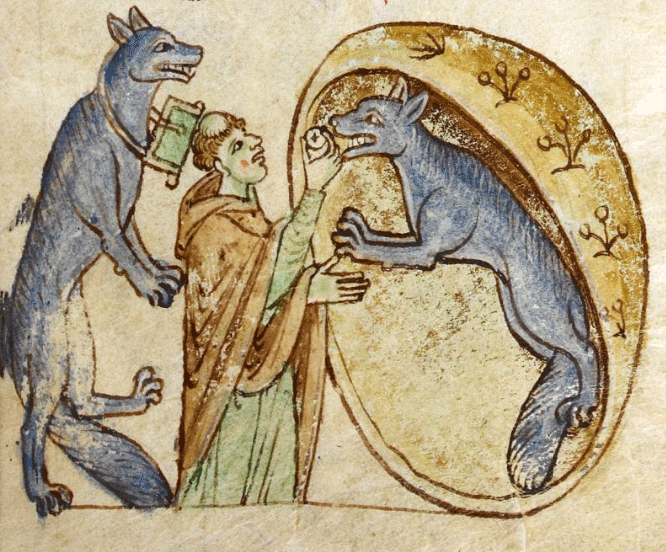 The Werewolves of Ossory, depicted in a copy of the Topographia.
The Werewolves and Social Rites
The story of the werewolves near the border of Meath is perhaps one of the most commented about section of the Topographia. With scholars taking a range of meanings from the tale which Gerald of Wales seems to give particular attention to. However, they have understated its religious connotations and the way Gerald relates these to critique social rites. Karkov has particularly tied the tale to political events. In the tale, a priest is travelling from Ulster to Meath during which he encounters two wolves on the edge of a forest on the border of Meath. During this period, Meath and Ulster were under the control of two Anglo-Norman nobles, Hugh de Llacy and John de Courcy, in between them was the Kingdom of Airgialla ruled by the Irish Murchad Ua Cerbaill. Murchad had submitted to Henry II and Prince John, but was in alliance with Ruaidrí Ua Conchobair, the High King of Ireland. Karkov however not only believes Gerald is portraying Airgialla as an Irish 'wilderness', but also suggests the tale is a criticism of the fian, bands of young and aristocratic fighting men. One of the terms for warrior, Fenian and others, was luch-thonn (wolf-skin), while in pre-conquest tales fennid is interchangeable for diberg (outlaw or brigand). Men who participated in such activities were also known as ac faelad (wolflings). Kim Mcone has argued that membership of the fian whether fictional or real was a socially endorsed rite of passage. These interpretations are correct in that Gerald is critiquing the social rites of the Irish through the werewolf tale, but do not fully consider how they relate to Gerald's religious agenda.
One of the claims of the tale is that one of the wolves 'said some things about God that seemed reasonable' and that the 'wolf gave a Catholic answer in all things'. This is remarkable, as Gerald is suggesting that not only the beasts are reasonable, but inhabit a mediate space where they are still faithful. The importance of this can be seen in the skinning of the wolves to human form. The she-wolf in the tale 'received from the hands of the priest all the last rites duly performed up until the last communion' and 'gave thanks also to God that in her last hour he had granted her such consolation'. The wolf then 'begged him not to deny to them in any way the gift and help of God'. The priest followed this and 'pulled all the skin off the she-wolf from the head down to the navel, folding it back with his paw as if it were a hand' and 'immediately the shape of an old woman, clear to be seen, appeared.' The fact that this tale revolves around the priest conferring and blessing the wolves, reveals Gerald's opinion of the Irish Church. It is like the wolves in that is similarly close to his personal view of orthodoxy, but is still covered by a 'skin'. Only by the removal of the skin by an outsider, 'the priest, can the Irish Church fully resemble the true faith. The fact that 'the skin which had been removed by the he-wolf resumed its former and position' and that the wolf still 'showed himself to them to be a man rather than a beast' further highlights the uneasy position the Irish Church inhabits in Gerald's mind.
Similar tales to this throughout the Topographia also show this. Gerald reports a rite of conferring kingship in Kenelcunill in northern Ulster. 'When the whole people of that land has been brought together in one place, a white mare is brought forward in the middle of the assembly' a man then 'has bestial intercourse with her before all, professing himself to be a beast also. The mare is then killed immediately, cut up in pieces and boiled in water.' Gerald criticises this social rite, but it is important to note he does this in the context of religion with it being 'unrighteous'. By stating he is 'professing himself to be a beast also' Gerald is referencing Mark 10:8, 'and the two will become one flesh. So they are no longer two, but one flesh.' The man by having bestiality with the white mare to be made King is losing his humanity in the process because of the unrighteousness act he is committing. Gerald is directly relating the social rite to his apprehensive view of the Irish Church. A similar pattern can be detected in Gerald's description of a hybrid that was half-ox and half-man 'in the neighbourhood of Wicklow when Maurice fitzGerald got possession of the country and the castle'. This instance could be compared with the presence of hybrids in Gerald's other work The Journey Through Wales and the Description of Wales. Jeffrey Cohen suggests that the presence of hybrids in this is a result of cross-cultural interaction between Anglo-Normans and the Welsh in the Marcher lands. A similar viewpoint on hybrids in the Topographia could be supported by the fact that the ox-man only appears after the Anglo-Norman conquest of Wicklow. The ox-man was eventually 'transferred to the society of men' because 'it had more of the man than beast'. As Gerald places importance on religion and morality as part of social rites, the fact that the ox-man eventually joined the society of men means it is reminiscent of the werewolf tale. It therefore adds to the suggestion that Gerald views the Irish Church as occupying an uneasy ground, that it neither completely adheres toor opposes his beliefs.
Conclusion
The Topographia Hibernica has all the trappings of a colonial text, however the way in which Gerald of Wales was particular concerned with Church Reform has been overlooked. His focus on rites and worship shows that he is especially concerned with the practices of the Irish Church and they relate or do not relate to his own personal views on reforming the Church. Because of Ireland's long Christian tradition this task requires deconstructing the Irish Church's history and its importance. The unsettled position which the Irish Church occupies in Gerald's mind can also be identified in the tales geography found in the text. The Topographia Hibernica is therefore not only a text with colonial connotations, but a text that combines these with Gerald of Wales's specific concerns regarding Church reform.
Bibliography:
Primary Source:
Gerald of Wales, The Topography of Ireland (1188) translated by John J. O'Meara in The History and Topography of Ireland. London: Penguin, 1982.
Secondary Sources:
Gerald of Wales was born at Manorbier in Pembrokeshire and therefore was from Marcher land. He was of Cambro-Norman descent, being related to Gerald of Windsor who had married Nesta, a daughter of Rhys ap Tudor, a prince of South Wales. This is important for understanding Gerald's account of Ireland, as it means he himself was of mixed descent and had actively participated in a society which had experienced close- sometimes forceful- contact between the Welsh and English. He therefore had first hand experience of how expansion, colonial in nature, affected society in the Marches. After finishing studying in Paris, Gerald began to use his talents for the benefit of the Church. He was appointed by Richard, Archbishop of Canterbury, to collect special dues in the diocese of St David's. In November 1183 he resigned as diocesan vicar, following which he payed his first visit to Ireland. Here for a year he spent a portion of his time collecting material for the writing of his books. Gerald was sent as part of Prince John's court who had been sent by Henry II of England to invade Ireland. Being appointed Bishop of Ferns or Leighlin, he stayed four months after the invasion. Gerald was therefore heavily involved in the pastoral and ecclesiastical parts of his role in the Church. We can perhaps see that there was curiosity about Ireland in England, by how much his book was received back in England. Gerald spent three days reading the Topographia to select audiences at Oxford, it was claimed that Baldwin, the Archbishop of Canterbury read a section of the book each day during his tour of Wales in 1183.
The History of the Topographia
However, in any attempt of Gerald to portray Ireland as alien and uncivilised he encountered a significant problem. Ireland and Britain had a significant history of contact between each other. Most importantly they fitted into the wider Christian community, making it more difficult for Gerald to demonise the Irish. A number of scholars have tried to place the Anglo-Norman conquest of Ireland as part of wider phenomena of European expansion in the period. For example, Angrett Simms has noticed similarities to Gerald in other commentators of the period. Most notably in Adam of Bremen, who wrote an account of the Scandinavians in the 1070s and Helmold of Bosau whose chronicle of the Slavs was written in the 1170s. However, many of these areas were still heavily pagan, and had not experienced the same level of contact, especially in the form of missionaries, that Ireland had previously had with the continent. As late as the 10th and 11th centuries new Irish communities were being founded in Europe, including at Waulsort in the Ardennes by St Cadroe of Armagh and in 946 and the establishment of another at Metz in the 970s.
Gerald therefore has a task in the Topographia to uncouple Ireland from its long Christian tradition. At times he is critical, but not always completely ruthless, in his criticism of the Irish Church. In the Table of Matters of the Topographia Gerald states that the Irish clergy are 'in many points praiseworthy' but 'the prelates should be reproved from their neglect of their pastoral office'. A similar message comes across in the third part of the text, during which Gerald quite heavily focuses on the faults he believes the Irish Church has:
'If the prelates from the time of Patrick through all those years had done a man's job, as they should have done, in preaching and instructing, chastising and correcting, they would have extirpated at any rate to a certain extent those abominations of the people already mentioned, and would have impressed upon them some semblance of honour and religious feeling. But there was no one among them to raise his voice as a trumpet. There was none to fight on the other side, and be a wall for the house of Israel. There was none to fight for the church of Christ even to exile, to say nothing of blood- that church which Christ had purchased for himself with his precious blood. Consequently all the saints of this country are confessors, and there is no martyr. It would be difficult to find such a state of things in any other Christian kingdom. There was found no one in those parts to cement the foundations of the growing church with the shedding of blood. There was no one to do this service; not single one. For they are pastors that wish to be fed, and do not wish to feed. They are prelates that do not wish to be of use, but rather to use. And they are bishops who welcome the honour and and name of their calling, but do not welcome its duties and responsibilities'.
This passage from the is pivotal in understanding Gerald of Wales's othering and demonisation of the Irish throughout the Topographia. The Irish Church is criticised on grounds of being too ascetic and its lack of concern regarding pastoral duties and active involvement in ecclesiastical matters.The amount of space dedicated to Church reform towards the end of the book shows that Gerald had this in mind while writing the rest of the Topographia and this markedly influences the colonial nature of the rest of the text. One such instance can be identified when he Gerald criticses a rite in Munster. According to his account there is a well once touched that causes a deluge of rain across the entire province. The rain will not stop until 'a pries, who is both virgin in mind and body and specially chosen for the purpose celebrates Mass in a chapel not far from the well' and 'appeases the well with a sprinkling of holy water and the milk of a cow of one colour'. This account may seem at first to derive simply from the prejudiced colonial nature of the Topographia, however it must also be understood within Gerald's viewpoint of the Church. The 'barbarous rite, without rime or reason' can be linked to Gerald's wider beliefs about reform. With this account he is hoping to alienate the Irish Church further from the rest of Europe by potraying as uncouth and almost pagan.This can also be identified when Gerald describes the Irish as 'ignorant of the rudiments of of the Faith' and 'shameful in their practices and culture'. Gerald is attempting to advance his agenda of Church reform by paganising the Irish, separating them from their long Christian tradition.
Perhaps, one of the most obvious ways through which Gerald distinguishes the Irish from the mainstream Christian tradition is by recasting its history. While describing the history of the Irish Church in part 3, there is a notable absence of Ireland's Golden Age of monasticism and missionary work on the continent. The absence of the former can be explained by Gerald's particular distaste for neglecting pastoral duties, at the cost of asceticism. Another way through which Gerald undermines the tradition of the Irish Church is by attacking the tradition of St Patrick driving out all the snakes out of Ireland. He writes 'Some indulge in the pleasant conjecture that Saint Patrick and all other saints of the land purged the island of all harmful animals. But it is more probable that from the earliest times, and long before the laying of the foundations of the Faith, the island was naturally without these as well as other things'. In this instance, Gerald is deliberately separating the myth regarding the absence of poison and snakes in Ireland from the its Christian tradition, by suggesting it has always naturally been like that. The effect of this is that it once again distances the Irish Church from the wider Christian community.
The Geography of the Topographia
The uneasiness of Ireland's position in the Topographia and Gerald's difficulty of placing it because of its historic relationship to the rest of Europe can also be identified in the geography found within the first part. Andrew Murphy has previously argued that the end of part one sets Ireland in direct opposition to the East, but with the purpose of placing Ireland at the zero point of a graduated scale that runs from East to West. By doing this Ireland is neither directly conforms to the 'otherness' or 'sameness' of the East or West. The most obvious example of this can be seen in Gerald's emphasis on the poisonous nature of the East. 'The Well of the Poisons brims over in the East. The farther from the East it operates, the less does it exercise the force of its natural efficacy' this until Ireland which Gerald states is absent of poison. This is a useful way at looking how in the eyes of Gerald, Ireland never fully fits into the conceptions of the East and West, but it is also a viewpoint that can be heavily expanded upon.
Murphy goes on state that the text states any form of mediation is impossible and morally detestable, as seen by a set of tales that stress unbreakable boundaries and dichotomies. However, he misses out the key religious undertones that Gerald is promoting in these tales. In one instance 'there is a Lake in Ulster which contains an island divided into two parts'. The key feature that divides the two parts is that 'one part contains a very beautiful church with a great reputation for holiness, and is well worth seeing;' yet 'the other part of the island is stony and ugly and abandoned to the use of evil spirits only.' The main subject of this division is the Church and it determines the welfare of any visitors to the island. Likewise, the tale of the Lake in Munster has follows a similar if more complex pattern. 'There is a lake in the north of Munster which contains two islands, one rather large and the other rather small. The larger has a church venerated from the earliest times. The smaller has a chapel cared for most devotedly by a few celibates called 'heaven-worshippers' or 'god-worshippers.' Gerald goes on to state that 'No woman or animal of the female sex could ever enter the larger island without dying immediately' on the smaller island 'no one ever dies or could die a natural death'. Those who live on the smaller island still 'sometimes suffer mortal sickness and endure the agony almost to their last gasp' when 'they are eventually so distressed that they prefer to die in death than drag out a life of death, they get themselves finally transported in a boat to the larger island' where 'as soon as they touch the ground there, they give up the ghost'. Once again the main subject of the division is religion, except this time neither part seems to be fully adequate. Gerald's purpose in including these tales is to show the position that he believes the Irish Church is in. The tales do not just show Ireland's position as neither directly conforming or opposing to the West, but they particularly focus on the Irish Church and how it neither fully adheres to or antagonises Gerald's outlook on the Faith.
The Werewolves and Social Rites
The story of the werewolves near the border of Meath is perhaps one of the most commented about section of the Topographia. With scholars taking a range of meanings from the tale which Gerald of Wales seems to give particular attention to. However, they have understated its religious connotations and the way Gerald relates these to critique social rites. Karkov has particularly tied the tale to political events. In the tale, a priest is travelling from Ulster to Meath during which he encounters two wolves on the edge of a forest on the border of Meath. During this period, Meath and Ulster were under the control of two Anglo-Norman nobles, Hugh de Llacy and John de Courcy, in between them was the Kingdom of Airgialla ruled by the Irish Murchad Ua Cerbaill. Murchad had submitted to Henry II and Prince John, but was in alliance with Ruaidrí Ua Conchobair, the High King of Ireland. Karkov however not only believes Gerald is portraying Airgialla as an Irish 'wilderness', but also suggests the tale is a criticism of the fian, bands of young and aristocratic fighting men. One of the terms for warrior, Fenian and others, was luch-thonn (wolf-skin), while in pre-conquest tales fennid is interchangeable for diberg (outlaw or brigand). Men who participated in such activities were also known as ac faelad (wolflings). Kim Mcone has argued that membership of the fian whether fictional or real was a socially endorsed rite of passage. These interpretations are correct in that Gerald is critiquing the social rites of the Irish through the werewolf tale, but do not fully consider how they relate to Gerald's religious agenda.
One of the claims of the tale is that one of the wolves 'said some things about God that seemed reasonable' and that the 'wolf gave a Catholic answer in all things'. This is remarkable, as Gerald is suggesting that not only the beasts are reasonable, but inhabit a mediate space where they are still faithful. The importance of this can be seen in the skinning of the wolves to human form. The she-wolf in the tale 'received from the hands of the priest all the last rites duly performed up until the last communion' and 'gave thanks also to God that in her last hour he had granted her such consolation'. The wolf then 'begged him not to deny to them in any way the gift and help of God'. The priest followed this and 'pulled all the skin off the she-wolf from the head down to the navel, folding it back with his paw as if it were a hand' and 'immediately the shape of an old woman, clear to be seen, appeared.' The fact that this tale revolves around the priest conferring and blessing the wolves, reveals Gerald's opinion of the Irish Church. It is like the wolves in that is similarly close to his personal view of orthodoxy, but is still covered by a 'skin'. Only by the removal of the skin by an outsider, 'the priest, can the Irish Church fully resemble the true faith. The fact that 'the skin which had been removed by the he-wolf resumed its former and position' and that the wolf still 'showed himself to them to be a man rather than a beast' further highlights the uneasy position the Irish Church inhabits in Gerald's mind.
Similar tales to this throughout the Topographia also show this. Gerald reports a rite of conferring kingship in Kenelcunill in northern Ulster. 'When the whole people of that land has been brought together in one place, a white mare is brought forward in the middle of the assembly' a man then 'has bestial intercourse with her before all, professing himself to be a beast also. The mare is then killed immediately, cut up in pieces and boiled in water.' Gerald criticises this social rite, but it is important to note he does this in the context of religion with it being 'unrighteous'. By stating he is 'professing himself to be a beast also' Gerald is referencing Mark 10:8, 'and the two will become one flesh. So they are no longer two, but one flesh.' The man by having bestiality with the white mare to be made King is losing his humanity in the process because of the unrighteousness act he is committing. Gerald is directly relating the social rite to his apprehensive view of the Irish Church. A similar pattern can be detected in Gerald's description of a hybrid that was half-ox and half-man 'in the neighbourhood of Wicklow when Maurice fitzGerald got possession of the country and the castle'. This instance could be compared with the presence of hybrids in Gerald's other work The Journey Through Wales and the Description of Wales. Jeffrey Cohen suggests that the presence of hybrids in this is a result of cross-cultural interaction between Anglo-Normans and the Welsh in the Marcher lands. A similar viewpoint on hybrids in the Topographia could be supported by the fact that the ox-man only appears after the Anglo-Norman conquest of Wicklow. The ox-man was eventually 'transferred to the society of men' because 'it had more of the man than beast'. As Gerald places importance on religion and morality as part of social rites, the fact that the ox-man eventually joined the society of men means it is reminiscent of the werewolf tale. It therefore adds to the suggestion that Gerald views the Irish Church as occupying an uneasy ground, that it neither completely adheres toor opposes his beliefs.
Conclusion
The Topographia Hibernica has all the trappings of a colonial text, however the way in which Gerald of Wales was particular concerned with Church Reform has been overlooked. His focus on rites and worship shows that he is especially concerned with the practices of the Irish Church and they relate or do not relate to his own personal views on reforming the Church. Because of Ireland's long Christian tradition this task requires deconstructing the Irish Church's history and its importance. The unsettled position which the Irish Church occupies in Gerald's mind can also be identified in the tales geography found in the text. The Topographia Hibernica is therefore not only a text with colonial connotations, but a text that combines these with Gerald of Wales's specific concerns regarding Church reform.
Bibliography:
Primary Source:
Gerald of Wales, The Topography of Ireland (1188) translated by John J. O'Meara in The History and Topography of Ireland. London: Penguin, 1982.
Secondary Sources:
Cohen, Jeffrey Jerome. "Hybrids, Monsters, Borderlands: The Bodies of Gerald of Wales." In The Postcolonial Middle Ages, edited by Jeffrey Jerome Cohen, 85-104. New York: Palgrave Macmillan US, 2000.
Karkov, Catherine. "Tales of the Ancients: Colonial Werewolves and the Mapping of Postcolonial Ireland." In Postcolonial Moves: Medieval through Modern, edited by Patricia Clare Ingham and Michelle R Warren, 93-110. New York: Palgrave Macmillan US, 2003.
Martin, F. X. "Gerald of Wales, Norman Reporter on Ireland." Studies: An Irish Quarterly Review 58, no. 231 (1969): 279-92.
Murphy, Andrew. But the Irish Sea Betwixt Us: Ireland, Colonialism, and Renaissance Literature. Lexington: University Press of Kentucky, 1999.
Wednesday, 9 August 2017
Review: The Merovingian Kingdoms 450-751 by Ian N.Wood
The 1994 book 'The Merovingian Kingdoms 450-751' by Ian Wood aims to address the period of the eponymous dynasty's rule and influence over significant parts of Western Europe up until its usurpation by the Carolingians. Wood approaches this task in a manner which combines chronology with thematic analysis allowing the reader to understand continuity and change on a number of important topics. However, the inconsistent way in which this is done raises questions about the target audience of the book.

Chapters on the political context are the most frequent and form the backbone of the chronological narrative. Starting from early barbarian settlement in Gaul the chapters describe the main events up to the deposition of the last Merovingian King, Childeric III, by Pippin. These chapters attempt to analyse any changes in the conduct of politics throughout the covered centuries. However, in some instances they fall short, especially in the early chapters which can be overly descriptive and short of analysis. Later on, with the rise of the Mayors of the Palace, the political side of the book becomes more in-depth. This is mainly in part due to the increased level of insightful analysis of primary sources, especially when facing the challenge of texts which may possibly considered as Carolingian propaganda. The book tends to focus on the Kingdom of Neustria, while at the same time Austrasia is noticeably covered to a much lesser degree. However, Wood is successful in describing what can be known about periphery territories. For example, we learn when Frisia and Alamania fall in and out of the Frankish sphere of influence. Likewise, the complex political situation in Aquitaine is described in detail. Nevertheless, it remains clear that the focus of the book is on the Kingdom of Neustria.
The narrative of events is dispersed with more analytical chapters. These are mainly on the Church, including its production of culture, and the economy. Other topics are assigned individual chapters, such as Merovingian Law and the role of royal women (most notably Brunhild). Nevertheless, Wood manages to place these chapters alongside the more politically oriented ones in a way that maintains the chronology. This is useful in showing economic and social changes over time, but means an opportunity to connect them more closely to the main narrative is missed.
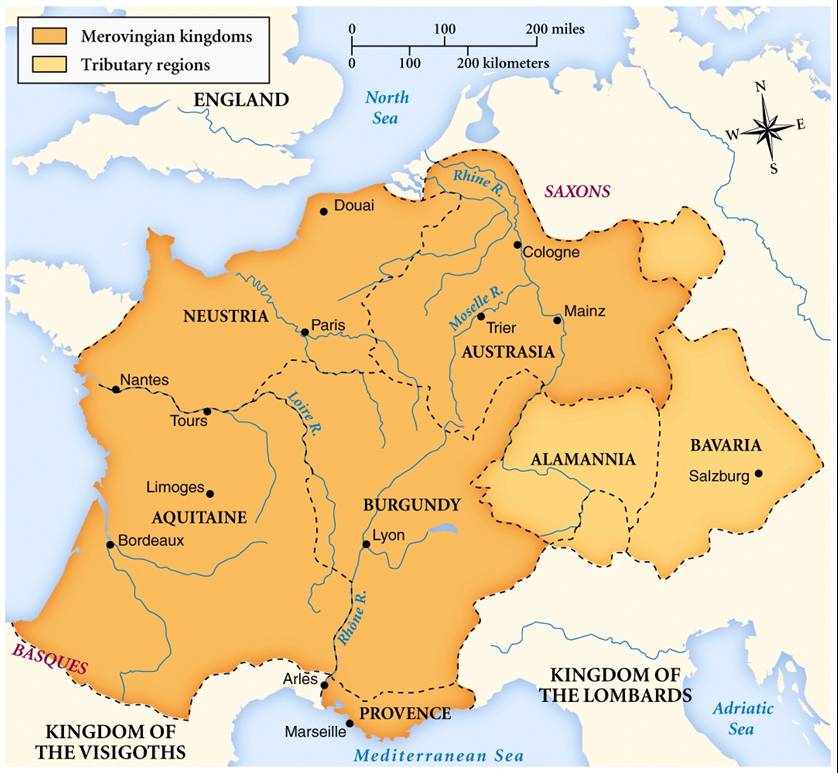
Wood mainly relies on textual sources for the book and is aware of the limitations of what he uses. Understandably, his early chapters are heavily reliant on Gregory of Tour's History, a pivotal source for the early Merovingian era. The Chronicle of Fredegar and its continuators are frequently used later in the book. However, Wood also uses a range of other sources, even if they are consulted less. Archaeological evidence is noticeably slim, when present it is only used in the context of the economy. The excavations of the emporia Dorestad are particularly used well. Numisatic evidence is also used to describe the economy. While, Wood could have perhaps used more forms of material evidence, this is often in part due to the nature of the evidence available rather than a fault attributable to the author. Indeed, his shrewd use of textual evidence in situations which may be unexpected helps to fill in some of the gaps. For example, in the chapter 'Land, Wealth and the Economy' he manages to infer from hagiography more details regarding the economic structure of the Frankish Kingdoms.
One of Wood's main arguments is that the transition between the Merovingian and Carolingian dynasties was one of continuity. He argues against the idea of a Merovingian decline. His emphasis on cultural continuity, including the production of manuscripts at Luxeuil and Corbie, implies that the Carolingians built on the achievements of the Merovingians, reliant on them for later developments. The same can be applied to the development of the emporia and also law. The political transition from the Merovingians to the Carolingians was also steady, featuring continuities on top of changes.
The book is also heavily footnoted and features a detailed bibliography. Wood states that citations of secondary material are aimed at students whose primary language is English. Works in French and German are only provided where no English alternative is available. This is prioritised over the inclusion of the latest scholarly research. The book also contains genealogies of the Merovingian dynasty. These are useful in particular when used in conjunction with the political narrative, due to the brevity of which some monarchs are dealt with. However, placing them to the front of the book or alongside the narrative may have made them more prominent for the reader. A number of maps are also included and these are helpful in providing a general overview of boundaries, but naturally are limited in the complexity they can show. These similarly could have been included earlier in the book to help the student or general reader.

Seal of Chilperic II from a letter dated 716
To conclude, 'The Merovingian Kingdoms 450-751' by Ian N.Wood is an attempt to offer an account of the entire Merovignian period, while at the same time maintaining thematic analysis by combining it with the chronological narrative. Wood is successful in doing this, however the chapters vary in depth and quality. Some political chapters are heavily descriptive and could have benefited from more analysis of textual sources or the means of implementing power itself. Chapters that tend to be focused on a particular issue, such as different aspects of the Church and economy tend to be more insightful. Nevertheless, Wood's approach both shows change and continuity in a mostly clear way and his argument that the Carolingians owe a lot to the Merovingians is persuasive.

Chapters on the political context are the most frequent and form the backbone of the chronological narrative. Starting from early barbarian settlement in Gaul the chapters describe the main events up to the deposition of the last Merovingian King, Childeric III, by Pippin. These chapters attempt to analyse any changes in the conduct of politics throughout the covered centuries. However, in some instances they fall short, especially in the early chapters which can be overly descriptive and short of analysis. Later on, with the rise of the Mayors of the Palace, the political side of the book becomes more in-depth. This is mainly in part due to the increased level of insightful analysis of primary sources, especially when facing the challenge of texts which may possibly considered as Carolingian propaganda. The book tends to focus on the Kingdom of Neustria, while at the same time Austrasia is noticeably covered to a much lesser degree. However, Wood is successful in describing what can be known about periphery territories. For example, we learn when Frisia and Alamania fall in and out of the Frankish sphere of influence. Likewise, the complex political situation in Aquitaine is described in detail. Nevertheless, it remains clear that the focus of the book is on the Kingdom of Neustria.
The narrative of events is dispersed with more analytical chapters. These are mainly on the Church, including its production of culture, and the economy. Other topics are assigned individual chapters, such as Merovingian Law and the role of royal women (most notably Brunhild). Nevertheless, Wood manages to place these chapters alongside the more politically oriented ones in a way that maintains the chronology. This is useful in showing economic and social changes over time, but means an opportunity to connect them more closely to the main narrative is missed.
Wood mainly relies on textual sources for the book and is aware of the limitations of what he uses. Understandably, his early chapters are heavily reliant on Gregory of Tour's History, a pivotal source for the early Merovingian era. The Chronicle of Fredegar and its continuators are frequently used later in the book. However, Wood also uses a range of other sources, even if they are consulted less. Archaeological evidence is noticeably slim, when present it is only used in the context of the economy. The excavations of the emporia Dorestad are particularly used well. Numisatic evidence is also used to describe the economy. While, Wood could have perhaps used more forms of material evidence, this is often in part due to the nature of the evidence available rather than a fault attributable to the author. Indeed, his shrewd use of textual evidence in situations which may be unexpected helps to fill in some of the gaps. For example, in the chapter 'Land, Wealth and the Economy' he manages to infer from hagiography more details regarding the economic structure of the Frankish Kingdoms.
One of Wood's main arguments is that the transition between the Merovingian and Carolingian dynasties was one of continuity. He argues against the idea of a Merovingian decline. His emphasis on cultural continuity, including the production of manuscripts at Luxeuil and Corbie, implies that the Carolingians built on the achievements of the Merovingians, reliant on them for later developments. The same can be applied to the development of the emporia and also law. The political transition from the Merovingians to the Carolingians was also steady, featuring continuities on top of changes.
The book is also heavily footnoted and features a detailed bibliography. Wood states that citations of secondary material are aimed at students whose primary language is English. Works in French and German are only provided where no English alternative is available. This is prioritised over the inclusion of the latest scholarly research. The book also contains genealogies of the Merovingian dynasty. These are useful in particular when used in conjunction with the political narrative, due to the brevity of which some monarchs are dealt with. However, placing them to the front of the book or alongside the narrative may have made them more prominent for the reader. A number of maps are also included and these are helpful in providing a general overview of boundaries, but naturally are limited in the complexity they can show. These similarly could have been included earlier in the book to help the student or general reader.
Seal of Chilperic II from a letter dated 716
To conclude, 'The Merovingian Kingdoms 450-751' by Ian N.Wood is an attempt to offer an account of the entire Merovignian period, while at the same time maintaining thematic analysis by combining it with the chronological narrative. Wood is successful in doing this, however the chapters vary in depth and quality. Some political chapters are heavily descriptive and could have benefited from more analysis of textual sources or the means of implementing power itself. Chapters that tend to be focused on a particular issue, such as different aspects of the Church and economy tend to be more insightful. Nevertheless, Wood's approach both shows change and continuity in a mostly clear way and his argument that the Carolingians owe a lot to the Merovingians is persuasive.
Sunday, 22 May 2016
Georgian Highlanders and the Last Crusaders: The Debate on the Khevsurs Origins
Richard Halliburton was one of the most extravagant and exciting adventurers of the 20th century, mostly famed for his gallant exploits such as swimming the Suez Canal and crossing the Alps on an elephant to imitate the famous general Hannibal. However, in 1935 he was in Tbilisi, the Soviet Republic of Georgia and it was here he heard a very strange tale.

Locals told him of how in 1915, in the middle of World War 1, citizens of Tbilisi were in awe one morning when warriors mounted upon horses, dressed like they were straight out of the Crusades,wearing rusty chain armour and carrying shields and broadswords, appeared and pledged their service to the Tsar, as they heard there was a war on. These were Khevsurs, a group of Georgian highlanders now from the region of Khevsureti.
Georgia is a diverse country full of languages and dialects and varying traditions. However, a mythos has developed that the Khevsurs, a group of Georgian Highlanders cut off by ice and snow for 9 months a year, are descended from Medieval Crusaders. This hypothesis was developed by locals who believed their ancestors were cut off from a larger crusading army and became stranded in the area, but also by the aforementioned Richard Halliburton and the Russian servicemen and also ethnographer Arnold Zisserman and is based on on observations that they gathered when they visited Georgia, but also a belief amongst the Khevsurs themselves that they hold this ancestry.
However,the traditional narrative is a far-cry from this hypothesis. Several Georgian, Greek and Roman sources mention the Khevsurs long before the crusading age. The religion of the Khevsureti is a unique mixture of Georgian Orthodoxy Christianity and pre-Christian paganism and although this would not rule out the crusader theory, it certainly seems likely the pagan element is retained from before the conversion of Mirian II of Iberia (a significant Kartvelian kingdom). Regardless, there has been enough evidence to create a theory.


Locals told him of how in 1915, in the middle of World War 1, citizens of Tbilisi were in awe one morning when warriors mounted upon horses, dressed like they were straight out of the Crusades,wearing rusty chain armour and carrying shields and broadswords, appeared and pledged their service to the Tsar, as they heard there was a war on. These were Khevsurs, a group of Georgian highlanders now from the region of Khevsureti.
Georgia is a diverse country full of languages and dialects and varying traditions. However, a mythos has developed that the Khevsurs, a group of Georgian Highlanders cut off by ice and snow for 9 months a year, are descended from Medieval Crusaders. This hypothesis was developed by locals who believed their ancestors were cut off from a larger crusading army and became stranded in the area, but also by the aforementioned Richard Halliburton and the Russian servicemen and also ethnographer Arnold Zisserman and is based on on observations that they gathered when they visited Georgia, but also a belief amongst the Khevsurs themselves that they hold this ancestry.
However,the traditional narrative is a far-cry from this hypothesis. Several Georgian, Greek and Roman sources mention the Khevsurs long before the crusading age. The religion of the Khevsureti is a unique mixture of Georgian Orthodoxy Christianity and pre-Christian paganism and although this would not rule out the crusader theory, it certainly seems likely the pagan element is retained from before the conversion of Mirian II of Iberia (a significant Kartvelian kingdom). Regardless, there has been enough evidence to create a theory.

Arnold Zisserman spent 25 years in the Caucasus (1842-67) and during his time there the Khevsurs were still under constant threat from the North Caucasus and most still had to live in Medieval fortress-villages. The Russian Empire who controlled Georgia at this point had been fighting the Muslim tribes in the North Caucasus for almost half a century by Zisserman's visit, most famously under the leadership of the Caucasian Avar Imam Shamil. Indeed, a major task for the Khevsurs was defending their northern border, as well as the protection and strengthening of their own folk version of Christianity. They were trusted as royal bodyguards and warriors against multiple foes. Khevsureti also worshipped flags-crosses and considered themselves permanent members of the army of the sacred flags.
The mythology of the Khevsureti is also symbiotic with their holy war ideology. The myths, or testaments as the locals call them, are oral histories of military movements undertook under the holy flags-crosses. Their mythology also takes into account apparent wars between heroes sometimes known as Sons of God and the role of combat in the conversion and Georgianisation of the pagan highlanders of the Central Caucasus. Fundamentally, it portrays the pivotal war the idea of 'Holy War' takes place in their mythology.
It is also debatable whether the Khevsurs 'post-conversion' were still pagan or not, even though they retained elements of their folklore. The Eastern Orthodox Church seems the post-conversion ceremonies carried out by the Khevsurs as 'pagan'. These ceremonies led by self-made priests styled crusaders are peace-pilgrimages. They involve tracing the routes of their ancestors' military campaigns and when they come upon a site of a historic victory, which are marked by small prayer-towers, they participate in replications of battles and the taking of these towers from enemies. Ritual combat tournaments and horse races are held on the steep rocky hills.
These ideas and concepts were possibly built during the 11th-13th centuries due to the effect of the Georgian monarchy. At this time the monarchy was pro-crusade and its culture heavily involved Christianity. Religion was seen as a fundamental part of Georgian state-building.The Georgians were indeed affected by the arrival of the Crusaders, it provided some relief and most modern scholars accept that their could have been limited settlement of the men arriving from the West in the area, as they are mentioned in manuscripts describing battles between Georgians and Muslims. The Battle of Didgori against the declining Seljuk Empire featured 100-200 Franks. The Georgian state faced several Mongol invasions in the 1230's and it began to gradually weaken until it completely collapsed into several fragmented territories in 1466. Nevertheless, the Khevsurs were intrinsically linked with the fate and policy of the Georgian state.
Above the Georgian state at its height in the 13th century (top) and the various territories post-dissolution (bottom).
The most obvious possible connection to the Crusaders is the clothing of the Khevsurs, which Richard Halliburton acutely describes. Upon his visit he was surprised to finds out that the Khevsurs were not wearing their iconic armour, but rather it was hung up in every home beside the aforementioned sword and gun. Halliburton writes 'Each mesh coat is formed of some twenty thousand tiny iron rings and goes on like a night shirt. The sleeves are short, but mesh gauntlets cover the forearms. With each suit goes a bag-like chain helmet with a hole cut for the face.' and 'A flap folds over,so that the entire head can be protected.For the shins there are likewise mesh greaves. Consequently when completely arrayed, the only parts of the body vulnerable are the knees and thighs.' Therefore, along with the photograph seen above, it is easy to see how the Khevsurs dress fits in with the traditional conception of the Crusader.
\There is also evidence in other traditions of the Khevsurs. Duelling is a popular custom and Halliburton describes 'Like their forefathers, the Crusader Knights, they have a passion for putting on their iron shirts and going at each other with broadswords.' Halliburton also notes how there was no referee-they knew the 'game' inside out- and that unlike the Medieval tournament, women did not play a major role in the event. Instead, they did not attend, but they could still retained the power to stop a duel. Halliburton notes Sundays are for duelling and getting drunk. They also had a strict system of physical training and martial art (see image below) which formed part of a larger Georgian martial art and military tradition. Once again a custom of the Khevsurs, combat as a sport, heavily links to a Western Medieval influence or heritage.
Finally, Richard Halliburton also thought he noticed several fragments of German and French in the language of the Khevsurs.

To conclude, the idea that the Khevsur highlanders descend from Medieval Crusaders is based on observation by the human, especially religious and societal customs. Although, it appears that there is some influence by the crusading movement on the Khevsureti. Their likeness seems to be influenced by the culture and policy of the Georgian state and the combination of pagan and Christian folklore, rather than significant direct colonisation. Therefore, although it may appear their is crusading heritage, there is enough evidence to suggest that the Khevsurs lived in the region long before the crusading movement and so therefore it is difficult to accept that the Khevsurs could have possibly descended from Western crusaders. So despite possible connections through language or custom, there is not enough evidence for this theory to be accepted in the main academic community.
Bibliography:
http://ejmas.com/jwma/articles/2003/jwmaart_amberger_0603.htm
http://hearstmuseum.berkeley.edu/exhibitions/photo2/photo2_intro.html
http://www.jodyandrews.net/blog/2014/4/25/the-wolf-and-the-lion-the-story-of-the-lost-crusaders
http://www.cenn.org/Magazine_1/legends.html
Image Credit goes to Wikimedia Commons and:
http://ejmas.com/jwma/articles/2003/jwmaart_amberger_0603.htm
http://www.jodyandrews.net/blog/2014/4/25/the-wolf-and-the-lion-the-story-of-the-lost-crusaders
Monday, 21 September 2015
It's Alive ! My Personal Historical Niggles
Yes, the blog is alive. It may have been almost a year to the date (well actually Gustavus Adolphus Day in November) that I did my last blog post. Of course, education gets in the way, but now I have decided to try and continue with a more casual tone then what I used to write with. Anyway, I thought I would start off discussing my own personal historical niggles. Whether, you think they are worthy or not I get annoyed by certain terms and ideas in history to varying degrees. And so let it begin !

The Byzant....Roman Empire

The map above shows the Byzantine Empire at its height under in 560 a.d under Emperor Justinian. Wait the Byzantine Empire ! why am I using a term coined by later historians ? This is my first niggle, I would prefer it to be called the Roman Empire, as it is effectively the Roman Empire or at least the Eastern Roman Empire (though apparently that is a later term as well, so maybe not.) The people of this empire called themselves Romaioi or Romioi (meaning Roman) or Graikoi (Greek) and they continued to refer to the empire as the Imperium Romanum (Latin) or Basileia Rhōmaiōn (Ancient Greek). Now really you could do a whole book on how the so called Byzantine Empire is the Roman Empire, with an added Greek element (that's a good idea), but it is a long and complex topic I suppose. The term 'Byzantine' was first used by the historian Hieronymus Wolf in 1557 over a century after the Fall of Constantinople. This term comes from the name of Constantinople, 'Byzantium' before Constantine made the city capital.
In the West, the Byzantine Empire was often called the Greek Empire in order to distinguish it from the Roman Empire of Charlemagne and his successors. In 800 A.D Pope Leo III used the excuse that the (Byzantine) Roman Empire had no male occupant at the time, to crown Charlemagne as Roman Emperor, because he needed his support. In the West, Imperator Romaniae was also used to describe the East, meaning Emperor of Romania, whereas Imperator Romanorum, Emperor of the Romans was used to describe Charlemagne and his successors. In the Islamic and Slavic worlds, no distinguishment was made where Byzantium was more straightforwardly seen as the continuation of the Roman Empire, one of the uses of the word Rûm in the Islamic World was simply as the name of the Roman (Byzantine) Empire.
There you go, we should really be calling Byzantium the Roman Empire, though to be fair I do understand the practicality of using it when we covering such distinct periods of time.
Constantinople not Istanbul

In 1953 the Four Lads sung about the official renaming of Constantinople to Istanbul. Though many may presume that Constantinople was renamed Istanbul in the 15th century after its conquest by the Ottomans this is a misconception. Constantinople was only officially renamed Istanbul in the first half of the 20th century. So this is a confusing topic, I must admit the city has many names. The name that was most common for official use until the fall of the Ottoman Empire, was Konstantiniyye which is an Arabic calqued (borrowed) form of Constantinople. Though it is wrong to say the word 'Istanbul' was never used, some sources show, in variants it exists back in the 10th century. It is the Greek version of a phrase that literally means 'in the city', so it is possible Istanbul was used in common speech in Turkish. Some times other names were more popular, such as Islambol, one source states that this was the more popular name in the 16th century and it was to some degree officially used from the late 17th century to the late 18th century.
By 1923, with the end of the Ottoman Empire ( fell in November 1922) and the creation of the Republic of Turkey all names except Istanbul had become obsolete in the Turkish language, but it was only in 1930 that Turkish authorities requested foreigners to adopt Istanbul with the Turkish Postal Service Law of 1930, otherwise there parcels would be rejected ! This led to Istanbul being the universally accepted name over time, and names such as Tsarigrad and Constantinople were no longer supposed to be used.
Just one final thing...this is a complex topic, every area of history is, I am not claiming to present the full picture, but a basic outline.By the way, Miklagarðr is an Old Norse name, meaning 'big city'.
Those horrid years between Rome and the Renaissance

The Dark Ages the time when commoners were oppressed by a right-wing state and orcs freely raided villages and slayed peasants and the Church controlled absolutely everything......
This niggle is of course relating to the negative view of the Medieval Period and I would argue that the belief that this period was darker than any over period is due to the love of Antiquity that Western thinking has held since the Renaissance onwards. I understand that in academia the term 'the Dark Ages' is barely accepted, even if it is, it nearly always solely refers to the Early Middle Ages (5th-10th centuries) following the 'chaos' from the Fall of Rome. However, I think the image of the 'backwards' Middle Ages is still found commonly in popular culture.
The idea of a 'darkness' was first expressed by the scholar Petrarch in the 1330s, who was a big fan of the Greeks and Romans and was a critic of the quality of late Latin literature, this idea was enchanced by the Renaissance.
Later, during the Reformation, the Medieval Period became associated with Catholic Corruption and with the Age of Enlightenment in the 17th and 18th it became associated with being the exact opposite of reason due to its association as an 'Age of Faith'. Even today much of Western society is based on Roman and Greek law and philosophy and so it is easy to see why this period has been frowned on, as it is not commonly associated with these things.
Of course, we must not be fools, the Roman and Greek heritage had to be preserved throughout the Middle Ages to last into later periods of history and so it was. Learning was not defunct in the Middle Ages, after all it saw the foundation of many universities.
Furthermore, it is wrong to group around a 1000 years of history into one period. On a website once I saw a brilliant example if we say the Middle Ages ended in the late 15th century (generically), it lasted around 1000 years from the Fall of Rome. It has been around 500 years since 1500 and think about all the major events that have happened in that time, which is half of the Medieval Period ! It is wrong to group the entire Medieval Period together !
This is why we divided it into the Early, High and Late periods and as previously mentioned the Early Middle Ages are perhaps where the biggest doubts are laid. Many would point to the Carolingian Renaissance of the hight of the Early Period, but I think it is wrong to insult the so-called 'barbarian' cultures. They may have adopted parts of Roman culture, but is that not exactly what the Romans did to other cultures absorb parts of them to suit their purposes. I watched a programme called The Dark Ages: An Age of Light by Waldemar Januszczak on BBC Four and this shows that art was still prominent in the Early Middle Ages.
It is my opinion negativity on these periods is based on the Modern Mind, logic is often valued over faith. The intellectuals in this period held beliefs that are perhaps not as popular now in the Modern academic world (I know this is a sweeping statement) and that our Roman and Hellenic heritage perhaps has a much larger impact than you would think, even in 2015.
The Not So German Empire
.svg/600px-Banner_of_the_Holy_Roman_Emperor_(after_1400).svg.png)
It is not uncommon to see the Holy Roman Empire referred to as the German Empire and this annoys me a bit (whether I am in the right that is up to you). Now this is a detailed topic and I will not go into it much.
The term 'Holy Roman Empire' was apparently used first in the 13th century, but in 1512 in a decree following the Diet of Cologne the name was changed to Holy Roman Empire of the German Nation. So should we call the Medieval Holy Roman Empire the German Empire ? I would say no, but I am no expert.
This also raises the idea of whether we should refer to the Kingdom of Germany using 'German' or not. The Kingdom of 'Germany' started as part of the Frankish Kingdom which split following the Treaty of Verdun, therefore the rulers were often referred to as rex Francorum or even just rex. The first reference to a 'German' Kingdom was when the Pope referred to his enemy Henry IV as rex teutonicorum, King of the Teutons.
In the Middle Ages, the 'Kings' only became emperors after a Papal coronation. The title rex Romanorum, King of the Romans was used to emphasise their rule before they were emperors. King of the Romans later became associated with the heir apparent.
So when did Germany come into existence, this is no easy question, the term German was first used all the way back in the 3rd century BC, but Germany itself in the modern sense came into being in 1871. Someone, I asked makes a valid point in referring to that 'German' is a valuable term pre-1871 as it refers to Germany 'culturally', it would almost impossible for one person to recount all the tiny states within the Holy Roman Empire.
Conclusion
My so called 'niggles' seem to mainly refer to particular terms and whether they are in or out of place, depending on when they are used. The problem is that though these terms may never have been spoke historically by the people to whom they refer to it, we must accept that they are in common usage and have some helpfulness. It would seem impossible, unless we were there at the time, to know and use the exact terminology, but I still think there is a problem of clearing up possible mistakes that could be made with these terms !
Image Credit goes to
Wikipedia
http://lotr.wikia.com/wiki/File:Orcs.png

Did you get it ? The words 'It's Alive!" is never actually used in the novel Frankenstein; or the Modern Prometheus. Also, Frankenstein's monster is often erroneously referred as simply Frankenstein.
The Byzant....Roman Empire
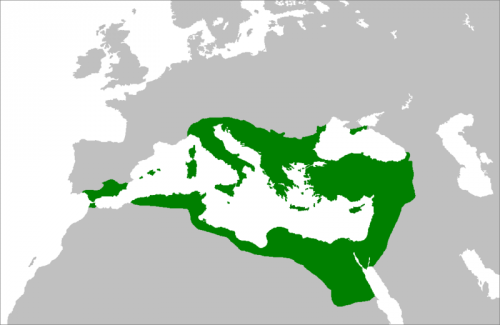
The map above shows the Byzantine Empire at its height under in 560 a.d under Emperor Justinian. Wait the Byzantine Empire ! why am I using a term coined by later historians ? This is my first niggle, I would prefer it to be called the Roman Empire, as it is effectively the Roman Empire or at least the Eastern Roman Empire (though apparently that is a later term as well, so maybe not.) The people of this empire called themselves Romaioi or Romioi (meaning Roman) or Graikoi (Greek) and they continued to refer to the empire as the Imperium Romanum (Latin) or Basileia Rhōmaiōn (Ancient Greek). Now really you could do a whole book on how the so called Byzantine Empire is the Roman Empire, with an added Greek element (that's a good idea), but it is a long and complex topic I suppose. The term 'Byzantine' was first used by the historian Hieronymus Wolf in 1557 over a century after the Fall of Constantinople. This term comes from the name of Constantinople, 'Byzantium' before Constantine made the city capital.
In the West, the Byzantine Empire was often called the Greek Empire in order to distinguish it from the Roman Empire of Charlemagne and his successors. In 800 A.D Pope Leo III used the excuse that the (Byzantine) Roman Empire had no male occupant at the time, to crown Charlemagne as Roman Emperor, because he needed his support. In the West, Imperator Romaniae was also used to describe the East, meaning Emperor of Romania, whereas Imperator Romanorum, Emperor of the Romans was used to describe Charlemagne and his successors. In the Islamic and Slavic worlds, no distinguishment was made where Byzantium was more straightforwardly seen as the continuation of the Roman Empire, one of the uses of the word Rûm in the Islamic World was simply as the name of the Roman (Byzantine) Empire.
There you go, we should really be calling Byzantium the Roman Empire, though to be fair I do understand the practicality of using it when we covering such distinct periods of time.
Constantinople not Istanbul
In 1953 the Four Lads sung about the official renaming of Constantinople to Istanbul. Though many may presume that Constantinople was renamed Istanbul in the 15th century after its conquest by the Ottomans this is a misconception. Constantinople was only officially renamed Istanbul in the first half of the 20th century. So this is a confusing topic, I must admit the city has many names. The name that was most common for official use until the fall of the Ottoman Empire, was Konstantiniyye which is an Arabic calqued (borrowed) form of Constantinople. Though it is wrong to say the word 'Istanbul' was never used, some sources show, in variants it exists back in the 10th century. It is the Greek version of a phrase that literally means 'in the city', so it is possible Istanbul was used in common speech in Turkish. Some times other names were more popular, such as Islambol, one source states that this was the more popular name in the 16th century and it was to some degree officially used from the late 17th century to the late 18th century.
By 1923, with the end of the Ottoman Empire ( fell in November 1922) and the creation of the Republic of Turkey all names except Istanbul had become obsolete in the Turkish language, but it was only in 1930 that Turkish authorities requested foreigners to adopt Istanbul with the Turkish Postal Service Law of 1930, otherwise there parcels would be rejected ! This led to Istanbul being the universally accepted name over time, and names such as Tsarigrad and Constantinople were no longer supposed to be used.
Just one final thing...this is a complex topic, every area of history is, I am not claiming to present the full picture, but a basic outline.By the way, Miklagarðr is an Old Norse name, meaning 'big city'.
Those horrid years between Rome and the Renaissance
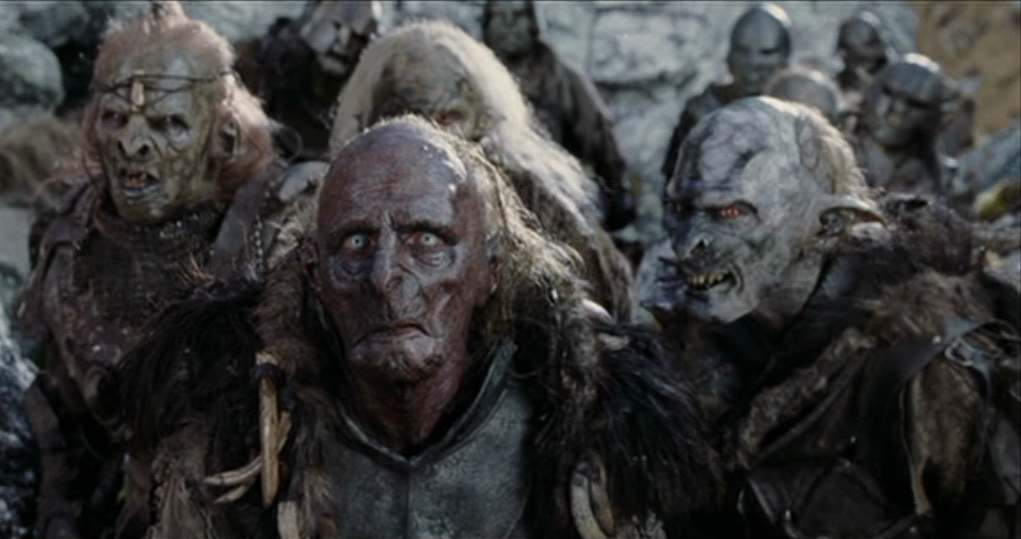
The Dark Ages the time when commoners were oppressed by a right-wing state and orcs freely raided villages and slayed peasants and the Church controlled absolutely everything......
This niggle is of course relating to the negative view of the Medieval Period and I would argue that the belief that this period was darker than any over period is due to the love of Antiquity that Western thinking has held since the Renaissance onwards. I understand that in academia the term 'the Dark Ages' is barely accepted, even if it is, it nearly always solely refers to the Early Middle Ages (5th-10th centuries) following the 'chaos' from the Fall of Rome. However, I think the image of the 'backwards' Middle Ages is still found commonly in popular culture.
The idea of a 'darkness' was first expressed by the scholar Petrarch in the 1330s, who was a big fan of the Greeks and Romans and was a critic of the quality of late Latin literature, this idea was enchanced by the Renaissance.
Later, during the Reformation, the Medieval Period became associated with Catholic Corruption and with the Age of Enlightenment in the 17th and 18th it became associated with being the exact opposite of reason due to its association as an 'Age of Faith'. Even today much of Western society is based on Roman and Greek law and philosophy and so it is easy to see why this period has been frowned on, as it is not commonly associated with these things.
Of course, we must not be fools, the Roman and Greek heritage had to be preserved throughout the Middle Ages to last into later periods of history and so it was. Learning was not defunct in the Middle Ages, after all it saw the foundation of many universities.
Furthermore, it is wrong to group around a 1000 years of history into one period. On a website once I saw a brilliant example if we say the Middle Ages ended in the late 15th century (generically), it lasted around 1000 years from the Fall of Rome. It has been around 500 years since 1500 and think about all the major events that have happened in that time, which is half of the Medieval Period ! It is wrong to group the entire Medieval Period together !
This is why we divided it into the Early, High and Late periods and as previously mentioned the Early Middle Ages are perhaps where the biggest doubts are laid. Many would point to the Carolingian Renaissance of the hight of the Early Period, but I think it is wrong to insult the so-called 'barbarian' cultures. They may have adopted parts of Roman culture, but is that not exactly what the Romans did to other cultures absorb parts of them to suit their purposes. I watched a programme called The Dark Ages: An Age of Light by Waldemar Januszczak on BBC Four and this shows that art was still prominent in the Early Middle Ages.
It is my opinion negativity on these periods is based on the Modern Mind, logic is often valued over faith. The intellectuals in this period held beliefs that are perhaps not as popular now in the Modern academic world (I know this is a sweeping statement) and that our Roman and Hellenic heritage perhaps has a much larger impact than you would think, even in 2015.
The Not So German Empire
It is not uncommon to see the Holy Roman Empire referred to as the German Empire and this annoys me a bit (whether I am in the right that is up to you). Now this is a detailed topic and I will not go into it much.
The term 'Holy Roman Empire' was apparently used first in the 13th century, but in 1512 in a decree following the Diet of Cologne the name was changed to Holy Roman Empire of the German Nation. So should we call the Medieval Holy Roman Empire the German Empire ? I would say no, but I am no expert.
This also raises the idea of whether we should refer to the Kingdom of Germany using 'German' or not. The Kingdom of 'Germany' started as part of the Frankish Kingdom which split following the Treaty of Verdun, therefore the rulers were often referred to as rex Francorum or even just rex. The first reference to a 'German' Kingdom was when the Pope referred to his enemy Henry IV as rex teutonicorum, King of the Teutons.
In the Middle Ages, the 'Kings' only became emperors after a Papal coronation. The title rex Romanorum, King of the Romans was used to emphasise their rule before they were emperors. King of the Romans later became associated with the heir apparent.
So when did Germany come into existence, this is no easy question, the term German was first used all the way back in the 3rd century BC, but Germany itself in the modern sense came into being in 1871. Someone, I asked makes a valid point in referring to that 'German' is a valuable term pre-1871 as it refers to Germany 'culturally', it would almost impossible for one person to recount all the tiny states within the Holy Roman Empire.
Conclusion
My so called 'niggles' seem to mainly refer to particular terms and whether they are in or out of place, depending on when they are used. The problem is that though these terms may never have been spoke historically by the people to whom they refer to it, we must accept that they are in common usage and have some helpfulness. It would seem impossible, unless we were there at the time, to know and use the exact terminology, but I still think there is a problem of clearing up possible mistakes that could be made with these terms !
Image Credit goes to
Wikipedia
http://lotr.wikia.com/wiki/File:Orcs.png
Subscribe to:
Posts (Atom)