Showing posts with label Rome. Show all posts

Tuesday, 13 October 2015

Rome's Greatest Enemies : Mithridates VI and the Rise of Pontus

It seems I am getting a bit classical, for a long time I have wished to do a post on Pontus, especially under its arguably greatest ruler Mithridates VI, but this has came at a time I find myself wanting to do a post on the Galatians and then I remembered I wanted to do a post on Zenobia and Palmyra a long time ago! Oh, bother, there are a lot of posts I wish to do and it seems that they have been lost in the trail of time, I remember writing in another post that I wanted to write a post on the Battle of Ayn Jalut! Well, I hope I will do all of these, but I have decided to start on Pontus. I must warn you though, that this topic would require a book to describe it fully and so yes I will most certainly miss out details, but I hope it inspires you to find out more!
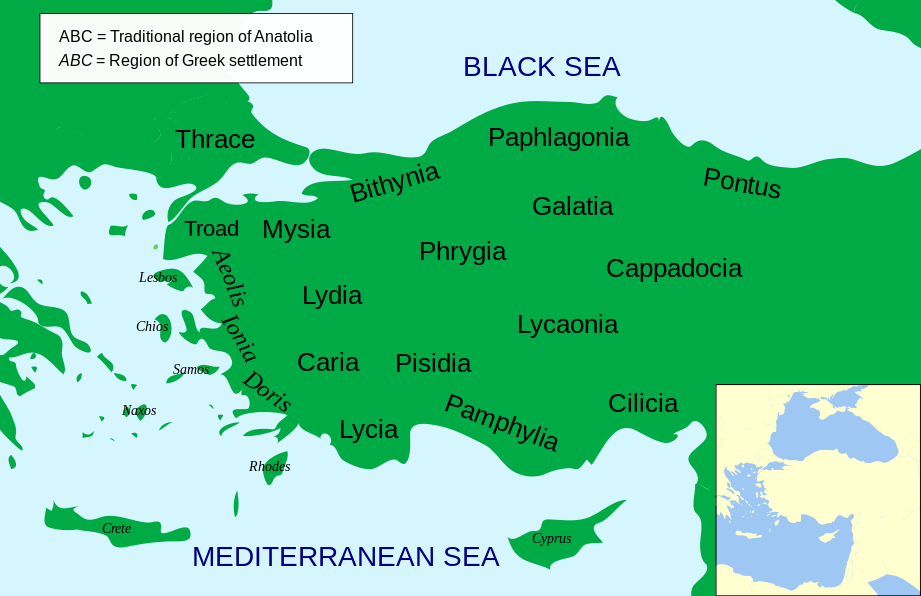


Pontus is a historical Greek designation for a region that is now found within the Black Sea Region of Turkey. This historical region ( I must stress though that the Black Sea Region encompasses far more than just historic Pontus) not only includes its coastline, but also up the hinterland to the Pontic Alps. Throughout history the exact boundaries of this region have varied, but it generally extended from Colchis (a western part of modern day Georgia) to Paphlagonia to the west, separating it from Bithynia. Basically, what the maps show. The one below is actually interesting as it shows a proposed Pontic state for after WW1 and it seems quite an interesting topic, alas it is not the focus of this post. It is key to understand these varying definitions of the region of Pontus and so I hope for the sake of this I have defined its general location well enough (for those who do not know already). There are also different names for the region and it was actually only caused Pontus at a certain point, but this article shall not delve into this.


Mithridates I founded the Kingdom of Pontus in 281 BCE which lasted until its conquest by the Roman Republic in 63 BCE. The focus of this article, Mithridates VI, is renowned for not only his conquests, but also his challenge to Roman power in Asia Minor. Mithradates succeeded his father in 120 BCE, you can probably guess his father's name. Mithradates was a popular name at the time for rulers in Anatolia and literally means 'gift of the god (Mithra)'.  To distinguish himself from Mithridates Euergetes, his father,he was surnamed Eupator or Dionysus. 

Euergetes was actually an ally of Rome, ironic considering his son's actions and he helped them during the Third Punic War. This alliance proved beneficial for the Kingdom of Pontus, allowing him to expand his power from the shores of the Black Sea to the Central Anatolia, where he fought against King Ariarathes VI of Cappadocia. He also forced the Paphlagonian ruler Pylaemenes to bequeath his realm to Pontus. Sinope was Euergetes'  which had a Hellenistic court and he liked to present himself as the champion of Hellenistic culture within Anatolia. In 120 BCE however he was murdered and left his Kingdom to his wife, a Seleucid princess named Laodice, and his two sons. One of them being our Mithridates (Eupator) and the other being Mithridates Chrestus (I did say Mithridates was a popular name.) Chrestus was Laodice's favourite and Eupator may have avoided several plots against hum.

Both of them were young and their mother was able to postpone the inevitable conflict. It seems at some point Eupator was able to seize control from his mother. She may have been put in prison. Not long after these events Chrestus disappears from the scene and it appears Mithridates Eupator became undisputed King of Pontus. It is a possibility that the Seleucid Empire may have wished to intervene on behalf of Laodice, but they were facing a civil war under their leader Antiochus VIII Gryphus. With Mithridates VI now the sole ruler of Pontus, he would continue his father's expansionist policy.


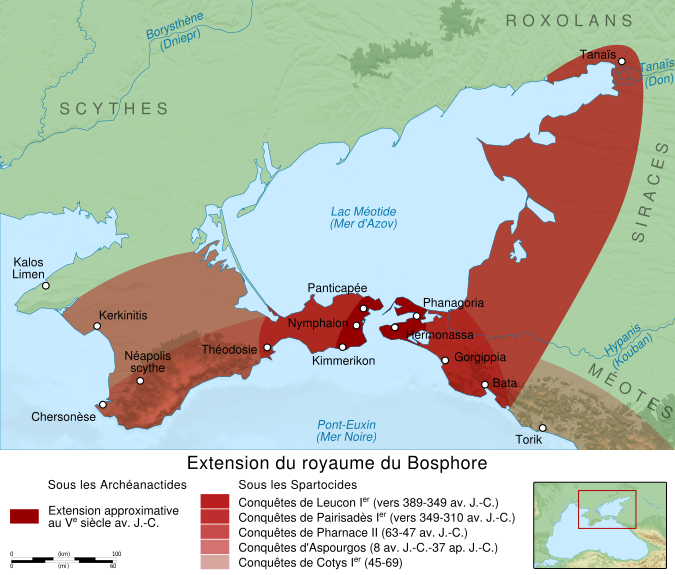
The picture above shows Mithridates VI, the man who only now would become renowned for his military exploits. These conquests included Colchis which it seems he took via military expeditions. But, he also gained land through other means, the Greeks of the Cimmerian Bosporus and of the Tauric Chersonese ( these certainly include the Bosporan Kingdom itself) across the Black Sea, were by far willing to give up independence in return for protection against their old enemy, the Scythians. Who were defeated, with the lands Mithridates aided becoming protectorates of Pontus. The map below shows the early expansion of the Bosporan Kingdom before it became under the control of Mithridates VI.


Mithridates was to now to turn his attention to Anatolia, where Pontic control had weakened after his father's death. Paphlagonia had freed itself, whereas Phrygia had been linked to the Roman province of Asia. He conspired with Nicomedes III of Bithynia to partition Paphlagonia and Galatia between themselves, but they soon fell out over Cappadocia and because it seemed Nicomedes was steering his lands into anti-Pontic alliance with the Romans. Two times in 95 and 92 BCE he was intially successful against Nicomedes, but was deprived of success by the Romans. It soon became clear, if Mithridates VI wanted to carry on expanding his Kingdom, a Roman-Pontic war would become an inevitably. 

While initially appearing to not be too concerned, he soon tried to depose Nicomedes IV of Bithynia, who was completely subservient to Rome. This effort was in vain and soon instigated by the Romans, Nicomedes IV attacked Pontic territory. Mithridates protested, once again in vain, against this towards the Romans. In 89 BCE, a combined Roman and Bithynian army was defeated by Mithridates and they were flung back to the coasts of the Aegean and the Propontis. Much of the western part of the province of Asia welcomed Mithridates, allying with him, but some such as Rhodes held out against him, which he failed to siege. In 88 BCE Mithridates had carried out a massacre of around 80,000 Roman and Italian settlers in Anatolian cities, which nearly wiped out the Roman presence. 

Mithridates had been seen as a champion of Hellenism and so it comes as no surprise that many cities in Greece, including Athens, took his side, welcoming his armies onto the mainland. He also made an alliance with the King of Armenia, Tigranes the Great, who married one of his daughters, Cleopatra of Pontus. As mentioned above, he had Rhodes besieged, but as I should say by his fleet, though I still assume it was unsuccessful in the long run. But, nevertheless, the Romans did respond by sending an army under Lucius Cornelius Sulla.


The map above shows the Kingdom of Pontus. The dark purple shows the Kingdom before his reign, the purple his early conquests and the pink his conquests as part of the First Mithridatic War. Furthermore, the green shows his Armenian ally. Maps like these show you the great extent of his power, but his story is far from over. Sulla drove Mithridates out of Greece proper, but he was forced to rush home, due to the threat of his rival Gaius Marius, therefore peace talks were completed, which were not only lenient, but also never ratified by the Senate. Although, Lucius Licinius Murena, was left to command the Roman forces in Anatolia, the situation allowed Mithridates to recoup his forces.
In 83 BCE Murena attacked Mithridates and so began the Second Mithridatic War, however this ended with a victory for Pontus and peace was quickly signed again. However, disputes were common place and it was not long before the Third Mithridatic War broke out, which would be the longest of the wars between Mithridates VI's Pontus and Rome. This was caused by a Roman attempt to annex Bithynia (which was bequested to Rome by it's last king) which Mithridates attacked with an even larger army. 

During this war, Mithridates defeated Marius Aurelius Cotta at Chalcedon, but was defeated by Lucius Licinius Lucullus at Cyzicus (73 BCE). Lucullus drove him to take refuge with Tigranes in Armenia, who was his son-in-law. Lucullus spent much time in Armenia, with there being two important battles at Tigranocerta (69 BCE) and Artaxata the following year. However, before Lucullus could finish the job he was superseded by Pompey ( Pompey the Great), perhaps due to political moves against him. 

After Pompey defeated Mithridates in 63 BCE, he fled with a small army from Colchis over the Caucasus Mountains to Crimea, where he made plans to raise yet another army to take on the Romans. However, he was betrayed by his son Machares (his eldest living) who was viceroy of Cimmerian Bosporan, who refused to help him fight. Mithridates had him killed and he took the throne of the Bosporan Kingdom for himself. It was then that Mithridates ordered the conscriptions and preparations for war.


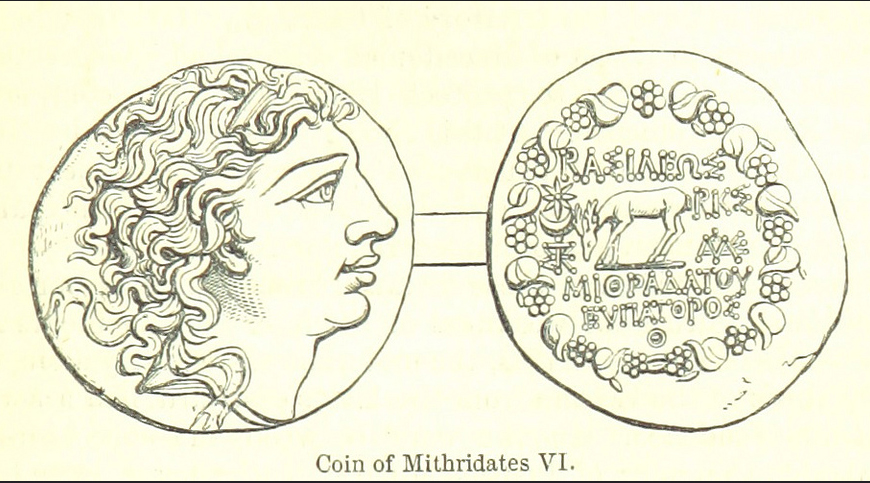
The coin above shows Mithridates, the man who for so long, had troubled the Romans, during the age of other troublemakers such as Spartacus. And yet he was soon to meet his end, in 63 BCE, one of his sons Pharnaces II of Pontus, with a core of Roman exiles, led a rebellion against him. Mithridates fled to the citadel in Panticapaeum, where he sadly committed suicide. Pompey buried Mithridates in the rock-cut tombs of his ancestors in Amasya, the old capital of Pontus.

After the Mithridatic Wars, part of Pontus was incorporated into the Roman Republic as the province of Bithynia et Pontus, whereas the eastern part survived as a client Kingdom. I have no doubt that Mithridates was a genuine fear of Rome, for not only because of the trouble he caused, but because of his possible championing of the Hellenistic/Greek cause. Although, there is no evidence to suggest this championing was a belief he personally held, I think it is though more often that it was simply a political tool, even so he was a genuine threat to Roman superiority. Mithridates was also a harsh ruler, as seen by the aforementioned massacred, but also by his leniency towards the Greeks becoming a harshness after the First Mithridatic War, against which he used deportation, murders and the freeing of slaves (that last crime is terrible!) Therefore, was he really a champion of Hellenism at all? Even, Pontus (at least the royal lineage) may have been of Persian and Greek heritage. Though his campaign in Greece as part of the First Mithridatic War, was only helped by Sulla who helped his troops to sack the city of Delphi.

So there we have it! What do you think, was Mithridates VI a champion of Hellenistic culture or a simply someone who saw a political savvy way to expand his kingdom? Share your opinion in the comments section if you want to!


Image credit goes to Wikipedia

Bibliography:

http://www.britannica.com/biography/Mithradates-VI-Eupator
http://www.livius.org/articles/person/mithridates/

Monday, 21 September 2015

It's Alive ! My Personal Historical Niggles

Yes, the blog is alive. It may have been almost a year to the date (well actually Gustavus Adolphus Day in November) that I did my last blog post. Of course, education gets in the way, but now I have decided to try and continue with a more casual tone then what I used to write with. Anyway, I thought I would start off discussing my own personal historical niggles. Whether, you think they are worthy or not I get annoyed by certain terms and ideas in history to varying degrees. And so let it begin !

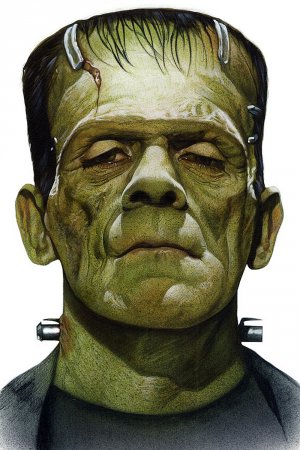
                                     Did you get it ? The words 'It's Alive!" is never actually used in the novel Frankenstein; or the Modern                            Prometheus. Also, Frankenstein's monster is often erroneously referred as simply Frankenstein.

The Byzant....Roman Empire


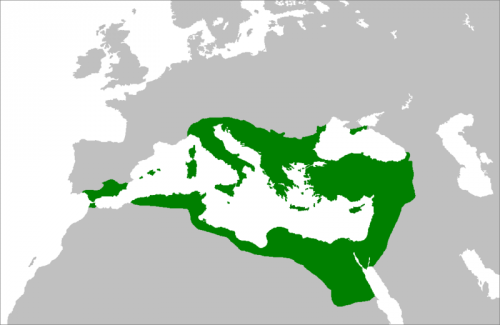
The map above shows the Byzantine Empire at its height under in 560 a.d under Emperor Justinian. Wait the Byzantine Empire ! why am I using a term coined by later historians ? This is my first niggle, I would prefer it to be called the Roman Empire, as it is effectively the Roman Empire or at least the Eastern Roman Empire  (though apparently that is a later term as well, so maybe not.) The people of this empire called themselves Romaioi or Romioi (meaning Roman) or Graikoi (Greek) and they continued to refer to the empire as the Imperium Romanum (Latin) or Basileia Rhōmaiōn (Ancient Greek). Now really you could do a whole book on how the so called Byzantine Empire is the Roman Empire, with an added Greek element (that's a good idea), but it is a long and complex topic I suppose. The term 'Byzantine' was first used by the historian Hieronymus Wolf in 1557 over a century after the Fall of Constantinople. This term comes from the name of Constantinople, 'Byzantium' before Constantine made the city capital. 

In the West, the Byzantine Empire was often called the Greek Empire in order to distinguish it from the Roman Empire of Charlemagne and his successors. In 800 A.D Pope Leo III used the excuse that the (Byzantine) Roman Empire had no male occupant at the time, to crown Charlemagne as Roman Emperor, because he needed his support. In the West,  Imperator Romaniae was also used to describe the East, meaning Emperor of Romania, whereas Imperator Romanorum, Emperor of the Romans was used to describe Charlemagne and his successors. In the Islamic and Slavic worlds, no distinguishment was made where Byzantium was more straightforwardly seen as the continuation of the Roman Empire, one of the uses of the word Rûm in the Islamic World was simply as the name of the Roman (Byzantine) Empire. 

There you go, we should really be calling Byzantium the Roman Empire, though to be fair I do understand the practicality of using it when we covering such distinct periods of time.

Constantinople not Istanbul


In 1953 the Four Lads sung about the official renaming of Constantinople to Istanbul. Though many may presume that Constantinople was renamed Istanbul in the 15th century after its conquest by the Ottomans this is a misconception. Constantinople was only officially renamed Istanbul in the first half of the 20th century. So this is a confusing topic, I must admit the city has many names. The name that was most common for official use until the fall of the Ottoman Empire, was Konstantiniyye which is an Arabic calqued (borrowed) form of Constantinople. Though it is wrong to say the word 'Istanbul' was never used, some sources show, in variants it exists back in the 10th century. It is the Greek version of a phrase that literally means 'in the city', so it is possible Istanbul was used in common speech in Turkish. Some times other names were more popular, such as Islambol, one source states that this was the more popular name in the 16th century and it was to some degree officially used from the late 17th century to the late 18th century.

By 1923, with the end of the Ottoman Empire ( fell in November 1922) and the creation of the Republic of Turkey all names except Istanbul had become obsolete in the Turkish language, but it was only in 1930 that Turkish authorities requested foreigners to adopt Istanbul with the Turkish Postal Service Law of 1930, otherwise there parcels would be rejected ! This led to Istanbul being the universally accepted name over time, and names such as Tsarigrad and Constantinople were no longer supposed to be used.

Just one final thing...this is a complex topic, every area of history is, I am not claiming to present the full picture, but a basic outline.By the way, Miklagarðr is an Old Norse name, meaning 'big city'.

Those horrid years between Rome and the Renaissance


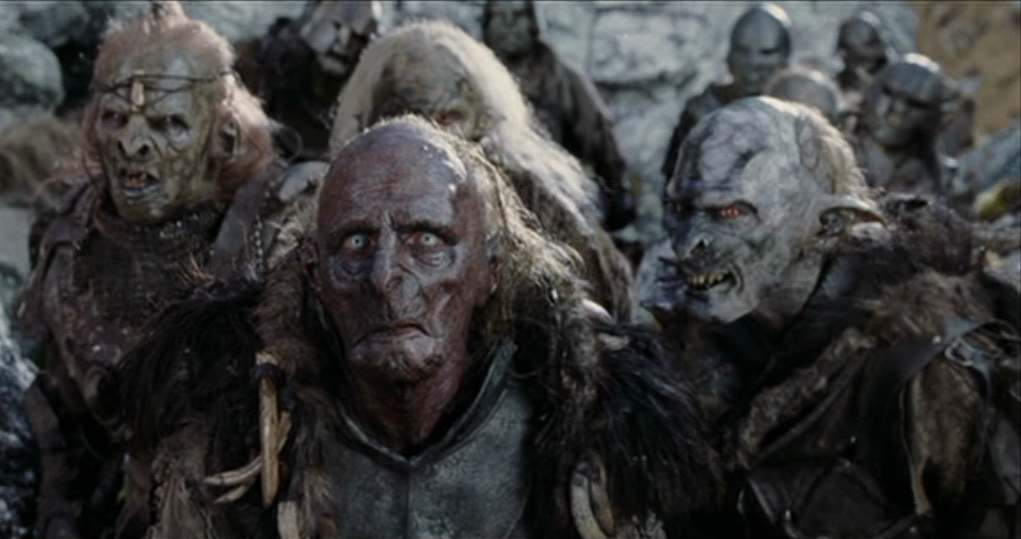
The Dark Ages the time when commoners were oppressed by a right-wing state and orcs freely raided villages and slayed peasants and the Church controlled absolutely everything......

This niggle is of course relating to the negative view of the Medieval Period and I would argue that the belief that this period was darker than any over period is due to the love of Antiquity that Western thinking has held since the Renaissance onwards. I understand that in academia the term 'the Dark Ages' is barely accepted, even if it is, it nearly always solely refers to the Early Middle Ages (5th-10th centuries) following the 'chaos' from the Fall of Rome. However, I think the image of the 'backwards' Middle Ages is still found commonly in popular culture.

The idea of a 'darkness' was first expressed by the scholar Petrarch in the 1330s, who was a big fan of the Greeks and Romans and was a critic of the quality of late Latin literature, this idea was enchanced by the Renaissance. 

Later, during the Reformation, the Medieval Period became associated with Catholic Corruption and with the Age of Enlightenment in the 17th and 18th it became associated with being the exact opposite of reason due to its association as an 'Age of Faith'. Even today much of Western society is based on Roman and Greek law and philosophy and so it is easy to see why this period has been frowned on, as it is not commonly associated with these things.

Of course, we must not be fools, the Roman and Greek heritage had to be preserved throughout the Middle Ages to last into later periods of history and so it was. Learning was not defunct in the Middle Ages, after all it saw the foundation of many universities. 

Furthermore, it is wrong to group around a 1000 years of history into one period. On a website once I saw a brilliant example if we say the Middle Ages ended in the late 15th century (generically), it lasted around 1000 years from the Fall of Rome. It has been around 500 years since 1500 and think about all the major events that have happened in that time, which is half of the Medieval Period ! It is wrong to group the entire Medieval Period together !

This is why we divided it into the Early, High and Late periods and as previously mentioned the Early Middle Ages are perhaps where the biggest doubts are laid. Many would point to the Carolingian Renaissance of the hight of the Early Period, but I think it is wrong to insult the so-called 'barbarian' cultures. They may have adopted parts of Roman culture, but is that not exactly what the Romans did to other cultures absorb parts of them to suit their purposes. I watched a programme called The Dark Ages: An Age of Light by Waldemar Januszczak on BBC Four and this shows that art was still prominent in the Early Middle Ages.

It is my opinion negativity on these periods is based on the Modern Mind, logic is often valued over faith. The intellectuals in this period held beliefs that are perhaps not as popular now in the Modern academic world (I know this is a sweeping statement) and that our Roman and Hellenic heritage perhaps has a much larger impact than you would think, even in 2015.

The Not So German Empire


It is not uncommon to see the Holy Roman Empire referred to as the German Empire and this annoys me a bit (whether I am in the right that is up to you). Now this is a detailed topic and I will not go into it much. 

The term 'Holy Roman Empire' was apparently used first in the 13th century, but in 1512 in a decree following the Diet of Cologne the name was changed to Holy Roman Empire of the German Nation. So should we call the Medieval Holy Roman Empire the German Empire ? I would say no, but I am no expert.

This also raises the idea of whether we should refer to the Kingdom of Germany using 'German' or not. The Kingdom of 'Germany' started as part of the Frankish Kingdom which split following the Treaty of Verdun, therefore the rulers were often referred to as rex Francorum or even just rex.  The first reference to a 'German' Kingdom was when the Pope referred to his enemy Henry IV as rex teutonicorum, King of the Teutons.

In the Middle Ages, the 'Kings' only became emperors after a Papal coronation. The title rex Romanorum, King of the Romans was used to emphasise their rule before they were emperors. King of the Romans later became associated with the heir apparent.

So when did Germany come into existence, this is no easy question, the term German was first used all the way back in the 3rd century BC, but Germany itself in the modern sense came into being in 1871. Someone, I asked makes a valid point in referring to that 'German' is  a valuable term pre-1871 as it refers to Germany 'culturally', it would almost impossible for one person to recount all the tiny states within the Holy Roman Empire. 

Conclusion 

My so called 'niggles' seem to mainly refer to particular terms and whether they are in or out of place, depending on when they are used. The problem is that though these terms may never have been spoke historically by the people to whom they refer to it, we must accept that they are in common usage and have some helpfulness. It would seem impossible, unless we were there at the time, to know and use the exact terminology, but I still think there is a problem of clearing up possible mistakes that could be made with these terms !


Image Credit goes to
Wikipedia
http://lotr.wikia.com/wiki/File:Orcs.png

Tuesday, 22 April 2014

Cola di Rienzo: An Extraordinary Medieval Leader

Cola di Rienzo was born in Rome in 1313. He claimed to be the son of the Holy Roman Emperor, Henry VII. However, his origins were more humble, his father a tavern-keeper and his mother a washer-woman. His early years were spent at Anagni an he devoted his time to the study of the ancient Rome, in the ancient writers of Livy, Valerius Maximus, Cicero, Seneca, Boethius and the poets. This filled him with determination to restore Rome to its former greatness and power, this was only fuelled by his desire to avenge his brother who had been killed by a noble. He returned to Rome as a student at the age of 20 and in 1343 he was sent on an errand to Pope Clement VI at Avignon (it was the time of the Avignon Papacy/ the Babylonian captivity), where he fulfilled his duties with ability and success. He was eventually appointed notary of the Roman civic treasury by the Pope and returned to Rome in 1344. He then began to plot a revolution that would return the city of Rome to its former glory. After, three years of working towards his goal, including by gaining supporters, on the 19th May 1347, heralds invited the people to the Capitol (Capitoline Hill) and on May 20th, Whit-Sunday, the meeting was held, where he was given unlimited power and authority, a few days later Rienzo took the title of tribune.

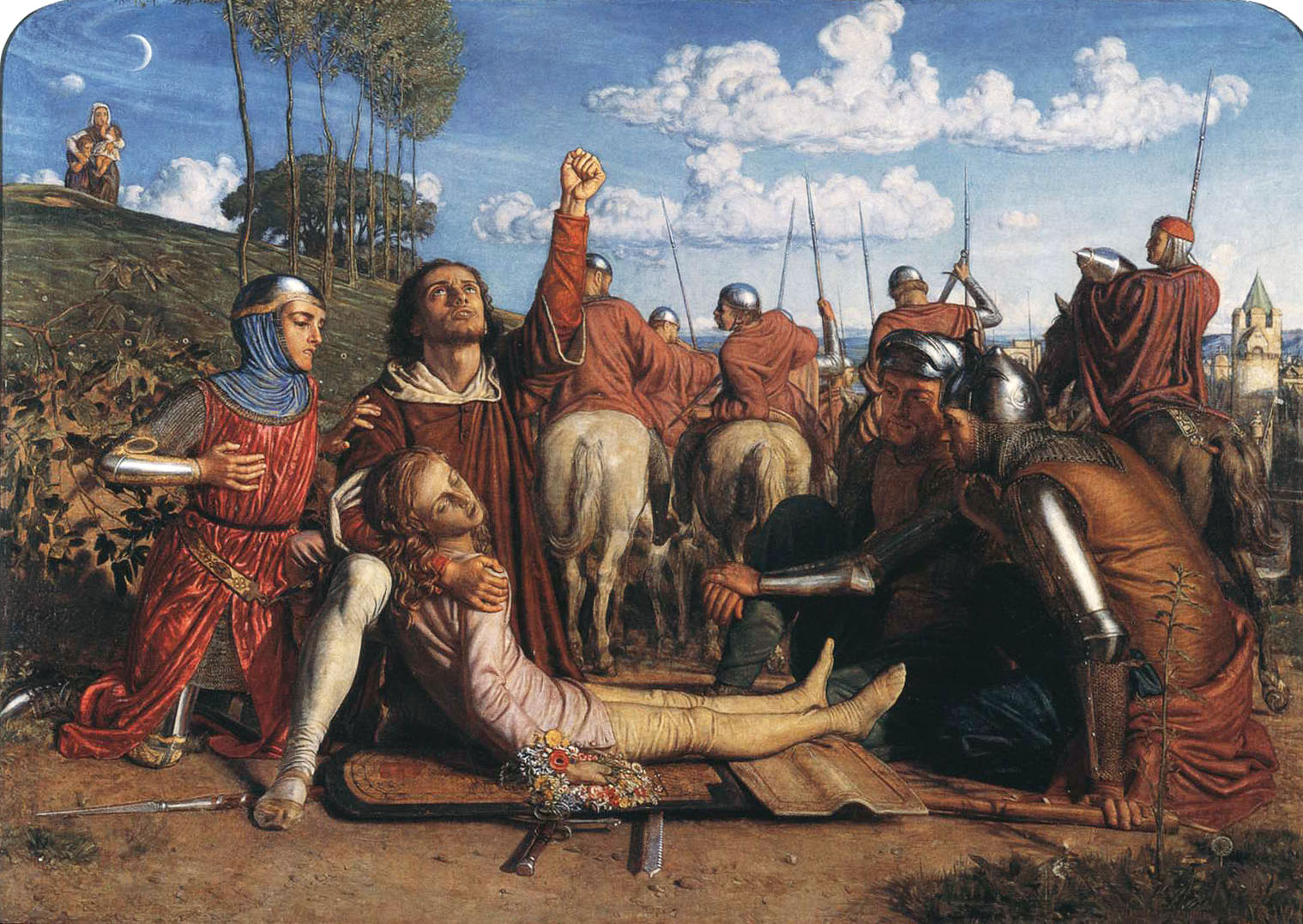
                                       Rienzo vowing to avenge the death of his younger brother

His authority was quickly accepted among most in Rome, his reign was immediately was marked with order and justice, compared to the previous disorder. In July, he proclaimed the sovereignty of the Roman people over the Empire and at first set himself with the task of restoring Rome's authority over the other Italian cities.  On August 1st 1347 he conferred Roman citizenship on all the cities of Italy and and proceeded to prepare for an election of a Roman Emperor of Italy the following year. On the following day the festival of the unity of Italy was celebrated. However, none of this had any political result. However, he was recognised by Joan of Naples, who and her bitter foe the King of Hungary asked for protection and aid. On August 15th he was crowned tribune.

However, his reign was soon to come to an end.. He then  seized and soon released Stefano Colonna and and some other barons. The Pope and the Emperor were both offended by his proposal to set up a new Roman Empire, and in October Clement gave power to a legate to dispose him. The exiled barons soon gathered troops and war began in the neighbourhood of Rome, but with aid from Louis I of Hungary and others, the rebels were defeated on the 20th November 1347. Although, he did not take part directly in the fighting, his most distinguished  foe , Colonna was killed. However, he was eventually declared a criminal, heretic and pagan by the Pope. He fled Rome and abdicated on December 15th 1347, following being terrified by a slight disturbance. He sought refuge in Naples, but quickly left and spent two years in an Italian mountain monastery.

Emerging from solitude, Cola journeyed to Prague in 1350, throwing himself on the protection of the Emperor Charles IV, denouncing the Pope's temporal power. Charles kept him prisoner for a year in the fortress of Raudnitz, then handing him over to Pope Clement. In August 1352, he appeared in Avignon and although he was tried by three cardinals and sentenced to death, the judgement was not carried out. When Clement died in December 1352, he had the chance to gain his freedom, when his successor Innocent VI saw him as a tool to strike at the baronial rulers of Rome. He was appointed the title senator and with a Papal legate he entered Rome in August 1354 and quickly regained his position and power. This term was to be even shorter than his first.

Having besieged the fortress of Palestrina, he returned to Rome where he treacherously seized the mercenary Giovanni Moriale and put him to death. Through this and other cruel and arbitrary acts he quickly lost the favour of the people. On October 8th 1354, Cola addressed some of the aroused people, but the building he was in was set on fire and as he tried to escape he was murdered by the mob.

Bibliography:

The Editors of Encyclopædia Britannica. "Cola Di Rienzo (Italian Leader)."Encyclopedia Britannica Online. Encyclopedia Britannica, n.d. Web. 22 Apr. 2014.
"Cola Di Rienzi." CATHOLIC ENCYCLOPEDIA:. N.p., n.d. Web. 22 Apr. 2014.

Image Credit goes to Wikipedia