Showing posts with label Roman Empire. Show all posts

Wednesday, 15 February 2017

The Bacaudae of Gaul and Hispania: Class Conflict and the Later Western Roman Empire


Economic explanations form a significant part of the debate and discourse on the fall of the Western Roman Empire. However, one aspect that has often been overlooked in this discourse is the role of class conflict. This has been to some degree due to the sparsity and relevance of evidence, especially relating to the poorest in Roman society. This in turn may also account for the extremely limited amount of attempts to interpret the fall of the empire in this light, when compared to the literature on the 'catastrophic' mass migration theories and other models, such as ethnogenesis. However, what can be inferred is that there were large scale internal revolts in Hispania and Gaul from the 2nd century onwards that were not associated with the designation of 'barbarian' or rebellious Roman officials and that these posed a serious enough problem to warrant forceful military action, when compared to other forms of lawlessness. The question is then to what extent do these mirror the modern conception of 'class conflict'?

If class conflict can be understood as antagonism between people of different socio-economic standing we must firstly consider what 'class' in the Roman Empire actually was. A traditional understanding would differentiate between those who were citizens and non-citizens, following this would be the distinction between those of aristocratic lineage and privilege and free commoners. The aristocratic elite could consist of those the senatorial class, the equestrians and local provincial elites and these in general held more practical power than other citizens. Of course, non-citizens, such as slaves also formed a lower part of the social hierarchy. Nevertheless, there are problems with this form of interpretation of class, definition by nature is restrictive and it is difficult to fully grasp the Roman conception of class outside of our contemporary understanding. With this in mind, it is possible to assess the role of class conflict in the fall of the Roman Empire.

Image result for later roman empire


The term Bacaudae came into existence in the 3rd century and often became synonymous with banditry throughout the Roman Empire. However, it has also been used to describe a variety of movements in the Later Roman Empire that could be associated with the idea of class conflict. Two main periods of activity can be identified in the 5th and late 3rd centuries that suggest there may have been some form of mass anti-elite action in the later Roman Empire, however it may also be possible to identify a degree of social tension and indeed revolt long before the term was invented. In the 2nd century, the revolt of the deserter Maternus attracted a wide range of discontents and was far beyond mere banditry. At first, Maternus mainly plundered villages and importantly estates, but as his movement gathered momentum it began to attack cities and soon overran large portions of Gaul and Hispania. The revolt was so dangerous that Septimus Severus, then governor of Gallia Lugdunensis, was unable to put it down and the central government was obliged to send an army into central and southern Gaul.

Can this revolt, neither identifiable with Roman authority nor barbarian, instead be described as the result of class conflict? The rebellion sprung up during a period of crisis, the latter 2nd century saw the calamitous campaigns of Marcus Aurelius, plague and also the civil wars of Septimus Severus and his rivals. There is no doubt that the poorer classes would have been heavily burdened by these events as landowners would most likely to have used them to curtail any consequences of the events. Furthermore, the fact that Maternus was able to overrun large portions of Gaul and Hispania suggest he had the support of the local populace, something which simple deserters or bandits would not be able to achieve. However, a key aspect of this revolt suggests it had no desire to overhaul the social order. Eventually, rebels began to infiltrate Italy and plot to assassinate the Emperor Commodus with the aim of replacing him with Maternus. So can the revolts after the coining of the term Bacaudae be more clearly connected with class conflict?

Image result for armorica
Armorica, the centre of 5th century Bacaudic activity, its borders the Loire and the Seine are marked. 


Likewise with the revolt of Maternus, we can possibly identify social tension after another series of calamitous events- The Crisis of the Third Century. Aurelius Victor, a Roman historian and politician, noted a revolt, beginning in 283-284, led by Aelianus and Amandus who gathered an army of farmers and brigands and mentions how the people of Gaul called them Bacaudae. This revolt in Gaul was only crushed when the Emperor Diocletian appointed Maximian as co-emperor in the West, with the sole purpose of defeating it. Before the revolt was defeated in 286. This revolt then was mainly made up of those of lower social standing and it was considered a significant enough threat to warrant serious action.

However, the Bacaudic revolts of the 5th century are perhaps even further identifiable with significant class conflict. The period brought a series of revolts especially in Armorica, the region of Gaul between the Seine and Loire rivers. It was here the longest and most successful revolt broke out between 407 and 417 and also the revolt of  Tibatto from 435 to 437. However, this century also saw saw conflict in Tarraconensis, Hispania. This period of Bacaudae activity was so severe that it required the Master of Both Services (the supreme military commander in the West) Flavius Asturius to take to the field against them in 441, by 454 the Romans were recruiting the support of the Visigoths to help defeat the Bacaudae. It is therefore clear that during the 5th century numerous large-scale revolts associated with the word Bacaudae broke out and can therefore possibly be identified as the result of social tension.
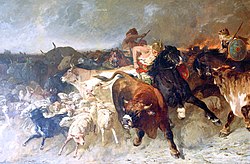

                                       Pillards Gaulois by Évariste-Vital Luminais

Does anything else suggest that the Bacaudic revolts can be directly associated with social tension? There is some evidence regarding the peace-time life of Bacaudae in a comedy called Querolus. It describes that by the Loire justice was not adminstered by a governing body, but by private individuals and countrymen. Thompson has also noted the fact that the comedy seems to suggest that the rich landowners were now being forced to work on the fields by the Bacaudae and that the small amount of evidence available suggests a lack of state control.

However, it is arguable that the idea of a 'peasant' revolutionist explanation for the Bacaudae can be overstated. Drinkwater has noted the differences between the revolts of the 3rd century and the 5th century- the similarity is only in the use of linguistics. In his opinion the revolts in the 3rd century were caused by a collapse of the authority of the Gallic aristocracy and peasants seeking security in second-order figures of authorities, such as lesser aristocrats, yeomen and even bandits. This was mostly as a result of the Third Century Crisis. In contrast, the revolts of the 5th century were not caused by hardship. By the beginning of the century the population of Gaul had took a severe hit due to barbarian invasion, civil war and the associated famine and disease. Therefore, by the middle of the century the peasantry should have been benefiting from the shortage of manpower. This would have been due to the fact that such a shortage would result in increased wages, lower and longer rents and more mobility in terms of where they could work. In this Gallic peasants standard of living increased and the revolts were a consequence of rising economic expectations.

A final point to consider is whether the Bacaudae had any role in the 'fall' of the Western Roman Empire and whether this has been underplayed. Those termed Bacaudae certainly seemed to have required severe military action and that they were a constant threat across centuries. However, the main problem with engaging with this idea is the lack of evidence- nearly all of it is text, with a substantial part of it only being indirect. Nevertheless, based on what we do have is reasonable to be assumed they were perceived as a major threat. Can the Bacaudae be put in a wider 'class conflict' narrative for the fall of the Empire? There is good reason to assume that the cause of these revolts were heavily motivated by economic trends in the latter years of the Empire. But we must also make this assumption mainly based on wider contextual evidence. Nevertheless, it is perhaps reasonable to make these connections.


Bibliography:


Drinkwater, J.F. "The Bacaudae of fifth-century Gail." In Fifth-century Gaul : a crisis of identity?, edited by J. F. Drinkwater and Hugh Elton. Cambridge: Cambridge University Press, 1992.

Thompson, E. A. "Peasant Revolts in Late Roman Gaul and Spain." Past & Present, no. 2 (1952): 11-23.

https://libcom.org/history/bagaudae-historys-first-revolutionaries-pablo-romero-gabella

https://www.karwansaraypublishers.com/pw/ancient-warfare/blog/roman-rebels-the-bacaudae/

Image Credit goes to:

Wikicommons

http://theancientweb.com/2011/01/language-and-identity-in-the-roman-empire/


Tuesday, 13 October 2015

Rome's Greatest Enemies : Mithridates VI and the Rise of Pontus

It seems I am getting a bit classical, for a long time I have wished to do a post on Pontus, especially under its arguably greatest ruler Mithridates VI, but this has came at a time I find myself wanting to do a post on the Galatians and then I remembered I wanted to do a post on Zenobia and Palmyra a long time ago! Oh, bother, there are a lot of posts I wish to do and it seems that they have been lost in the trail of time, I remember writing in another post that I wanted to write a post on the Battle of Ayn Jalut! Well, I hope I will do all of these, but I have decided to start on Pontus. I must warn you though, that this topic would require a book to describe it fully and so yes I will most certainly miss out details, but I hope it inspires you to find out more!


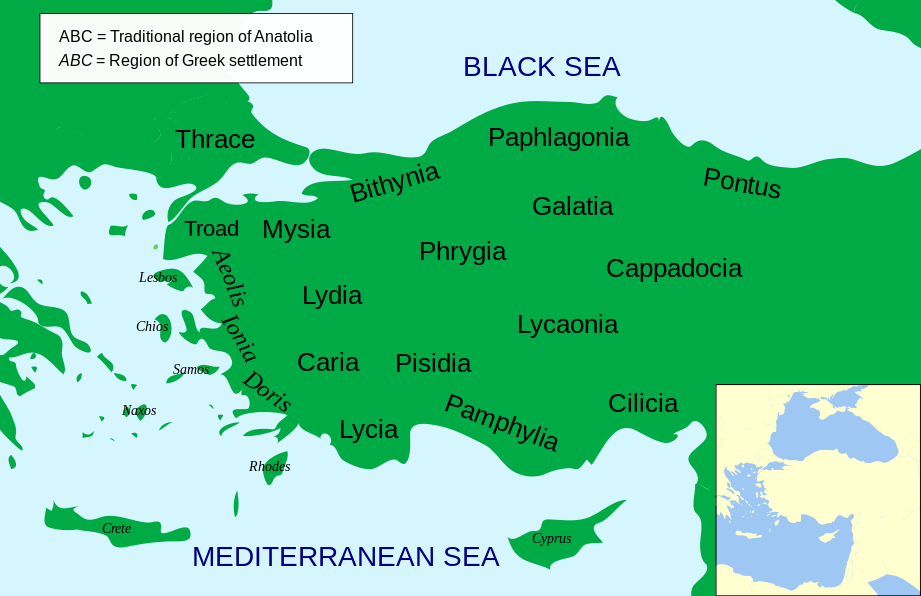
Pontus is a historical Greek designation for a region that is now found within the Black Sea Region of Turkey. This historical region ( I must stress though that the Black Sea Region encompasses far more than just historic Pontus) not only includes its coastline, but also up the hinterland to the Pontic Alps. Throughout history the exact boundaries of this region have varied, but it generally extended from Colchis (a western part of modern day Georgia) to Paphlagonia to the west, separating it from Bithynia. Basically, what the maps show. The one below is actually interesting as it shows a proposed Pontic state for after WW1 and it seems quite an interesting topic, alas it is not the focus of this post. It is key to understand these varying definitions of the region of Pontus and so I hope for the sake of this I have defined its general location well enough (for those who do not know already). There are also different names for the region and it was actually only caused Pontus at a certain point, but this article shall not delve into this.


Mithridates I founded the Kingdom of Pontus in 281 BCE which lasted until its conquest by the Roman Republic in 63 BCE. The focus of this article, Mithridates VI, is renowned for not only his conquests, but also his challenge to Roman power in Asia Minor. Mithradates succeeded his father in 120 BCE, you can probably guess his father's name. Mithradates was a popular name at the time for rulers in Anatolia and literally means 'gift of the god (Mithra)'.  To distinguish himself from Mithridates Euergetes, his father,he was surnamed Eupator or Dionysus. 

Euergetes was actually an ally of Rome, ironic considering his son's actions and he helped them during the Third Punic War. This alliance proved beneficial for the Kingdom of Pontus, allowing him to expand his power from the shores of the Black Sea to the Central Anatolia, where he fought against King Ariarathes VI of Cappadocia. He also forced the Paphlagonian ruler Pylaemenes to bequeath his realm to Pontus. Sinope was Euergetes'  which had a Hellenistic court and he liked to present himself as the champion of Hellenistic culture within Anatolia. In 120 BCE however he was murdered and left his Kingdom to his wife, a Seleucid princess named Laodice, and his two sons. One of them being our Mithridates (Eupator) and the other being Mithridates Chrestus (I did say Mithridates was a popular name.) Chrestus was Laodice's favourite and Eupator may have avoided several plots against hum.

Both of them were young and their mother was able to postpone the inevitable conflict. It seems at some point Eupator was able to seize control from his mother. She may have been put in prison. Not long after these events Chrestus disappears from the scene and it appears Mithridates Eupator became undisputed King of Pontus. It is a possibility that the Seleucid Empire may have wished to intervene on behalf of Laodice, but they were facing a civil war under their leader Antiochus VIII Gryphus. With Mithridates VI now the sole ruler of Pontus, he would continue his father's expansionist policy.


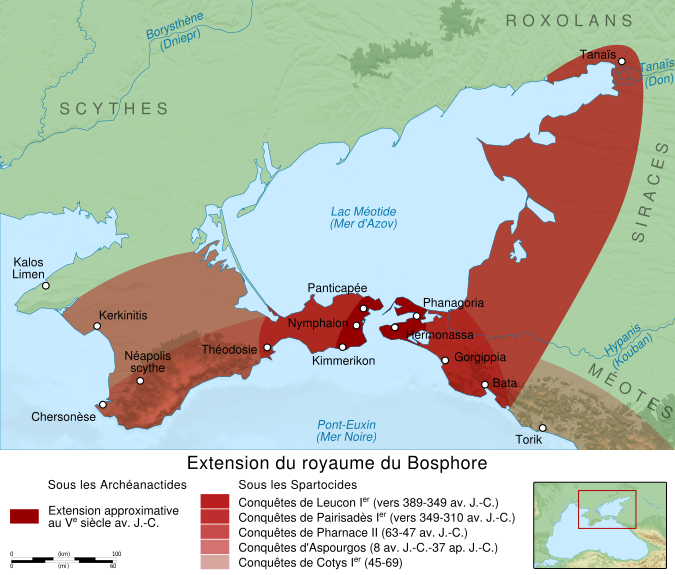
The picture above shows Mithridates VI, the man who only now would become renowned for his military exploits. These conquests included Colchis which it seems he took via military expeditions. But, he also gained land through other means, the Greeks of the Cimmerian Bosporus and of the Tauric Chersonese ( these certainly include the Bosporan Kingdom itself) across the Black Sea, were by far willing to give up independence in return for protection against their old enemy, the Scythians. Who were defeated, with the lands Mithridates aided becoming protectorates of Pontus. The map below shows the early expansion of the Bosporan Kingdom before it became under the control of Mithridates VI.


Mithridates was to now to turn his attention to Anatolia, where Pontic control had weakened after his father's death. Paphlagonia had freed itself, whereas Phrygia had been linked to the Roman province of Asia. He conspired with Nicomedes III of Bithynia to partition Paphlagonia and Galatia between themselves, but they soon fell out over Cappadocia and because it seemed Nicomedes was steering his lands into anti-Pontic alliance with the Romans. Two times in 95 and 92 BCE he was intially successful against Nicomedes, but was deprived of success by the Romans. It soon became clear, if Mithridates VI wanted to carry on expanding his Kingdom, a Roman-Pontic war would become an inevitably. 

While initially appearing to not be too concerned, he soon tried to depose Nicomedes IV of Bithynia, who was completely subservient to Rome. This effort was in vain and soon instigated by the Romans, Nicomedes IV attacked Pontic territory. Mithridates protested, once again in vain, against this towards the Romans. In 89 BCE, a combined Roman and Bithynian army was defeated by Mithridates and they were flung back to the coasts of the Aegean and the Propontis. Much of the western part of the province of Asia welcomed Mithridates, allying with him, but some such as Rhodes held out against him, which he failed to siege. In 88 BCE Mithridates had carried out a massacre of around 80,000 Roman and Italian settlers in Anatolian cities, which nearly wiped out the Roman presence. 

Mithridates had been seen as a champion of Hellenism and so it comes as no surprise that many cities in Greece, including Athens, took his side, welcoming his armies onto the mainland. He also made an alliance with the King of Armenia, Tigranes the Great, who married one of his daughters, Cleopatra of Pontus. As mentioned above, he had Rhodes besieged, but as I should say by his fleet, though I still assume it was unsuccessful in the long run. But, nevertheless, the Romans did respond by sending an army under Lucius Cornelius Sulla.


The map above shows the Kingdom of Pontus. The dark purple shows the Kingdom before his reign, the purple his early conquests and the pink his conquests as part of the First Mithridatic War. Furthermore, the green shows his Armenian ally. Maps like these show you the great extent of his power, but his story is far from over. Sulla drove Mithridates out of Greece proper, but he was forced to rush home, due to the threat of his rival Gaius Marius, therefore peace talks were completed, which were not only lenient, but also never ratified by the Senate. Although, Lucius Licinius Murena, was left to command the Roman forces in Anatolia, the situation allowed Mithridates to recoup his forces.
In 83 BCE Murena attacked Mithridates and so began the Second Mithridatic War, however this ended with a victory for Pontus and peace was quickly signed again. However, disputes were common place and it was not long before the Third Mithridatic War broke out, which would be the longest of the wars between Mithridates VI's Pontus and Rome. This was caused by a Roman attempt to annex Bithynia (which was bequested to Rome by it's last king) which Mithridates attacked with an even larger army. 

During this war, Mithridates defeated Marius Aurelius Cotta at Chalcedon, but was defeated by Lucius Licinius Lucullus at Cyzicus (73 BCE). Lucullus drove him to take refuge with Tigranes in Armenia, who was his son-in-law. Lucullus spent much time in Armenia, with there being two important battles at Tigranocerta (69 BCE) and Artaxata the following year. However, before Lucullus could finish the job he was superseded by Pompey ( Pompey the Great), perhaps due to political moves against him. 

After Pompey defeated Mithridates in 63 BCE, he fled with a small army from Colchis over the Caucasus Mountains to Crimea, where he made plans to raise yet another army to take on the Romans. However, he was betrayed by his son Machares (his eldest living) who was viceroy of Cimmerian Bosporan, who refused to help him fight. Mithridates had him killed and he took the throne of the Bosporan Kingdom for himself. It was then that Mithridates ordered the conscriptions and preparations for war.


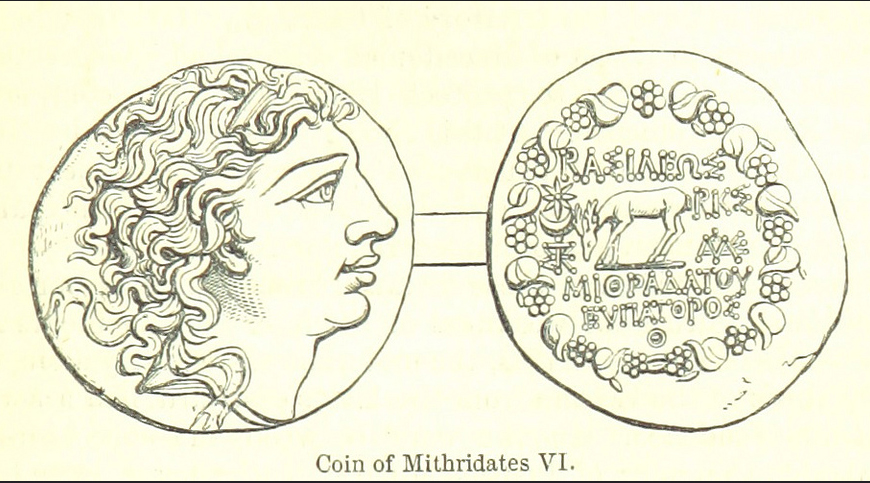
The coin above shows Mithridates, the man who for so long, had troubled the Romans, during the age of other troublemakers such as Spartacus. And yet he was soon to meet his end, in 63 BCE, one of his sons Pharnaces II of Pontus, with a core of Roman exiles, led a rebellion against him. Mithridates fled to the citadel in Panticapaeum, where he sadly committed suicide. Pompey buried Mithridates in the rock-cut tombs of his ancestors in Amasya, the old capital of Pontus.

After the Mithridatic Wars, part of Pontus was incorporated into the Roman Republic as the province of Bithynia et Pontus, whereas the eastern part survived as a client Kingdom. I have no doubt that Mithridates was a genuine fear of Rome, for not only because of the trouble he caused, but because of his possible championing of the Hellenistic/Greek cause. Although, there is no evidence to suggest this championing was a belief he personally held, I think it is though more often that it was simply a political tool, even so he was a genuine threat to Roman superiority. Mithridates was also a harsh ruler, as seen by the aforementioned massacred, but also by his leniency towards the Greeks becoming a harshness after the First Mithridatic War, against which he used deportation, murders and the freeing of slaves (that last crime is terrible!) Therefore, was he really a champion of Hellenism at all? Even, Pontus (at least the royal lineage) may have been of Persian and Greek heritage. Though his campaign in Greece as part of the First Mithridatic War, was only helped by Sulla who helped his troops to sack the city of Delphi.

So there we have it! What do you think, was Mithridates VI a champion of Hellenistic culture or a simply someone who saw a political savvy way to expand his kingdom? Share your opinion in the comments section if you want to!


Image credit goes to Wikipedia

Bibliography:

http://www.britannica.com/biography/Mithradates-VI-Eupator
http://www.livius.org/articles/person/mithridates/