Economic explanations form a significant part of the debate and discourse on the fall of the Western Roman Empire. However, one aspect that has often been overlooked in this discourse is the role of class conflict. This has been to some degree due to the sparsity and relevance of evidence, especially relating to the poorest in Roman society. This in turn may also account for the extremely limited amount of attempts to interpret the fall of the empire in this light, when compared to the literature on the 'catastrophic' mass migration theories and other models, such as ethnogenesis. However, what can be inferred is that there were large scale internal revolts in Hispania and Gaul from the 2nd century onwards that were not associated with the designation of 'barbarian' or rebellious Roman officials and that these posed a serious enough problem to warrant forceful military action, when compared to other forms of lawlessness. The question is then to what extent do these mirror the modern conception of 'class conflict'?
If class conflict can be understood as antagonism between people of different socio-economic standing we must firstly consider what 'class' in the Roman Empire actually was. A traditional understanding would differentiate between those who were citizens and non-citizens, following this would be the distinction between those of aristocratic lineage and privilege and free commoners. The aristocratic elite could consist of those the senatorial class, the equestrians and local provincial elites and these in general held more practical power than other citizens. Of course, non-citizens, such as slaves also formed a lower part of the social hierarchy. Nevertheless, there are problems with this form of interpretation of class, definition by nature is restrictive and it is difficult to fully grasp the Roman conception of class outside of our contemporary understanding. With this in mind, it is possible to assess the role of class conflict in the fall of the Roman Empire.

The term Bacaudae came into existence in the 3rd century and often became synonymous with banditry throughout the Roman Empire. However, it has also been used to describe a variety of movements in the Later Roman Empire that could be associated with the idea of class conflict. Two main periods of activity can be identified in the 5th and late 3rd centuries that suggest there may have been some form of mass anti-elite action in the later Roman Empire, however it may also be possible to identify a degree of social tension and indeed revolt long before the term was invented. In the 2nd century, the revolt of the deserter Maternus attracted a wide range of discontents and was far beyond mere banditry. At first, Maternus mainly plundered villages and importantly estates, but as his movement gathered momentum it began to attack cities and soon overran large portions of Gaul and Hispania. The revolt was so dangerous that Septimus Severus, then governor of Gallia Lugdunensis, was unable to put it down and the central government was obliged to send an army into central and southern Gaul.
Can this revolt, neither identifiable with Roman authority nor barbarian, instead be described as the result of class conflict? The rebellion sprung up during a period of crisis, the latter 2nd century saw the calamitous campaigns of Marcus Aurelius, plague and also the civil wars of Septimus Severus and his rivals. There is no doubt that the poorer classes would have been heavily burdened by these events as landowners would most likely to have used them to curtail any consequences of the events. Furthermore, the fact that Maternus was able to overrun large portions of Gaul and Hispania suggest he had the support of the local populace, something which simple deserters or bandits would not be able to achieve. However, a key aspect of this revolt suggests it had no desire to overhaul the social order. Eventually, rebels began to infiltrate Italy and plot to assassinate the Emperor Commodus with the aim of replacing him with Maternus. So can the revolts after the coining of the term Bacaudae be more clearly connected with class conflict?

Likewise with the revolt of Maternus, we can possibly identify social tension after another series of calamitous events- The Crisis of the Third Century. Aurelius Victor, a Roman historian and politician, noted a revolt, beginning in 283-284, led by Aelianus and Amandus who gathered an army of farmers and brigands and mentions how the people of Gaul called them Bacaudae. This revolt in Gaul was only crushed when the Emperor Diocletian appointed Maximian as co-emperor in the West, with the sole purpose of defeating it. Before the revolt was defeated in 286. This revolt then was mainly made up of those of lower social standing and it was considered a significant enough threat to warrant serious action.
However, the Bacaudic revolts of the 5th century are perhaps even further identifiable with significant class conflict. The period brought a series of revolts especially in Armorica, the region of Gaul between the Seine and Loire rivers. It was here the longest and most successful revolt broke out between 407 and 417 and also the revolt of Tibatto from 435 to 437. However, this century also saw saw conflict in Tarraconensis, Hispania. This period of Bacaudae activity was so severe that it required the Master of Both Services (the supreme military commander in the West) Flavius Asturius to take to the field against them in 441, by 454 the Romans were recruiting the support of the Visigoths to help defeat the Bacaudae. It is therefore clear that during the 5th century numerous large-scale revolts associated with the word Bacaudae broke out and can therefore possibly be identified as the result of social tension.
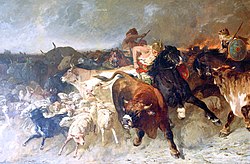
Pillards Gaulois by Évariste-Vital Luminais
Does anything else suggest that the Bacaudic revolts can be directly associated with social tension? There is some evidence regarding the peace-time life of Bacaudae in a comedy called Querolus. It describes that by the Loire justice was not adminstered by a governing body, but by private individuals and countrymen. Thompson has also noted the fact that the comedy seems to suggest that the rich landowners were now being forced to work on the fields by the Bacaudae and that the small amount of evidence available suggests a lack of state control.
However, it is arguable that the idea of a 'peasant' revolutionist explanation for the Bacaudae can be overstated. Drinkwater has noted the differences between the revolts of the 3rd century and the 5th century- the similarity is only in the use of linguistics. In his opinion the revolts in the 3rd century were caused by a collapse of the authority of the Gallic aristocracy and peasants seeking security in second-order figures of authorities, such as lesser aristocrats, yeomen and even bandits. This was mostly as a result of the Third Century Crisis. In contrast, the revolts of the 5th century were not caused by hardship. By the beginning of the century the population of Gaul had took a severe hit due to barbarian invasion, civil war and the associated famine and disease. Therefore, by the middle of the century the peasantry should have been benefiting from the shortage of manpower. This would have been due to the fact that such a shortage would result in increased wages, lower and longer rents and more mobility in terms of where they could work. In this Gallic peasants standard of living increased and the revolts were a consequence of rising economic expectations.
A final point to consider is whether the Bacaudae had any role in the 'fall' of the Western Roman Empire and whether this has been underplayed. Those termed Bacaudae certainly seemed to have required severe military action and that they were a constant threat across centuries. However, the main problem with engaging with this idea is the lack of evidence- nearly all of it is text, with a substantial part of it only being indirect. Nevertheless, based on what we do have is reasonable to be assumed they were perceived as a major threat. Can the Bacaudae be put in a wider 'class conflict' narrative for the fall of the Empire? There is good reason to assume that the cause of these revolts were heavily motivated by economic trends in the latter years of the Empire. But we must also make this assumption mainly based on wider contextual evidence. Nevertheless, it is perhaps reasonable to make these connections.
Bibliography:
Drinkwater, J.F.
"The Bacaudae of fifth-century Gail." In Fifth-century Gaul : a
crisis of identity?, edited by J. F. Drinkwater and Hugh Elton. Cambridge:
Cambridge University Press, 1992.
https://libcom.org/history/bagaudae-historys-first-revolutionaries-pablo-romero-gabella
https://www.karwansaraypublishers.com/pw/ancient-warfare/blog/roman-rebels-the-bacaudae/
Image Credit goes to:
Wikicommons
http://theancientweb.com/2011/01/language-and-identity-in-the-roman-empire/

.jpg/800px-C%C3%A9sar_(13667960455).jpg)


