For the purpose of keeping a record and for my own satisfaction, I have decided to start a journal for my third-year undergraduate dissertation on this blog. Naturally, I checked that this complies with my university's assessment guidelines and I am happy to say that I am free to go ahead with it. The first post will inevitably be introductory, however the format of following ones may vary. For example, some may be updates if I make an interesting discovery or on a relevant piece of primary or secondary material. These posts will also likely be in a less formal prose, due to the nature of a keeping a journal. For my dissertation, I am carrying out a Social Network Analysis (SNA) of Ostrogothic Italy using Cassiodorus' Variae. This post will therefore act as a way to introduce some relevant concepts and ideas
Social Network Analysis
Social Network Analysis is a methodology used to investigate social relationships within a group. In its simplest terms, looking at how people are connected and what defines those relationships. While visualisation via a graph (such as the example below showing a social media network) forms a key part of SNA, the methodology also comes with a range of metrics to examine a social network. A couple of examples include: centrality (used to measure the importance of an individual) and clustering coefficient (referring to the tendency for cliques or groups to form in a network). SNA is therefore a technique with a rich set of measurements to analyse connections and as Scott points out a well developed history.
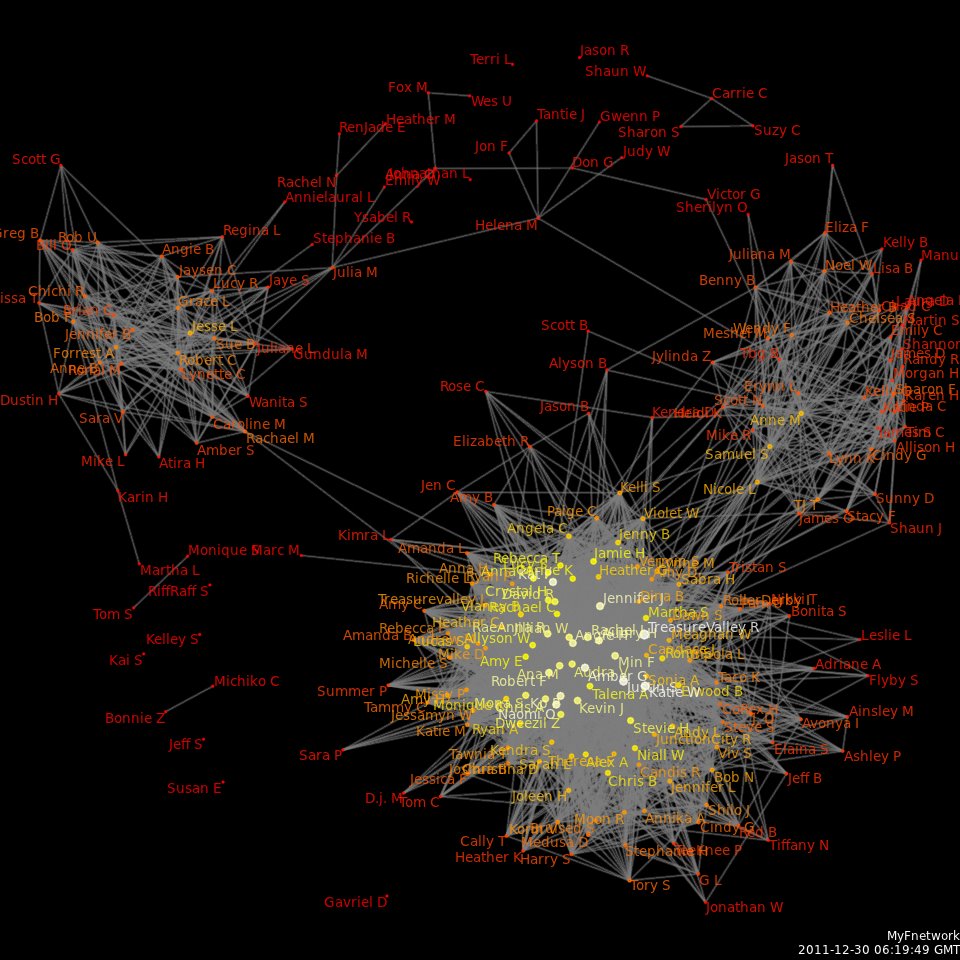
While SNA developed from sociology, its used in other disciplines is increasingly prominent. Perhaps, unsurprisingly to the interdisciplinary nature of some parts of modern academia. Previous attempts at its use in History have included a study of four Anglo-Saxon texts, as well as early eleventh century Holy Roman princes. It has not however been applied to the Variae of Cassiodorus and I will outline later why I think it should be.
To carry out Social Network Analysis, one firstly needs to construct a database, using a program such as Microsoft Excel. There will at least be two sections for this: one for the 'nodes' or individual actors within a network and one for the 'wedges' the connections or lines between people. The nodes section contains 'labels'- these are simply characteristics of individuals. The best way to explain this is by describing the ones I am using to analyse the Variae. For example, I am tracking whether the name of an individual is Gothic or Roman (using two prosopographies as a reference) their gender, location and status or profession. These labels will be important in the final analysis at it allows you to examine the characteristics that define connections within a network. For example, are Romans more connected to other Romans than Goths? Do prominent politicians such as Faustus and Agapitus have a stronger network? Once the database is finished I will import it into a visualisation and metrics software such as Gephi. This is in order to identify patterns and make measurements relevant to the technique. While SNA does not need to be carried out using a computer, it is much easier to use one.
The Variae and Ostrogothic Italy
The Variae and sixth-century Italy are promising for Social Network Analysis for a number of reasons. The letters of Cassiodorus has a large literature of qualitative historiography, however a statistical analysis of them has not yet been undertook. This important as the source has been used to support a range of assumptions, such as that Goths were mainly soldiers and Romans civilians. Patrick Amory's suggestion is that the Variae were used to promote an ideology of civilitas, that Goths and Romans were distinct but harmonious parts of society is one of many arguments based on a qualitative analysis that can be examined using SNA.
This inevitably raises the question in how one should approach the Variae. Thomas Hodgkin, in his valuable 1886 translation of the Variae, treats them as empirical resource into the Ostrogothic chancery, providing exact and mostly accurate information about the running of the kingdom. However, more recent scholarship has tended to emphasise the literary qualities of the Variae more. Shane Bjornlie suggests that Cassiodorus later revised these documents, likely during his stay in Constantinople from 540 until 554 or leading up to it. This a result of the Gothic Wars, was an attempt to rehabilitate the Italian elite and allow them to keep their positions under Justinian by trying to show that they were not serving a 'barbarian' regime under Theodoric.
Although I am carrying out a quantitative analysis, I cannot simply ignore these literary qualities. However, this does not necessarily need to be problematic, the Variae is likely a mixture of data and technique. Bjornlie himself admits this. Therefore, the information I collect can be used for looking at the textual nature of the letters and as a window into the Ostrogothic Kingdom itself. Looking at what defines relationships during Theodoric's reign, with the Variae as a source, will therefore be beneficial in multiple ways.
.jpg/800px-Gesta_Theodorici_-_Flavius_Magnus_Aurelius_Cassiodorus_(c_485_-_c_580).jpg)
Conclusion
Hopefully, this post has served to introduce some of the ideas and concepts that are relevant to my dissertation. It has certainly helped my clarity on the subject to try and write up and explain it. As I build my database more and more, I am already starting to identify patterns more and more and this will be fruitful when I start using the metrics available in Social Network Analysis for my study. I am sure it will be provide an interesting way to look at connections within sixth-century Italy.
Primary Sources:
Social Network Analysis
Social Network Analysis is a methodology used to investigate social relationships within a group. In its simplest terms, looking at how people are connected and what defines those relationships. While visualisation via a graph (such as the example below showing a social media network) forms a key part of SNA, the methodology also comes with a range of metrics to examine a social network. A couple of examples include: centrality (used to measure the importance of an individual) and clustering coefficient (referring to the tendency for cliques or groups to form in a network). SNA is therefore a technique with a rich set of measurements to analyse connections and as Scott points out a well developed history.
While SNA developed from sociology, its used in other disciplines is increasingly prominent. Perhaps, unsurprisingly to the interdisciplinary nature of some parts of modern academia. Previous attempts at its use in History have included a study of four Anglo-Saxon texts, as well as early eleventh century Holy Roman princes. It has not however been applied to the Variae of Cassiodorus and I will outline later why I think it should be.
To carry out Social Network Analysis, one firstly needs to construct a database, using a program such as Microsoft Excel. There will at least be two sections for this: one for the 'nodes' or individual actors within a network and one for the 'wedges' the connections or lines between people. The nodes section contains 'labels'- these are simply characteristics of individuals. The best way to explain this is by describing the ones I am using to analyse the Variae. For example, I am tracking whether the name of an individual is Gothic or Roman (using two prosopographies as a reference) their gender, location and status or profession. These labels will be important in the final analysis at it allows you to examine the characteristics that define connections within a network. For example, are Romans more connected to other Romans than Goths? Do prominent politicians such as Faustus and Agapitus have a stronger network? Once the database is finished I will import it into a visualisation and metrics software such as Gephi. This is in order to identify patterns and make measurements relevant to the technique. While SNA does not need to be carried out using a computer, it is much easier to use one.
The Variae and Ostrogothic Italy
The Variae and sixth-century Italy are promising for Social Network Analysis for a number of reasons. The letters of Cassiodorus has a large literature of qualitative historiography, however a statistical analysis of them has not yet been undertook. This important as the source has been used to support a range of assumptions, such as that Goths were mainly soldiers and Romans civilians. Patrick Amory's suggestion is that the Variae were used to promote an ideology of civilitas, that Goths and Romans were distinct but harmonious parts of society is one of many arguments based on a qualitative analysis that can be examined using SNA.
This inevitably raises the question in how one should approach the Variae. Thomas Hodgkin, in his valuable 1886 translation of the Variae, treats them as empirical resource into the Ostrogothic chancery, providing exact and mostly accurate information about the running of the kingdom. However, more recent scholarship has tended to emphasise the literary qualities of the Variae more. Shane Bjornlie suggests that Cassiodorus later revised these documents, likely during his stay in Constantinople from 540 until 554 or leading up to it. This a result of the Gothic Wars, was an attempt to rehabilitate the Italian elite and allow them to keep their positions under Justinian by trying to show that they were not serving a 'barbarian' regime under Theodoric.
Although I am carrying out a quantitative analysis, I cannot simply ignore these literary qualities. However, this does not necessarily need to be problematic, the Variae is likely a mixture of data and technique. Bjornlie himself admits this. Therefore, the information I collect can be used for looking at the textual nature of the letters and as a window into the Ostrogothic Kingdom itself. Looking at what defines relationships during Theodoric's reign, with the Variae as a source, will therefore be beneficial in multiple ways.
Conclusion
Hopefully, this post has served to introduce some of the ideas and concepts that are relevant to my dissertation. It has certainly helped my clarity on the subject to try and write up and explain it. As I build my database more and more, I am already starting to identify patterns more and more and this will be fruitful when I start using the metrics available in Social Network Analysis for my study. I am sure it will be provide an interesting way to look at connections within sixth-century Italy.
Primary Sources:
Cassiodorus, Variae translated
in The Letters of Cassiodorus: Being A Condensed Translation Of The Variae
Epistolae Of Magnus Aurelius Cassiodorus Senator translated by Thomas
Hodgkin. London:
Henry Frowde, 1886.
Secondary
Sources:
Amory,
Patrick. People and Identity
in Ostrogothic Italy, 489-554. Cambridge; New York: Cambridge
University Press, 1997
Bjornlie,
Shane. Politics and Tradition between Rome, Ravenna and Constantinople:
A Study of Cassiodorus and the Variae, 527-544. Cambridge:
Cambridge University Press, 2013.
The Prosopography of the Later Roman
Empire, Vol 3 edited by Arnold Jones, John Martindale and John Morris.
Cambridge: Cambridge University Press, 1992.
Gramsch,
Robert, Máirín MacCarron,
Pádraig
MacCarron, and Joseph Yose. "Medieval Historical, Hagiographical and
Biographical Networks." In Maths
Meets Myths: Quantitative Approaches to Ancient Narratives, edited by Ralph
Kenna, Máirán MacCarron and Pádraig MacCarron, 45-69. Cham: Springer
International Publishing, 2017.
Scott,
John. Social Network Analysis: A Handbook. 2017 ed. Thousand Oaks,
California: SAGE Publications, 1991.


.png)
