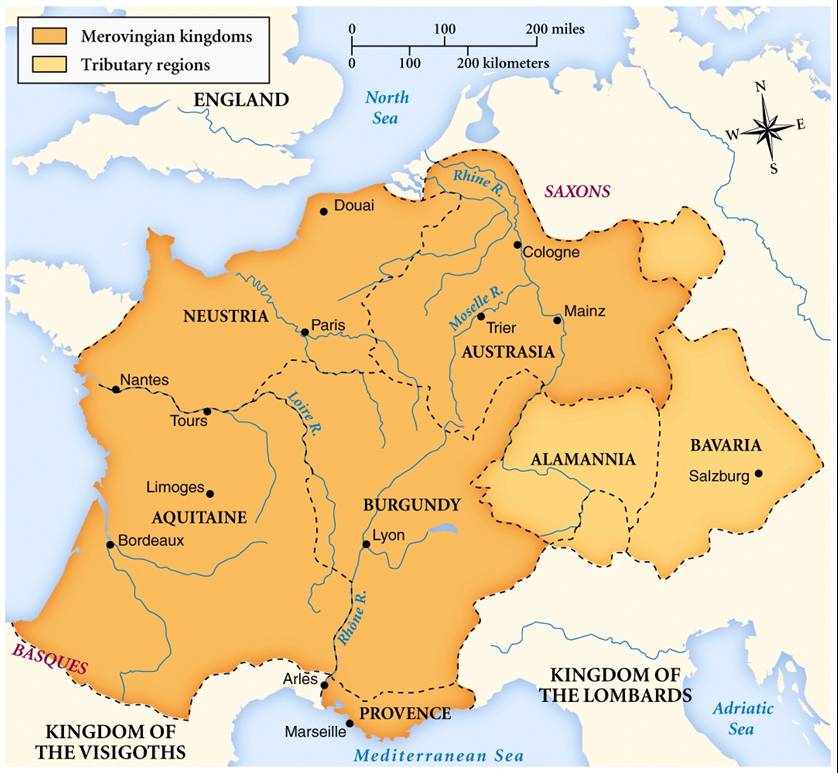
Book II of Gregory of Tours' Ten Books of Histories (also known as the History of the Franks) forms one the main narrative sources for the reign of the late fifth and early sixth century, Frankish King Clovis. Gregory's depiction of him has provoked much discussion. This is inevitable, due to the fact Clovis' reign predated the text by half a century and yet remains our most complete source on him. Furthermore, the historiography on the account have long portrayed it as inaccurate and being influenced by the context of Gregory's wider rhetorical aims regarding faith. Many of these studies have been concerned with finding the 'real' Clovis behind the layers of Gregory's narrative. This can be seen in an article by William Daly which reconstructed Clovis using more contemporary sources, such as the letters of Remigus of Rheims and Avitus of Vienne. These efforts are honourable, but it has meant that Gregory's depiction of Clovis has always been studied with the aim of uncovering facts about its subject. It has not been studied in its own right as written and literary account. This post aims to address these problems by suggesting that the account can also tell us a lot about Gregory and the uneasy position Clovis occupies in his mind, as a key figure in the formation of early Merovingian power and as a convert to Catholicism.
To achieve this, it is first important to explain why the account of Clovis in the Histories have been considered inaccurate. Daly argues that twentieth-century historians of Clovis saw him as barbaric, due to too much reliance on Gregory. According to this viewpoint, Gregory sought to demonise Clovis due to the fact he had been an Arian Christian, rather than Catholic. His portrayal is of a brutal and savage barbarian. Interestingly, Daly's idea of negative discrimination against Clovis in Gregory's account contradicts the judgement made by a number of other scholars. Halsall and Van Dam suggest the portrayal of Clovis in Book II is in fact positive, he is compared to Old Testament Kings. In these instances, Clovis is shown as moral figure. While these approaches all fundamentally agree that Gregory's account is unreliable they differ on what makes this so.
I argue that this is because there are tensions in the Histories regarding Clovis, he is neither fully 'barbaric' nor 'civilised'. He is instead in between these categories, Gregory does not portray him as fully one or the other. This is due to the fact that these definitions or labels are fluid, they contain a set of ideals which can never be fully realised in real or in this case literary form. When writing his account of Clovis, Gregory may be attempting to portray him as one or the other, but he simply cannot due to the openness of the concepts of 'barbarity' and 'civilisation'.

To achieve this, it is first important to explain why the account of Clovis in the Histories have been considered inaccurate. Daly argues that twentieth-century historians of Clovis saw him as barbaric, due to too much reliance on Gregory. According to this viewpoint, Gregory sought to demonise Clovis due to the fact he had been an Arian Christian, rather than Catholic. His portrayal is of a brutal and savage barbarian. Interestingly, Daly's idea of negative discrimination against Clovis in Gregory's account contradicts the judgement made by a number of other scholars. Halsall and Van Dam suggest the portrayal of Clovis in Book II is in fact positive, he is compared to Old Testament Kings. In these instances, Clovis is shown as moral figure. While these approaches all fundamentally agree that Gregory's account is unreliable they differ on what makes this so.
I argue that this is because there are tensions in the Histories regarding Clovis, he is neither fully 'barbaric' nor 'civilised'. He is instead in between these categories, Gregory does not portray him as fully one or the other. This is due to the fact that these definitions or labels are fluid, they contain a set of ideals which can never be fully realised in real or in this case literary form. When writing his account of Clovis, Gregory may be attempting to portray him as one or the other, but he simply cannot due to the openness of the concepts of 'barbarity' and 'civilisation'.
Ninth-century depiction of Clovis' baptism.
Clovis and the Bishop
One such instance can be identified when Gregory describes plundering following the defeat of 'Syagrius, the King of the Romans', a ruler of Roman origin in the north of Gaul ( His II.27). Apparently, 'many churches were plundered by the troops of Clovis, for he still held fast to his pagan idolatries.' The beginning of this episode appears at first to be polemical. Clovis is shown to be carrying out a negative act due to his paganism. However, as the account goes on it becomes more complex.
The soldiers under the command of Clovis stole a large ewer and other works from a Church. The bishop of which sent messengers to the King to beg for its restoration to the Church. Clovis' response is contradictory, it is both pagan and yet at the same time shows respect for the bishop. He states 'Follow me to Soissons, where all the objects which we have seized are to be distributed. If this vessel for which your bishop is asking falls to my share, I will meet his wishes.'
Far from being unashamedly positive or negative, Gregory's account of Clovis seems to have a level of nuance. The King is seen as unwilling to abandon the idea of sharing loot from warfare. This may be the result of the fact that this practice persisted into Gregory's era, while being 'barbaric' in origin, plundering was still important in the sixth-century Merovingian kingdom. Therefore, Clovis' use of it is simultaneously civilised and uncivilised. To Gregory, Clovis' actions are somewhere between these two labels. This can also be seen by the fact that he is willing to give his share back to the Bishop.
A more interesting dynamic opens in the passage as we move on, Clovis demands that he is given above his normal share as King, in order for him to return the ewer. This is unexpected, he is not completely violating tradition, but is demanding an exceptional case because of the need to return the bishop's stolen goods. Only one man opposes this saying that he is shall nothing but his fair share. Clovis later strikes this man down with his axe, upon recognising him on the parade-ground a year later.
The contrast between Clovis and this agitator can also help us understand how Clovis is neither fully barbaric or civilised. The latter is described as 'feckless, fellow, greedy and prompt to anger', matching many of the Classical barbarian stereotypes. Clovis instead shows traits that differ from these, he 'hid his chagrin under a pretence of long-suffering patience'. Clovis is therefore portayed as being more emotionally restrained. However, it is important to note that this was also a pretence and that he struggled to do this, suffering while remaining patient. He shows behaviour which falls between the stereotypes of barbarity and Romaness.
These levels of nuance in the text do not exist because Gregory is an objective reporter, but because they are rather a reflection the uneasy space Clovis occupies in his mind. In fifth-century Gaul there were competing ideas regarding identity that could not easily fall into the binary ideas of 'Roman' and 'barbarian'. Gaul itself still had a strong Gallo-Roman identity. There were competing ideas of kingship: Christian, Roman, Pagan and the symbolic 'Long-Haired' ideology. Clovis himself was an Arian Christian, rather than a Catholic, before his conversion.
My assertion is that when Gregory approaches writing his account of King Clovis, his account is contradictory because labels such as 'Roman' and 'barbarian' are too simplistic to reflect the actual complexity of the era he is writing about. Therefore, while one may argue Gregory's account aims to portray Clovis as barbaric or the opposite - a moral figure, the text itself shows him to be fully neither. Whatever Gregory's intended meaning was, there are ideas in the text that run counter to it, due to the concepts of 'Roman' and 'barbarian' being open and fluid. It is impossible for Gregory to write about Clovis without these contradictions- even if sometimes they are almost unnoticeable.

Leading up to the Conversion
The faith of Clovis is also problematic for Gregory. According to him, Clovis converted directly from paganism to Christianity, when in reality he had already adopted Arianism before his baptism. This has previously been explained as a direct conversion making Clovis look more like an Old Testament king. Ian N.Wood has tried to argue that in the Histories, Clovis' military successes are directly tied to his Catholicism.
However, the Histories also shows tensions regarding this- Clovis is once again neither fully 'barbaric' or 'civilised', with faith having an important role to play in this. This is most apparent leading up to his conversion. Clotild, the wife of Clovis, wanted their first son baptised. However, 'no sooner had he received baptism than he died in his white robes' (His II. 29). Clovis reproaches Clotild for this, saying if he had been born under the pagan gods he [the son] would have survived. This is intriguing, as this seems to directly contradict what you would expect in account by Gregory- the Christian baptism, not a pagan one leads to the child's death.
Further on in this passage, Clovis and Clotild bear a second son, called Chlodomer. He also began to ail once baptised as a Christian, however this time Clotild prayed for the son and he recovered. There seems a contradiction here; Chlodomer starts to die when baptised, but then also recovers through prayer. Two acts of Christian faith seem to have opposite effects. What can explain this?
I argue it originates from Gregory's simplification of religion in the age of Clovis. As mentioned, Clovis is shown as a pagan, when in reality he was an Arian Christian. Religion like 'barbarity' was also fluid in fifth-century Gaul. Gregory is unable to simply use the labels of 'Christian' and 'Pagan' when describing Clovis without tensions arising in the text. Contradictions emerge because while trying to represent Clovis he encounters the difficulty of representing him in such static terms, which do not match the actual openness and fluidity the had in the fifth-century.
After the Conversion
After his conversion to Catholicism, Gregory writes about Clovis' wars. Wood argues this emerges from an attempt to portray Clovis as the champion of Christendom, as seen by his wars a number of Arians within Gaul. Two of these were the brothers Gundobad and Godigisel who ruled over the territory between the Rhône and the Saône. Both 'like their subjects belonged to the Arian sect' (His II, 32). It may come as a suprise then that Clovis decides to ally with one of them.
'Godigisel heard of the victories won by King Clovis' and so 'he sent envoys to him in secret'. Clovis 'gladly accepted the offer'. Clovis in this instance seems quite practical, he is willing to be in alliance with an Arian if it helps him to defeat other heretics. This could have been a temporary, but it nevertheless shows a willingness and flexibility that one might not expect from a moralising text.
Not much later in the text Clovis shows a lesser degree of tolerance: 'I find it hard to go on seeing these Arians occupy a part of Gaul' he states (His II.37). Clovis now wants to take them over 'with God's help'. Once again we face two contradictions in Gregory's portrayal of Clovis, a flexible figure who is willing to ally with an Arian if it suits his current situation and a less tolerant man who wishes to drive all Arians out of Gaul.
Why do these contradictions exist? This is once again because the language of being civilised and uncivilised, of barbarity and belief, is inadequate to deal with the actual actions of Clovis in the account. As argued, these terms are in reality very open and do not have a fixed definition. Gregory's military action here can be seen in both or a mixture of these terms. Therefore, regardless of the way he is trying to portray Clovis- simple or not, Gregory encounters difficulty in doing so without a level of contradiction in the text.
Conclusion
This article has shown that Gregory's account of King Clovis is worth studying beyond its ability to accurately reflect the fifth-century king. While it may have been intended to demonise or moralise Clovis, the account does not show him in such simple terms. It has tensions within in it, Clovis neither appears fully barbaric or civilised. This is because dichotomies such as these are highly problematic and suggest a degree of conformity within the definitions which does not exist. To conclude, Gregory's account is therefore contradictory, as he is unable to express his account of Clovis without being trapped by these closed and simple terms.
Clovis and the Bishop
One such instance can be identified when Gregory describes plundering following the defeat of 'Syagrius, the King of the Romans', a ruler of Roman origin in the north of Gaul ( His II.27). Apparently, 'many churches were plundered by the troops of Clovis, for he still held fast to his pagan idolatries.' The beginning of this episode appears at first to be polemical. Clovis is shown to be carrying out a negative act due to his paganism. However, as the account goes on it becomes more complex.
The soldiers under the command of Clovis stole a large ewer and other works from a Church. The bishop of which sent messengers to the King to beg for its restoration to the Church. Clovis' response is contradictory, it is both pagan and yet at the same time shows respect for the bishop. He states 'Follow me to Soissons, where all the objects which we have seized are to be distributed. If this vessel for which your bishop is asking falls to my share, I will meet his wishes.'
Far from being unashamedly positive or negative, Gregory's account of Clovis seems to have a level of nuance. The King is seen as unwilling to abandon the idea of sharing loot from warfare. This may be the result of the fact that this practice persisted into Gregory's era, while being 'barbaric' in origin, plundering was still important in the sixth-century Merovingian kingdom. Therefore, Clovis' use of it is simultaneously civilised and uncivilised. To Gregory, Clovis' actions are somewhere between these two labels. This can also be seen by the fact that he is willing to give his share back to the Bishop.
A more interesting dynamic opens in the passage as we move on, Clovis demands that he is given above his normal share as King, in order for him to return the ewer. This is unexpected, he is not completely violating tradition, but is demanding an exceptional case because of the need to return the bishop's stolen goods. Only one man opposes this saying that he is shall nothing but his fair share. Clovis later strikes this man down with his axe, upon recognising him on the parade-ground a year later.
The contrast between Clovis and this agitator can also help us understand how Clovis is neither fully barbaric or civilised. The latter is described as 'feckless, fellow, greedy and prompt to anger', matching many of the Classical barbarian stereotypes. Clovis instead shows traits that differ from these, he 'hid his chagrin under a pretence of long-suffering patience'. Clovis is therefore portayed as being more emotionally restrained. However, it is important to note that this was also a pretence and that he struggled to do this, suffering while remaining patient. He shows behaviour which falls between the stereotypes of barbarity and Romaness.
These levels of nuance in the text do not exist because Gregory is an objective reporter, but because they are rather a reflection the uneasy space Clovis occupies in his mind. In fifth-century Gaul there were competing ideas regarding identity that could not easily fall into the binary ideas of 'Roman' and 'barbarian'. Gaul itself still had a strong Gallo-Roman identity. There were competing ideas of kingship: Christian, Roman, Pagan and the symbolic 'Long-Haired' ideology. Clovis himself was an Arian Christian, rather than a Catholic, before his conversion.
My assertion is that when Gregory approaches writing his account of King Clovis, his account is contradictory because labels such as 'Roman' and 'barbarian' are too simplistic to reflect the actual complexity of the era he is writing about. Therefore, while one may argue Gregory's account aims to portray Clovis as barbaric or the opposite - a moral figure, the text itself shows him to be fully neither. Whatever Gregory's intended meaning was, there are ideas in the text that run counter to it, due to the concepts of 'Roman' and 'barbarian' being open and fluid. It is impossible for Gregory to write about Clovis without these contradictions- even if sometimes they are almost unnoticeable.
Leading up to the Conversion
The faith of Clovis is also problematic for Gregory. According to him, Clovis converted directly from paganism to Christianity, when in reality he had already adopted Arianism before his baptism. This has previously been explained as a direct conversion making Clovis look more like an Old Testament king. Ian N.Wood has tried to argue that in the Histories, Clovis' military successes are directly tied to his Catholicism.
However, the Histories also shows tensions regarding this- Clovis is once again neither fully 'barbaric' or 'civilised', with faith having an important role to play in this. This is most apparent leading up to his conversion. Clotild, the wife of Clovis, wanted their first son baptised. However, 'no sooner had he received baptism than he died in his white robes' (His II. 29). Clovis reproaches Clotild for this, saying if he had been born under the pagan gods he [the son] would have survived. This is intriguing, as this seems to directly contradict what you would expect in account by Gregory- the Christian baptism, not a pagan one leads to the child's death.
Further on in this passage, Clovis and Clotild bear a second son, called Chlodomer. He also began to ail once baptised as a Christian, however this time Clotild prayed for the son and he recovered. There seems a contradiction here; Chlodomer starts to die when baptised, but then also recovers through prayer. Two acts of Christian faith seem to have opposite effects. What can explain this?
I argue it originates from Gregory's simplification of religion in the age of Clovis. As mentioned, Clovis is shown as a pagan, when in reality he was an Arian Christian. Religion like 'barbarity' was also fluid in fifth-century Gaul. Gregory is unable to simply use the labels of 'Christian' and 'Pagan' when describing Clovis without tensions arising in the text. Contradictions emerge because while trying to represent Clovis he encounters the difficulty of representing him in such static terms, which do not match the actual openness and fluidity the had in the fifth-century.
After the Conversion
After his conversion to Catholicism, Gregory writes about Clovis' wars. Wood argues this emerges from an attempt to portray Clovis as the champion of Christendom, as seen by his wars a number of Arians within Gaul. Two of these were the brothers Gundobad and Godigisel who ruled over the territory between the Rhône and the Saône. Both 'like their subjects belonged to the Arian sect' (His II, 32). It may come as a suprise then that Clovis decides to ally with one of them.
'Godigisel heard of the victories won by King Clovis' and so 'he sent envoys to him in secret'. Clovis 'gladly accepted the offer'. Clovis in this instance seems quite practical, he is willing to be in alliance with an Arian if it helps him to defeat other heretics. This could have been a temporary, but it nevertheless shows a willingness and flexibility that one might not expect from a moralising text.
Not much later in the text Clovis shows a lesser degree of tolerance: 'I find it hard to go on seeing these Arians occupy a part of Gaul' he states (His II.37). Clovis now wants to take them over 'with God's help'. Once again we face two contradictions in Gregory's portrayal of Clovis, a flexible figure who is willing to ally with an Arian if it suits his current situation and a less tolerant man who wishes to drive all Arians out of Gaul.
Why do these contradictions exist? This is once again because the language of being civilised and uncivilised, of barbarity and belief, is inadequate to deal with the actual actions of Clovis in the account. As argued, these terms are in reality very open and do not have a fixed definition. Gregory's military action here can be seen in both or a mixture of these terms. Therefore, regardless of the way he is trying to portray Clovis- simple or not, Gregory encounters difficulty in doing so without a level of contradiction in the text.
Conclusion
This article has shown that Gregory's account of King Clovis is worth studying beyond its ability to accurately reflect the fifth-century king. While it may have been intended to demonise or moralise Clovis, the account does not show him in such simple terms. It has tensions within in it, Clovis neither appears fully barbaric or civilised. This is because dichotomies such as these are highly problematic and suggest a degree of conformity within the definitions which does not exist. To conclude, Gregory's account is therefore contradictory, as he is unable to express his account of Clovis without being trapped by these closed and simple terms.
Bibliography:
Primary Sources:
Gregory of Tours, Ten
Books of Histories (593-94) translated by Lewis Thorpe in The History of the Franks. London:
Penguin, 1974.
Secondary Sources:
Daly, William M. "Clovis: How Barbaric, How Pagan?". Speculum 69, no. 3 (1994): 619-64.
Halsall, Guy. Barbarian Migrations and The Roman West, 376-568. Cambridge: Cambridge University Press, 2005.
Van Dam, Raymond. "Merovingian Gaul and the Frankish Conquests." In New Cambridge Medieval History, Vol.1, edited by Paul Fouracre, 193-231. Cambridge: Cambridge University Press, 2005.
Wood, Ian N. "Gregory of Tours and Clovis." Revue belge de philologie et d'histoire 63, no. 2 (1985): 249-72.