Showing posts with label History of Islam. Show all posts

Thursday, 17 July 2014

Historical Book Review : Aspects of the Crusades by J.J Saunders

As I enjoy reading History books, I thought it would be a good idea to start to review some of the books I have read. The first book I shall review is J.J Saunders' Aspects of the Crusades. 


.

Introduction

Essentially, the book is a collection of essays regarding, as the title suggests, various aspects of the crusades, many of these aspects not frequently covered and so an interesting read is created. However, it is also short at only 80 pages, with around 60 of these being part of the main content and over 10 of these being notes. Saunders makes a point in the book itself that it is not just from a Western viewpoint and takes into account material regarding the Arab point of view. In order to display the wide range of topics covered to a worthy level, I shall list the chapters below:


  1. The Literature of the Crusades
  2. The Idea of a Holy War
  3. The Role of the Assassins
  4. The Significance of Egypt
  5. The Armenian Ally
  6. The Franks and the Mongols
  7. The Passing of the Near Eastern Civilisation
Positives

Many of the topics covered are interesting, but also it is often difficult to find information on these topics and so the book is indeed enlightening in rarely covered areas. For the common reader, it may be difficult to find material anywhere else in such detail on these 'aspects' and so if you have a particular interest in several or perhaps one of these topics I would strongly recommend it. The book is also highly readable and should not be difficult to swallow, although a basic knowledge of the Crusades is probably required due to the specific nature of the essays. My favourite essays were probably, the ones relating to Egypt, the Assassins, the Armenians and The Franks and the Mongols. In particular, the chapter on the Armenians was very insightful. I must profess that I discovered this book through a sample chapter on the significance of Egypt, which was most helpful  for writing an essay for my AS History course. This sample is legitimately available at http://web.archive.org/web/20110605033053/http://www.deremilitari.org/resources/pdfs/saunders.pdf , as you may have inferred it was this sample that also encouraged me to purchase the full book. I will not spoil the sample chapter's theory on Egypt, as you will be amazed by how significant Egypt was in terms of the Crusades.

Negatives
 
Alas, as with any book some parts do not match the greatness of others, though in this instance I suggest it is down to personal opinion. Although, some of the other chapters are indeed good, they are not as interesting as the others. As I have mentioned this no fault of the author, it is just down to my personal tastes. For some reason, when I bought the book ( having looked at the essay titles beforehand) I thought the essay on The Literature of the Crusades would be somewhat different for some reason ( possibly just expecting information on fiction, such as poetry).

Conclusion

I would thoroughly recommend this book, but I should note that it is not the simplest book to receive. I personally, bought it on AbeBooks and I would suggest it would be very hard if not impossible to gain a new copy of the book. As you may have noticed the image of the book is not to a great standard for a review, this is due to the difficulty of finding an image of the book on the internet. You should also consider that you are buying a very short book, that will probably be second hand, for a price which is quite hefty for the quanitity. In this instance, I would suggest that it is quality not quantity that matters and if you are really interested in purchasing the book, then you should buy it. However, look around for the best price, it was quite a lot cheaper on AbeBooks compared to Amazon, despite both offering only used copies.

Obscure But Important Battles: From Guadalete to Khalkhin Gol

History is full of famous battles, such as Hastings, Waterloo and Poltava, all of importance. However, there are also many battles that are of similar significance that are nowhere near as well known. This post aims to introduce a few of these battles and provoke interest and further research into the battles. By no means will the detail in this post be comprehensive, as the post aims to briefly describe these battles and the impact that they had. Also, the Battle of Ain Jalut, one of the many obscure but important battles, has not been mentioned as it may have a post by itself.

The Battle of Guadalete


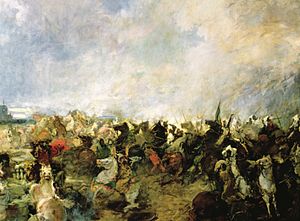
The Battle of Guadalete was fought between Christian Visigoths and an invading force of Muslim Arabs and Berbers on the southern shore of the Iberian Peninsular in 711 AD.  The Visigothic King of Hispania, Roderic was informed of the attack, while he was fighting the Basques, forcing him to march south. Although numbers for the battle vastly differ, one suggestion is that there 33,000 on the Visigothic side and 12,000 on the side of the Umayyads  (Lewis suggests this). The Muslims carried out hit and run attacks while the Visigoths moved en masses (in one body). A cavalry wing that had pledged to betray Roderic did and stood aside, allowing the Muslim cavalry to exploit the break. The Visigoth army was eventually routed and King Roderic was slain. Following this much of Iberia fell under the control of Muslims, with Islam only finally being driven out of Iberia with the end of the Reconquista and the Fall of Granada in 1492, over 780 years later.


The Battle of Molodi


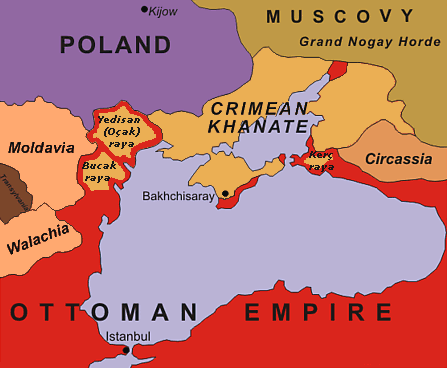
The Battle of Molodi was fought in 1572  between a Russian army and the Crimean Khanate, a vassal of the Ottoman Empire. The Russians had an army of around 60,000-70,000 men led by Prince Mikhail Vorotynsky against an army of about 120,000 lead by Khan Devlet I Giray. The battle was a resounding success for the Russians, as the horde was defeated so badly that the Sultan and the Khan gave up any hope of expanding upwards into Russia, thus preventing Ottoman or Crimean expansion northwards and possibly saving Russia as a whole. The map is of the Crimean Khanate in 1600, after the battle took place.

The Battle of Blenheim


The Battle of Blenheim was a pivotal battle of the War of the Spanish Succession, with the French and Bavarians fighting against multiple forces including those of the Emperor, England and the United Provinces in the year of 1704.Louis XIV had hoped to knock Emperor Leopold out of the war by seizing Vienna and therefore leading to a favourable peace settlement. The defeat of the French was of much importance, ending Louis XIV's hope for a quick victory, maintaining the Grand Alliance and putting Bavaria out of the war. As a turning point in the war, one could argue that if the battle had gone the other way, the Bourbons may have won the war and therefore a French-Spanish nation or union could have been eventually formed.

The Battle of Warsaw


The Battle of Warsaw of 1920, although not part of World War I and World War 2, is still probably one of the most important battles of the 20th century. When Soviet forces invaded Poland in 1920, the Polish army disorderly retreated westwards, with their forces on the verge of disintegration. As Soviet forces approached Warsaw and the nearby Modin Fortress, a Polish counter-attack lead by Józef Piłsudski, disrupted the Soviet offensive and forced them to retreat eastward, in a disorganised manner, across the Neman River. The battle had huge implications, if the Bolsheviks had successfully taken Poland, a Germany weakened by WWI would have also been vulnerable to a Soviet attack and therefore the installation of a Marxist system. This may have eventually resulted in Marxist governments throughout Central and Western Europe, obviously vastly affecting events, such as the possibility of a different or even no World War 2.

The Battle of Khalkhin Gol


The Battle of Khalkin Gol was fought in August 1939, weeks before the start of WW2 and it was fought by the Soviet Union and the People's Republic of Mongolia against the Empire of Japan. It was part of the undeclared Soviet-Japanese border conflicts, which were the result of the Japanese occupations of Korea and Manchuria. After the occupations, the Japanese turned their attention north leading to these conflicts. The battle, a Japanese defeat helped to prevent any further expansion north, dictating policy for WW2. It may also have played a factor in Japanese expansion in the Pacific, as expansion north-west no longer seemed to be an option. The battle was also the first victory for the soon-to-be famous General Georgy Zhukov, winning him his first of four Hero of the Soviet Union awards.

Bibliography:

"Major Battles." Islamic Spain. N.p., n.d. Web. 17 July 2014. <http://www.islamicspain.tv/Andalusi-Society/Major-Battles.htm>.

"Молодинская битва." Молодинская битва. N.p., n.d. Web. 17 July 2014. <http://www.hrono.ru/sobyt/1500sob/1572molod.php>.

The Editors of Encyclopædia Britannica. "Battle of Blenheim (European History)." Encyclopedia Britannica Online. Encyclopedia Britannica, n.d. Web. 17 July 2014. <http://www.britannica.com/EBchecked/topic/69261/Battle-of-Blenheim>.

"Polish-Soviet War: Battle of Warsaw." History Net Where History Comes Alive World US History Online PolishSoviet War Battle of Warsaw Comments. N.p., n.d. Web. 17 July 2014. <http://www.historynet.com/polish-soviet-war-battle-of-warsaw.htm>

"Khalkhin-Gol: The Forgotten Battle That Shaped WW2." History of Russia. N.p., n.d. Web. 17 July 2014. <http://historyofrussia.org/khalkhin-gol-battle-nomonhan/>.

Image Credit goes to Wikipedia


Sunday, 2 February 2014

Enemy at the Gate: The Second Arab Siege of Constantinople

The Second Arab Siege of Constantinople

After the failed Arab Siege of Constantinople (674-678), which the traditional view of events and even actual occurrence has been questioned, the Arabs launched another combined land and sea effort to take the capital of the Byzantine Empire later. This later effort would lead to the Second Arab Siege of Constantinople (717-718). An 80,000 strong army led by Maslama ,brother of Caliph Umar II crossed the Bosporus, while a fleet of around 1,800 ships sailed into the Marmara, south of the city. Emperor Leo III was able to use Constantinople's famed walls to his advantage, as it was. Meanwhile, the fleet failed to sail up the Bosporus, as the Greek fleet harassed it, using Greek Fire.

                                        The Siege depicted in the 14th century Bulgarn translation of  the Manasses Chroncle

The winter of of 717/718 was very harsh, and the Arab land forces were hit hard, due to shortages of supplies. However, Constantinople was supplied via the Black Sea, therefore the winter did not have an as large of an effect on the Byzantines. An Egyptian fleet of around 400 ships and an African fleet of around 360 ships arrived in the spring time and a fresh army started to march through Asia Minor. Many Christian Egyptians in the Arab fleets began to defect to the Byzantines. Furthermore, successive assaults on Constantinople could still not breach the walls. The Bulgarians who had established friendly relations with the Byzantines a year, came to the aid of Constantinople and in July the Arabs were devastated by a Bulgar attack. Contempraries report at least 30,000 Arabs died in the first Bulgarian attack. The attack was likely devastating due to the combination of starvation, disease and being demoralised due to multiple failed assaults on the city.

In August 718 the Arabs were forced to retreat in the face of the Bulgarian onslaught and the lack of successes against the city. Part of the Arab army tried to retreat through Anatolia, whereas the other half attempted to retreat on the remaining Arab vessels. A devastating storm hit the Arab fleet on the way back. All but 5 of the ships were destroyed and the retreating Arab forces on-board the ships were destroyed.

The failure to take Constantinople was a severe blow to Caliph Umar II and the Umayyad Caliphate's general expansion. If the city had fallen it is possible the Byzantine Empire would have disintegrated, opening Europe to Muslim incursions centuries before the Ottoman Empire and while Europe was in turmoil following the fall of Rome. The blow to the Caliphate's might led to Umar II contemplating an evacuation of recent Arab conquests, such as Transoxiana and Hispania and even abandoning the Arab conquests of some Byzantine territory. Although Umar's advisers persuaded him not to take such drastic actions, most Arab garrisons were withdrawn from Byzantine frontier districts. This battle can be compared to the Battle of Tours, as they both helped in halting Islam's expansion into Europe and in establishing Christian dominance on the continent.

Image Credit:
http://en.wikipedia.org/wiki/File:47-cropped-manasses-chronicle.jpg
Sources:
http://www.thelatinlibrary.com/imperialism/notes/constantinoplesiege.html
http://www.byzantium.xronikon.com/battle.php?byzbat=b8_02


Tuesday, 28 January 2014

The Battle of Talas: A Key Event in the History of Paper

The Battle of Talas

The Battle of Talas (751 AD) fought between the Chinese Tang Dynasty and the Abbasid Caliphate had political ramifications for Central Asia, as well as being an important event in the history of technology. It was the capture of Chinese prisoners at the Battle of Talas that lead to the introduction of paper to the Islamic world.Prisoners in Samarkand were ordered to produce paper, and the Muslim expansion into Central Asia allowed the transmission of paper-making technology to the Islamic world. By the year 794 AD paper manufacturing could be found in Baghdad.

                                    A Spring Outing of the Tang Court , Zhang Xuan (713-755)

By the end of the period of the Umayyad Caliphate (661-750) Transoxania ( the ancient name used for the land between the Amu Darya and Syr Darya rivers) was mostly incorporated into the Islamic world. However, it was this expansion that opposed the Chinese and the Abbasids, as China had had presence in these areas of Central Asia since the second century B.C. Furthermore, under the Tang Dynasty's reign, China's  influence in Transoxania itself, had grown. A crisis ensured, when a pro-Tibetan ruler cam to power in the kingdom of Gilgit. (The Tibetans influence in the politics of the region had rapidly increased in the 7th century). In 747 AD the Korean general Kao Hsien-chih campaigned against Gilgit, ending the Tibetans influence over it. Another dispute, this time between the kingdoms of Ferghana and Chach, forced Hsien-chih to respond to Ferghana calling for aid and besiege Chach. He promised to let the King of Chach have safe passage, but then decapitated him. The son of the decapitated King escaped and took word Abu Muslim, the Abbasid governor of Khorasan.

Abu Muslim mustered his forces, added reinforcements from Tukharistan and joined with Ziyadi ibn Salih at Samarkand, where Ziyad tool control of the army. The armies met near the town of Talas, on the Talas River.The number of troops the Arabs had at the battle was not recorded by any side, however it is estimated the Arabs may have had 200,000 men, whereas the Chinese had only  30,000 men, according to the Chinese accounts ( Arab accounts put this at 100,000). The battle lasted for five days, according to Chinese annals, whereas the Arab records are inconclusive relating to its duration. However, all records agree that the battle was a major victory for the Arabs. The Chinese blamed on the Turkish Karluk mercenaries, saying they betrayed them. However, it is argued that it is likely that the Karluks were in fact on the Arabs side from the start.

The importance of this battle is debatable. The battle did weaken the Tang Dynasty and may have contributed to their loss of influence in Central Asia, and therefore the spread of Islam into Asia. However, the decline of the Tang dynasty can not be exclusively blamed on the Battle of Talas. Around this time China was facing trouble from the Tibetans, Uygur Turks in Mongolia and the Khitan people. For example, just  two months before Talas the Khitans defeated the Chinese near Ping-lu in 751. Also, the young kingdom of Nan-chao dealt devastating losses to Chinese force in 754. Therefore, it could be argued the Battle of Talas was not decisive in China's loss of influence in Central Asia, rather it was a cumulation of several threats to the Tang Dynasty that led to this decline.

Sources:
http://www.saudiaramcoworld.com/issue/198205/the.battle.of.talas.htm
Image Credit:
http://en.wikipedia.org/wiki/File:Spring_Outing_of_the_Tang_Court.jpg

Thursday, 12 September 2013

The Battle of Tours: A Quick Look at The Battle that Changed History

The Battle That Changed History


                                                                        Image Credit: http://nobility.org/2011/10/20/battle-of-tours/

The Battle of Tours of 732 (or Poitiers, but not be confused with the battle in 1356) involved Charles Martel leading a force of Merovingian Franks against the Umayyad Caliphate. The Umayyad's had conquered the Iberian Peninsular in the early 700's. They then set out to invade southern France, but were repelled by the Duke of Aquitaine, Odo the Great, at the Battle of Toulouse (721). However, ten years later the Umayyads returned and crushed Odo's forces at the Battle of the River Garonne . Duke Odo looked for aid from Charles Martel. However, Martel only promised aid if Odo submitted to the Franks. Martel knew he had to raise a professional army to defeat the invaders, rather than using conscripts. Martel tried to remain undetected as he marched, so he could choose where to position his forces. He ended up positioning his forces between Tours and Poitiers. Abdul Rahman al Ghafiqi, leader of the Umayyad forces, was shocked when Martel's 30,000 men were positioned in a square on top of  terrain unfavourable for a Umayyad attack. Abdul Rahman' pause for a week while he gathered all his forces (up to 80,000). This pause allowed Martel to gather more veteran infantry at his position. However, a week later the pause ended and Abdul Rahman sent his cavalry into battle.

Martel's infantry held against wave after wave of cavalry. Eventually, the Umayyad cavalry broke through, but Martel was still saved, as his guard repelled the assault. However, the battle changed dramatically when some of Martel's men started to free prisoners in the Umayyad camp. Martel had sent the men out earlier. A large portion of the Umayyad force believed their plunder from the campaign was in danger and so the raced back to try and save it. Abdul Rahman was surrounded and killed by the Franks, when he tried to stop the supposed retreat.The Franks pursued the Umayyads for a short time. The Umayyads fully retreated and as a result they fled the whole of France, back to Iberia.

It seems the battle changed history, in the sense that it halted the advance if Islam into France. However, in 735 the new governor of al-Andalus, 'Uqba b. Al-Hajjaj moved into France to avenge Tours. Up until 739, the governor carried out raids on places such as Lyon, Burgundy and Piedmont. However, Charles Martel saved the day again with two campaigns, one in 736 and 739 . However, the Umayyads were still not defeated yet. But, in 759 Pippin the Short finally expelled the Umayyads out of France after the fall of Narbonne. The aftermath of the Battle of Tours reveals the Battle of France was far from over after Tours. This leads to one final question, did the Battle of Tours change history ? In my opinion, I think if the Umayyad's won the battle,  they would have advanced even further into France and possibly secured some land for a long period. However, the Franks won the Battle of Tours, and so now I shall say my opinion on what historically happened.  I believe, regardless of the Battle of the Tours, the Umayyads could have eventually finished their invasion of France successfully. It was the campaigns that followed that truly ended the Ummayad threat and therefore, in terms of the Umayyad's not winning Tours, I think the battle did change history, but in terms of the Franks winning, the battle did not change history greatly.

Sources: Greatly, 

http://militaryhistory.about.com/od/battleswarsto1000/p/tours.htm


Tuesday, 3 September 2013

The Greatest Ottoman Sieges in History

The Great Sieges

Throughout, history there have been many sieges, some of these have altered the course of history, while others have been on a spectacular scale. Regardless of this, there have been many sieges that can be called great. One empire, the Ottoman Empire, participated in many great sieges. Below is a brief description of some of the greatest sieges the empire participated in.

The Siege of Constantinople (1453)


                                          Image Credit:from http://everyhistory.org/1400constantinople1.html, by Jean Chartier

The siege of Constantinople took place between the attacking Ottoman Empire and the defending Byzantine Empire. The Byzantine, or East Roman, Empire had been declining for centuries and by the time of the siege of 1453 the empire had reduced in size,drastically. There were around 10,000 defenders of the capital of the Byzantine Empire and about 100,000 attackers led by Sultan Mehmed II. The siege began on the 6th April 1453. At the beginning of the siege the Ottomans seized the last few Byzantine strongholds and also heavily bombarded the Byzantine walls for 12 days. However, the Byzantine troops easily defended a breach in their walls. When, Genovosi ships broke through the Ottoman fleet and passed the chain placed across the harbour and resupplied the city. Mehmed II decided he needed control of the Golden Horn. Therefore, Ottoman ships were dragged overland and 30 ships were in the harbour by the 22nd of April. Over the next weeks of the siege the Ottomans launched several assaults on the city, whether by breach, ladder, tower or by  trying to dig tunnels under the walls. However, the Byzantines held. However, on the 29 May 1453 the city finally fell in a final assault, in which Emperor Constantine XII Palaiologos was killed. The city likely fell because the defenders were heavily outnumbered, tired and low on supplies. The siege changed history as it opened Europe up to the Ottoman Empire.

The Siege of Vienna (1529)
                                           
                                                         Image Credit: http://apippas.wordpress.com

Since the Siege of Constantinople (1453) the Ottoman Empire had grown even stronger. In 1529, as it besieged Vienna, the empire reached its height. The Siege marked an end to the rapid expansion of the Ottoman Empire in Europe. In May 1453 the Ottoman Army of  around 120,000 men left Constantinople for Vienna. However, unusual downpours of rain affected the Ottoman march, for example the Ottomans had to leave their heavy cannons behind. However, on September 29th the Ottoman Army reached Vienna.  The Ottomans quickly surrounded the city, but the Holy Roman Emperor,Charles V was away fighting against France. There just over 20,000 men defending the city. Suleiman had obviously expected the city to surrender, which he also wanted, as only then would he get the full treasures of Vienna according to Islamic Marshal Law.  As the rain had prevented the Ottomans from bringing there larger cannons they had to use small ineffective cannons. However, their main use was to incite fear in the populace of Vienna. The Ottomans dug tunnels and tried to place explosives under the walls. However, on the 28th September it rained and the black powder for the explosives was soak. On October the 9th the rain stopped and the Ottoman explosives were detonated. However, the breach was easily defended by the Landsknecht. A final assault on October 14th was easily repelled. The siege marked the beginning of the long decline of the Ottoman Empire, as it would never reach the same heights again.

The Siege of Malta (1565)


                                          Image Credit:http://www.historynotes.info/place-to-visit-malta-804/

On the 18th May 1565 the Ottoman armada arrived at Malta. The Ottomans wanted to gain a foothold in the Mediterranean, to use as a position to use to gain more power. The Ottomans once again had a sizeable army of around 40,000, while the defending Knights Hospitalier only had 600 Knights. However, they did have the support of some mercenaries and some Maltese irregular troops. In total, the defending force summed up to about 8,000 men. Jean Parisot de Valette,Grand Master of the Order of Malta, was in charge of the defenders. The Ottomans began their siege by assaulting the Fort St Elmo, Valette was hoping to hold on until promised relief from Sicily came. However, within a week the fort was nearly reduced to rubble. Despite, Valette still supplying the fort, it eventually was overwhelmed on the 23rd of June. The Ottomans assaulted more and more Maltese positions, but each time they were repelled. Sometimes, the Ottomans nearly won the siege, just to be driven away again. In the beginning of September, the Ottoman commander, Mustafa Pasha, ordered his men to take Mdina. His idea was to go through the winter there. However, on the 8th September the Ottomans had gave up and were preparing to leave the island. But, the day before a relief force of 8,000 men arrived on the island. After much pursuit, the Ottomans left Malta on September 11th.

Sources:

http://www.historytoday.com/tony-rothman/great-siege-malta
http://apippas.wordpress.com
http://everyhistory.org/1400constantinople1.html