When the Soviet Union inherited the lands of the Russian Empire, it also inherited the rich ethnic diversity of its people. Under the Russian Empire the process of Russification was forced upon the differing ethnic groups. In the 1920s and into the 1930s the Soviet Union's policy was actively the opposite of this, Korenizatsiya (also spelled Korenizatsiia), which literally means 'nativisation' or 'indigenisation', aimed to appeal to the masses in the ethnically non-Russian regions of the Soviet Union. There several thought processes and ideas behind this.

An ethnic map of European Russia from before World War 1.
One of the most eminent ideas behind, can be seen in the words of Stalin, who is quoted to have said 'Allow a (disconcerted minority group) to use its native language and the discontent will pass by itself'. Nation-building had been the objective of many of the minorities of the Russian Empire following the collapse of the Russian Empire and the successive Russian Civil War, many of these groups had actively opposed the Bolsheviks during the war. For example, the Democratic Republic of Georgia and the Ukrainian People's Republic actively opposed the Bolsheviks. Korenizatsiya aimed to not only amend this, but also encourage more harmonious relations with the ethnic minorities in the name of the unity of the Soviet Union.
The policy of Korenizatsiya also fitted the Socialist ideal, Lenin and Stalin both persisted that eventually an international culture and language would exist.. The concessions to nationalities could be seen as part of an effort to show that the ethnic minorities were to not be discluded as they had been under the Empire's policy of Russification, which had been a significant part of imperial policy, as such as that seen during the intense period under Alexander III after the Crimean War. An important point is that Stalin himself was an ethnic non-Russian, of Georgian heritage, despite his later reintroduction of Russifying based policy after the period of Korenizatsiya.
Korenitsiya had several key means of implementation. Territories however were built for each officially recognised minority, regardless of their size.The creation of the Soviet Union in 1922 and the ongoing creation of its republics formed a part of this process. Autonomous Soviet Socialist Republics (ASSRs) were often found within Union Republics, for example the Karelian ASSR formed part of the Russian Soviet Federative Republic. Both types of republics were typically based on ethnic lines. Furthermore, although the USSR would become much more centralised, technically each constituent republic part of the was allowed to secede from the union as per the Soviet Constitution.

A key part of Korenizatsiya was linguistics. Each minority was assigned its own national language, whether or not it had previously existed. Extensive cultural and language programmes were rolled out in this language. Minorities were also actively encouraged to take part in government and bureaucracy, with each minority having a degree of local government ruled by themselves. Minorities were also encouraged within in the Communist Party. Books for Russian speaking children informed them of the more distant parts of the Soviet Union and told them about the everyday lives of their 'fellow citizens'. It is important to realise that some of these nations were artificial and did not always align culturally with the actual inhabitants.
We can also seen a distinguishment between certain nations, some were seen as more 'backwards'. A group of children's books went beyond describing exotic nations and actively showed the rapid change in Central Asia caused by the Soviet Union. A common theme was the contrast in the way the 'old way' was portrayed in comparison to the Soviet rule. Now science, technology and equality was present instead of poverty, hardship and inqequality between the classes and genders, according to the books.

Naturally, Korenizatsiya evolved during the period it was in place. The idea itself can be seen as early as 1913, when Lenin sent a young Stalin to Vienna, as capital of the Austro-Hungarian Empire it was culturally diverse. Stalin returned with his ideas for the policy. In 1919 Lenin, following the revolution, managed to persuade officials to reverse the policy of Russification and in 1923 the idea started to become in practice. At the 12th Party Congress in 1923, Stalin identified two major threats to the Soviet nationalities policy, local nationalism and Russian chauvinism against minorities.
It was at the 16th Party Congress in 1930 that Stalin emphasised that the plan was to build a universalised society, with a common language and currency as previously mentioned. The 1936 Constitution finally saw the idea that the states of the Soviet Union now formed a harmonious union to serve one state, Stalin proclaimed that the basis for a socialist society was now born and thus now the Soviet Union was now officially a Socialist state.
However, contrary to this, Stalin also began to reverse the idea of Korenizatsiya in the mid 1930's and followed the policy of Russification like the preceding Russian Empire. Purges saw a large portion of minority officials removed from power. Stalin altered the nations that had existed, in what became Karachay-Cherkessia, Stalin combined Caucasian and Turkic peoples whose languages were mutually unintelligible. But, not only were different peoples combined into fewer republics, Stalin also divided ethnic groups. The former Mongolian Buryat Autonomous Republic was divided into 3: Buryatia, Aga Buryat and Ust' Orda. Stalin also deported large numbers of people from their native territory before and during WW2, such as Volga Germans and the Crimean Tatars.The official reason given was that these various groups were collaborating with the Germans or that they were anti-Soviet rebels.
From 1937 onwards, the press began to praise Russian language and culture. Changes once again took place within education to suit the new Russification. Russian heroes from history were once again glorified. The Soviet Union was re -energised with patriotism, thus it was no suprise that World War II was to be called 'the Great Patriotic War'.

Representatives of Soviet Nationalities in Red Square.
Korenizatsiya was never wholly popular as policy. Although it won over many of those who went against the Bolsheviks on national grounds during the Civil War. Opposition was not only to be found by Russians living within non-Russian areas, but also by people of non-Russian origin who had been Russified. Therefore, although Korenizatsiya did pacify some of those who had initially opposed the socialist ideal of internationalism proposed under the Soviet Union, the idea itself was to be only reversed fully by the head of the Soviet state and one of it's original proponents, Joseph Stalin.
Bibliography:
Image Credit goes to
WikiCommons
http://russiasperiphery.blogs.wm.edu/central-asia/general/korenizatsiia/
http://siberiantimes.com/science/casestudy/news/n0124-scientists-map-the-dna-of-ethnic-groups-in-former-soviet-union/
https://www.lib.uchicago.edu/e/webexhibits/sovietchildrensbooks/nationalities.html
An ethnic map of European Russia from before World War 1.
One of the most eminent ideas behind, can be seen in the words of Stalin, who is quoted to have said 'Allow a (disconcerted minority group) to use its native language and the discontent will pass by itself'. Nation-building had been the objective of many of the minorities of the Russian Empire following the collapse of the Russian Empire and the successive Russian Civil War, many of these groups had actively opposed the Bolsheviks during the war. For example, the Democratic Republic of Georgia and the Ukrainian People's Republic actively opposed the Bolsheviks. Korenizatsiya aimed to not only amend this, but also encourage more harmonious relations with the ethnic minorities in the name of the unity of the Soviet Union.
The policy of Korenizatsiya also fitted the Socialist ideal, Lenin and Stalin both persisted that eventually an international culture and language would exist.. The concessions to nationalities could be seen as part of an effort to show that the ethnic minorities were to not be discluded as they had been under the Empire's policy of Russification, which had been a significant part of imperial policy, as such as that seen during the intense period under Alexander III after the Crimean War. An important point is that Stalin himself was an ethnic non-Russian, of Georgian heritage, despite his later reintroduction of Russifying based policy after the period of Korenizatsiya.
Korenitsiya had several key means of implementation. Territories however were built for each officially recognised minority, regardless of their size.The creation of the Soviet Union in 1922 and the ongoing creation of its republics formed a part of this process. Autonomous Soviet Socialist Republics (ASSRs) were often found within Union Republics, for example the Karelian ASSR formed part of the Russian Soviet Federative Republic. Both types of republics were typically based on ethnic lines. Furthermore, although the USSR would become much more centralised, technically each constituent republic part of the was allowed to secede from the union as per the Soviet Constitution.
A children's book shows changes in agriculture in Central Asia under the Soviet Union.
We can also seen a distinguishment between certain nations, some were seen as more 'backwards'. A group of children's books went beyond describing exotic nations and actively showed the rapid change in Central Asia caused by the Soviet Union. A common theme was the contrast in the way the 'old way' was portrayed in comparison to the Soviet rule. Now science, technology and equality was present instead of poverty, hardship and inqequality between the classes and genders, according to the books.
This military poster which uses Ukrainian language and imagery, showcasing Ukrainisation as a wider part of Korenizatsiya.
Naturally, Korenizatsiya evolved during the period it was in place. The idea itself can be seen as early as 1913, when Lenin sent a young Stalin to Vienna, as capital of the Austro-Hungarian Empire it was culturally diverse. Stalin returned with his ideas for the policy. In 1919 Lenin, following the revolution, managed to persuade officials to reverse the policy of Russification and in 1923 the idea started to become in practice. At the 12th Party Congress in 1923, Stalin identified two major threats to the Soviet nationalities policy, local nationalism and Russian chauvinism against minorities.
It was at the 16th Party Congress in 1930 that Stalin emphasised that the plan was to build a universalised society, with a common language and currency as previously mentioned. The 1936 Constitution finally saw the idea that the states of the Soviet Union now formed a harmonious union to serve one state, Stalin proclaimed that the basis for a socialist society was now born and thus now the Soviet Union was now officially a Socialist state.
However, contrary to this, Stalin also began to reverse the idea of Korenizatsiya in the mid 1930's and followed the policy of Russification like the preceding Russian Empire. Purges saw a large portion of minority officials removed from power. Stalin altered the nations that had existed, in what became Karachay-Cherkessia, Stalin combined Caucasian and Turkic peoples whose languages were mutually unintelligible. But, not only were different peoples combined into fewer republics, Stalin also divided ethnic groups. The former Mongolian Buryat Autonomous Republic was divided into 3: Buryatia, Aga Buryat and Ust' Orda. Stalin also deported large numbers of people from their native territory before and during WW2, such as Volga Germans and the Crimean Tatars.The official reason given was that these various groups were collaborating with the Germans or that they were anti-Soviet rebels.
From 1937 onwards, the press began to praise Russian language and culture. Changes once again took place within education to suit the new Russification. Russian heroes from history were once again glorified. The Soviet Union was re -energised with patriotism, thus it was no suprise that World War II was to be called 'the Great Patriotic War'.
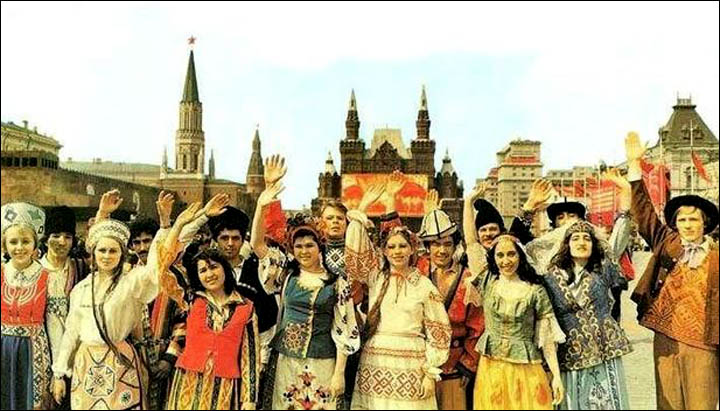
Representatives of Soviet Nationalities in Red Square.
Korenizatsiya was never wholly popular as policy. Although it won over many of those who went against the Bolsheviks on national grounds during the Civil War. Opposition was not only to be found by Russians living within non-Russian areas, but also by people of non-Russian origin who had been Russified. Therefore, although Korenizatsiya did pacify some of those who had initially opposed the socialist ideal of internationalism proposed under the Soviet Union, the idea itself was to be only reversed fully by the head of the Soviet state and one of it's original proponents, Joseph Stalin.
Bibliography:
https://www.lib.uchicago.edu/e/webexhibits/sovietchildrensbooks/nationalities.html
http://www.globalsecurity.org/military/world/russia/cccp-nationalities-stalin.htm
http://www.globalsecurity.org/military/world/russia/cccp-nationalities-lenin.htm
http://www.history.com/this-day-in-history/ussr-established
http://www.inquiriesjournal.com/articles/731/2/the-soviet-nationality-policy-in-central-asia
http://www.globalsecurity.org/military/world/russia/cccp-nationalities-stalin.htm
http://www.globalsecurity.org/military/world/russia/cccp-nationalities-lenin.htm
http://www.history.com/this-day-in-history/ussr-established
http://www.inquiriesjournal.com/articles/731/2/the-soviet-nationality-policy-in-central-asia
Image Credit goes to
WikiCommons
http://russiasperiphery.blogs.wm.edu/central-asia/general/korenizatsiia/
http://siberiantimes.com/science/casestudy/news/n0124-scientists-map-the-dna-of-ethnic-groups-in-former-soviet-union/
https://www.lib.uchicago.edu/e/webexhibits/sovietchildrensbooks/nationalities.html