G.G Astill has identified that studies on urbanism in England between the seventh and ninth century have tended to focus on two aspects in regards to the economy. Firstly, long-distance trade and the quality of goods in the trade network with the second aspect, regional trade, superseding these in more recent studies. This post aims to assess whether it is still possible for any meaningful conclusions to be derived from evidence for long-distance trade in Early Medieval England by focusing on Viking York. Following the conquest of York in 866-867 by the Great Heathen Army a succession of Viking Kings was established. This political rule lasted until the expulsion of Eric Bloodaxe in 954, with periodic interruptions by English reconquests. A range of archaeological evidence suggests that York in this period was well-connected in regards to trade. This post suggests two main problems arise while interpreting it. Firstly, that due to the nature of the evidence speculation plays an important role in making any judgement on long-distance trade. Secondly, that the evidence exists and that despite it being a lot more problematic than evidence for regional trade it cannot be entirely dismissed.


A number of luxury goods have been discovered in excavations in York from the Viking Period. The discovery of silk in the Coppergate dig suggests that townsmen, at least those of a higher standing, were wealthy enough to buy a luxury material. A cap made out of silk also discovered in York seems to further attest to this. The Eastern Roman Empire, was the nearest area which produced a significant amount of silk, however there is no evidence to suggest that it may not have derived from further afield, such as China and India, a possibility considering the Viking’s access to the ‘Silk Road’. It could also be presumed that other luxury goods such as oils and spices may have reached York via its trade connections to Byzantium and Asia. These leave no traces, but as we have evidence of other luxury goods from these areas, it is possible that these could have also been found in Viking York.
Further evidence for York being part of a long distance trade network could be derived from biological archaeology. Within the Coppergate dig one discovery was the a seashell of the cowrie Cypraea pantherina, a species endemic to the Red Sea and the Gulf of Aden, thus implying a visitor in York from this area. The dyeplant club moss was found during the Coppergate Dig, which was also not endemic to York, this is likely to be from Scandinavia or Germany, the location of its natural habitat. Biological evidence in this instance proves that York had numerous foreign visitors or least visitors with overseas contact.
From the evidence shown so far a number of points can be made. Firstly, that some forms of evidence for long-distance trade require more conjecture than others. In terms of luxury goods such as silk we can identify that these goods physically existed in Viking York, but we are left to guess how they got there. Perishable goods may have also been traded, but this cannot be fully proven or disprove. While evidence which is less direct, such as remains of non-endemic animals or plants, may suggest that there may have been travel between distant areas, it does not reveal whether this because of trade or not. Even if trade makes the most sense in terms of travelling in Early Medieval Europe.
 Silk Cap from the Coppergate Dig
Numismatics
Numismatic evidence can perhaps provide more hopeful evidence on the trade of York in the Viking Period. Coins can be useful as evidence as they can not only show the quality of coinage, but also the distance they have circulated. A recurring find in multiple hoards are dirhams from Samarkand, suggesting coinage from Central Asia circulated as far as York. Firstly, 15 of these can be identified in the Vale of York Hoard. Whereas, multiple dirhams were also found in the Bossall Hoard. Furthermore testimony to this is a coin found in the Coppergate dig which bears an inscription in Arabic marking that it was minted for the Arab Caliph Isma’il Ibn Achmad also in Samarkand. These coins appear quite frequently, but are still less apparent than coins originating from England itself. Furthermore, they could say more about the trade power of the Samanids and other parts of the Islamic World than the trade connections of Viking York itself.
A potential meaningful conclusion can be made from comparing the frequency of dirhams in hoards of the Viking period compared to those from periods of English control. Not a single dirham has been found in an English hoard later than the reign of King Athelstan, furthermore following the collapse of the Viking kingdom no dirhams have been identified in any hoards at all. This could suggest long-distance contact with the Islamic World was dependent on Viking control of York. However, this still requires a level of speculation and does not necessarily explain why this was the case.
Numisatics can also tell us more about the prosperity of Viking York. A Carolingian denier which ended production in 877 could correlate with the years leading up to the end of Viking York. Furthermore, the quality of coinage can also tell us a lot about the Viking’s positive influence on York’s economy. The coins of 9th century pre-Viking Northumbria mostly consist of poor quality stycas made of copper. However, after the Viking conquest we see a clear difference in quality. For example, a hoard of coins discovered at Cuerdale on the banks of the River Ribble in Lancashire contains many silver pennies minted in York in the names of the Viking kings Siefred and Cnut. Succeeding these and up until King Athelstan’s temporary reconquest of the city in 927, we also have the ‘St Peter’s Pence’, silver pennies also minted in York. The increased quality of coinage under the Vikings is evident. However, it is difficult to show that whether their political control itself was responsible for the injection of silver bullion into the economy of York or whether or other economic factors played a role.
Conclusion
The debate over whether long-distance trade and how it should be treated in regards to the Early Medieval economy raises an even more important question in regards to historiography and archaeology. The role of conjecture and hypothesis in academia. If we were to take a hard empiricist view with regards to long-distance trade it would be impossible to say anything conclusively apart from the fact that goods and currencies physically existed in York from areas that are geographically distant. However, this in itself is not the sole purpose of any academic enterprise, making wider conclusions always requires interpretation of the evidence available, which is never fully complete. However, this certainly does not gave someone free reign to conjecture without thought. It is clear that in some instances speculation is much more possible than others and this can certainly be said in regards to long distance trade in Viking York. The evidence for it certainly exists, but it is hard to identify any wider patterns due to its scarcity in contrast to the evidence for regional trade. As such, as always it remains important for the scholar to remain aware of the difference between evidence and interpretation, especially when the line between them can be fine.
Primary Sources:
Secondary Sources:
Astill, Grenville. G. "Towns and Town Hierarchies in Saxon England." Oxford Journal of Archaeology 10, no. 1 (1991): 95-117.
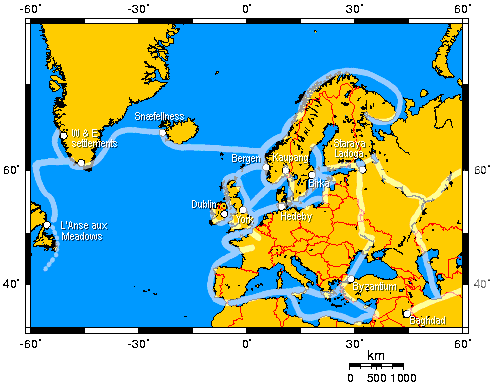
Context
The first barrier to long-distance trade, was naturally the geographic space any physical goods had to travel. This was not necessarily a problem in the context of Early Medieval Europe and the North Sea. Inland waterways in Viking York were highly accessible. Ships such as the Sutton Hoo or Skudelev II type could have accessed the Ouse’s river system as far as York and Ripon, even with modern water levels which are shallower when compared to the levels of the Early Medieval Period due to modern agricultural practices. Therefore, travel to inland areas by boat was not only feasible, but also allowed the Viking rulers of York full access to the economy of maritime trade and therefore helping York grow as economic centre in turn benefitted their own trade routes. Travel distance by ship whether oar or sail-powered in the period of Viking rule was significantly quicker than overland travel. It would have taken five days to reach Jarrow from Bamburgh overland (75 miles apart), yet in the same time it a person could have sailed to Francia from the same place (400 miles apart). Therefore, overseas trade via boat was not only practical, but also more beneficial as it allowed access to a wider range of goods at quicker pace than regional trade.
The possibility of long-distance trade could also be understood in the context of Viking expansion. Kurild-Klitgaard and Svendsen theorise that the Vikings moved from plundering to settling and conquest, due to the eventual decline in income caused by overplundering and the greater potential gains in income from the more sustainability of profit and permanence of settling and conquest. The establishment of more permanent political entities or economic connections has often resulted in talk of Viking trade networks, as shown in the map above. If such a view is to be taken, Viking York could be seen a having been at the centre of a long-distance trade network connecting it as far as Central Asia. Through Scandinavia it would have had access to the furs, slaves, wax and honey from Russia, onwards from this the Vikings had access to the so-called ‘Silk Road’ across the Caspian Sea via the ports of Itil and Gorgan, possibly even granting them access to goods from the Far East.
However, suggesting York was connected to these different ports relies on some assumptions. Firstly, it risks viewing the Vikings as a homogeneous entity or people. This is often still apparent in scholarly literature. However, we cannot simply assume that Vikings in York would have felt any connection to other parts of the Viking world, such as Kievan Rus. The idea of a 'Viking World' itself can be dangerous and can often result in assumptions that distant geographic areas had any economic connections or common feelings. Furthermore, if goods did travel between different areas of Viking influence it is unlikely the trade was direct. Rollason has argued that the dirhams found in York probably originate from Sweden rather than Central Asia, due to the frequency of their discovery in the former. As such if goods from Asia did reach York it was more likely through short, closer and different stages of trade rather than a single movement of goods from one side of the 'Viking World' to another.
Long-Distance Trade
A number of luxury goods have been discovered in excavations in York from the Viking Period. The discovery of silk in the Coppergate dig suggests that townsmen, at least those of a higher standing, were wealthy enough to buy a luxury material. A cap made out of silk also discovered in York seems to further attest to this. The Eastern Roman Empire, was the nearest area which produced a significant amount of silk, however there is no evidence to suggest that it may not have derived from further afield, such as China and India, a possibility considering the Viking’s access to the ‘Silk Road’. It could also be presumed that other luxury goods such as oils and spices may have reached York via its trade connections to Byzantium and Asia. These leave no traces, but as we have evidence of other luxury goods from these areas, it is possible that these could have also been found in Viking York.
Further evidence for York being part of a long distance trade network could be derived from biological archaeology. Within the Coppergate dig one discovery was the a seashell of the cowrie Cypraea pantherina, a species endemic to the Red Sea and the Gulf of Aden, thus implying a visitor in York from this area. The dyeplant club moss was found during the Coppergate Dig, which was also not endemic to York, this is likely to be from Scandinavia or Germany, the location of its natural habitat. Biological evidence in this instance proves that York had numerous foreign visitors or least visitors with overseas contact.
From the evidence shown so far a number of points can be made. Firstly, that some forms of evidence for long-distance trade require more conjecture than others. In terms of luxury goods such as silk we can identify that these goods physically existed in Viking York, but we are left to guess how they got there. Perishable goods may have also been traded, but this cannot be fully proven or disprove. While evidence which is less direct, such as remains of non-endemic animals or plants, may suggest that there may have been travel between distant areas, it does not reveal whether this because of trade or not. Even if trade makes the most sense in terms of travelling in Early Medieval Europe.

Numismatics
Numismatic evidence can perhaps provide more hopeful evidence on the trade of York in the Viking Period. Coins can be useful as evidence as they can not only show the quality of coinage, but also the distance they have circulated. A recurring find in multiple hoards are dirhams from Samarkand, suggesting coinage from Central Asia circulated as far as York. Firstly, 15 of these can be identified in the Vale of York Hoard. Whereas, multiple dirhams were also found in the Bossall Hoard. Furthermore testimony to this is a coin found in the Coppergate dig which bears an inscription in Arabic marking that it was minted for the Arab Caliph Isma’il Ibn Achmad also in Samarkand. These coins appear quite frequently, but are still less apparent than coins originating from England itself. Furthermore, they could say more about the trade power of the Samanids and other parts of the Islamic World than the trade connections of Viking York itself.
A potential meaningful conclusion can be made from comparing the frequency of dirhams in hoards of the Viking period compared to those from periods of English control. Not a single dirham has been found in an English hoard later than the reign of King Athelstan, furthermore following the collapse of the Viking kingdom no dirhams have been identified in any hoards at all. This could suggest long-distance contact with the Islamic World was dependent on Viking control of York. However, this still requires a level of speculation and does not necessarily explain why this was the case.
Numisatics can also tell us more about the prosperity of Viking York. A Carolingian denier which ended production in 877 could correlate with the years leading up to the end of Viking York. Furthermore, the quality of coinage can also tell us a lot about the Viking’s positive influence on York’s economy. The coins of 9th century pre-Viking Northumbria mostly consist of poor quality stycas made of copper. However, after the Viking conquest we see a clear difference in quality. For example, a hoard of coins discovered at Cuerdale on the banks of the River Ribble in Lancashire contains many silver pennies minted in York in the names of the Viking kings Siefred and Cnut. Succeeding these and up until King Athelstan’s temporary reconquest of the city in 927, we also have the ‘St Peter’s Pence’, silver pennies also minted in York. The increased quality of coinage under the Vikings is evident. However, it is difficult to show that whether their political control itself was responsible for the injection of silver bullion into the economy of York or whether or other economic factors played a role.
Conclusion
The debate over whether long-distance trade and how it should be treated in regards to the Early Medieval economy raises an even more important question in regards to historiography and archaeology. The role of conjecture and hypothesis in academia. If we were to take a hard empiricist view with regards to long-distance trade it would be impossible to say anything conclusively apart from the fact that goods and currencies physically existed in York from areas that are geographically distant. However, this in itself is not the sole purpose of any academic enterprise, making wider conclusions always requires interpretation of the evidence available, which is never fully complete. However, this certainly does not gave someone free reign to conjecture without thought. It is clear that in some instances speculation is much more possible than others and this can certainly be said in regards to long distance trade in Viking York. The evidence for it certainly exists, but it is hard to identify any wider patterns due to its scarcity in contrast to the evidence for regional trade. As such, as always it remains important for the scholar to remain aware of the difference between evidence and interpretation, especially when the line between them can be fine.
Bibliography:
Primary Sources:
Carolingian Denier, 840-877 AD, Vale of York, YORYM :
1999.27.
Coins of the Samanid Empire, 899-924 AD, Vale of York, YORYM: 2009.55.679-93.
Silk Cap, 900-950
AD, York, YORYM : 1980.7.8129.
Secondary Sources:
Astill, Grenville. G. "Towns and Town Hierarchies in Saxon England." Oxford Journal of Archaeology 10, no. 1 (1991): 95-117.
Dolley, R.H.M ‘A Neglected But Vital Yorkshire Hoard’, British Numisatic Journal 28, (1955-57):
13-14.
Ferguson, Christopher “Re-evaluating Early Medieval Northumbrian
Contacts and the ‘Coastal Highway,” in Early
Medieval Northumbria: Kingdoms and Communities, AD 450-1100, ed. David Petts and Sam Turner, 283-303. Turnhout:
Brepols Publishers, 2011.
Hall, Alan and Harry Kenward, “Settling people
in their environment: plant and animal remains from Anglo-Scandinavian York” in
Aspects of Anglo-Scandinavian York, 372-426.
York: The Council for British Archaeology, 2004.
Hall, Richard A, D.T
Evans, K.Hunter-Mann and A.J Mainman. Anglo-Scandinavian Occupation at 16-22
Coppergate: Defining a Townscape. York: Council for British Archaeology,
2014.
Hall, Richard. The Excavations at York: The Viking Dig.
London: The Bodley Head, 1985.
Haywood John, The Penguin Historical Atlas of the Vikings.
London: Penguin Group, 1995.
Kurrild-Klitgaard, Peter
and Gert Tinggard Svendsen, “Rational Bandits: Plunder, Public Goods, and the
Vikings.” Public Choice, 117 no. 3/4, Essays
in the Memory of Mancur Olson (2003): 255-272.
Rollason, David. Northumbria, 500-1100: Creation and
Destruction of a Kingdom. Cambridge: Cambridge University Press, 2003.
Image Credit goes to:
Wikicommons
http://www.historyofyork.org.uk/themes/viking/viking-silk-cap
http://www.hurstwic.org/history/articles/daily_living/text/Towns.htm


