Sunday, 2 February 2014

Byzantium's Secret Weapon: Greek Fire

Greek Fire

Throughout its existence, Byzantium faced many foes and challenges, pivotal in helping it to survive was the state weapon Greek Fire. Greek Fire was a sticky liquid flame that was helpful in both land and naval engagements. Methods of deployment vary, however primarily use were tubes which would be used to spray the fire. To enhance the effect of Greek Fire figureheads of animals were placed on ships, such as a lion's head, and it would appear as if they were spewing fire. Other methods of deployment, include a hand-held projector, comparisons could be made to a modern flame-thrower, and grenade-like deployment methods, possibly using a light catapult.
                                                                   Handheld method of deployment.

Though the precise ingredients for Greek Fire are unknown, suggestions for ingredients have included combinations of Pine Resin, naptha, quicklime, sulphur or niter. As the weapon was so powerful and gave them such an edge over their opponents, no foreigner could hope to learn the state secret and its importance also meant that it was a well guarded state secret. It was such a potent weapon, that it still burnt on water. This potency, however, also lead to safety measures for Greek Fire's use. Firstly, men who used the fire in battle, wore fireproof leather armour. Ships and equipment also remained fireproof by using a unique mixture of vinegar, alum and talc. City defences and building also received treatment to remain fireproof.

The origin of Greek Fire, has in some instances been attributed to Kallinikos, an engineer from Syria, which had been conquered by the Muslims. However, it is possible that chemists and alchemists in Constantinople may have discovered the weapon. However, despite it being a potent weapon, Greek Fire was not a super weapon. The Byzantines had to be careful to not burn their own men and the weapon also had a maximum range, and when enemies were used to the weapon, they could simply move around it. Also, the weapon could only be used effectively at sea with a calm sea and with favourable wind conditions. The Muslims also adapted to Greek Fire by protecting their ships by using methods such as felts of hides soaked with vinegar Furthermore, it should not be though it was only Greek Fire that allowed the Eastern Empire to survive so long, many factors contributed to its long survival. However, Greek Fire was certainly helpful in allowing the legacy of Rome, Byzantium, to survive for centuries.

Image Credit:
http://en.wikipedia.org/wiki/File:Hand-siphon_for_Greek_fire,_medieval_illumination_(detail).jpg
Sources:
http://neobyzantium.com/greek-fire-the-byzantine-secret-weapon/


Enemy at the Gate: The Second Arab Siege of Constantinople

The Second Arab Siege of Constantinople

After the failed Arab Siege of Constantinople (674-678), which the traditional view of events and even actual occurrence has been questioned, the Arabs launched another combined land and sea effort to take the capital of the Byzantine Empire later. This later effort would lead to the Second Arab Siege of Constantinople (717-718). An 80,000 strong army led by Maslama ,brother of Caliph Umar II crossed the Bosporus, while a fleet of around 1,800 ships sailed into the Marmara, south of the city. Emperor Leo III was able to use Constantinople's famed walls to his advantage, as it was. Meanwhile, the fleet failed to sail up the Bosporus, as the Greek fleet harassed it, using Greek Fire.

                                        The Siege depicted in the 14th century Bulgarn translation of  the Manasses Chroncle

The winter of of 717/718 was very harsh, and the Arab land forces were hit hard, due to shortages of supplies. However, Constantinople was supplied via the Black Sea, therefore the winter did not have an as large of an effect on the Byzantines. An Egyptian fleet of around 400 ships and an African fleet of around 360 ships arrived in the spring time and a fresh army started to march through Asia Minor. Many Christian Egyptians in the Arab fleets began to defect to the Byzantines. Furthermore, successive assaults on Constantinople could still not breach the walls. The Bulgarians who had established friendly relations with the Byzantines a year, came to the aid of Constantinople and in July the Arabs were devastated by a Bulgar attack. Contempraries report at least 30,000 Arabs died in the first Bulgarian attack. The attack was likely devastating due to the combination of starvation, disease and being demoralised due to multiple failed assaults on the city.

In August 718 the Arabs were forced to retreat in the face of the Bulgarian onslaught and the lack of successes against the city. Part of the Arab army tried to retreat through Anatolia, whereas the other half attempted to retreat on the remaining Arab vessels. A devastating storm hit the Arab fleet on the way back. All but 5 of the ships were destroyed and the retreating Arab forces on-board the ships were destroyed.

The failure to take Constantinople was a severe blow to Caliph Umar II and the Umayyad Caliphate's general expansion. If the city had fallen it is possible the Byzantine Empire would have disintegrated, opening Europe to Muslim incursions centuries before the Ottoman Empire and while Europe was in turmoil following the fall of Rome. The blow to the Caliphate's might led to Umar II contemplating an evacuation of recent Arab conquests, such as Transoxiana and Hispania and even abandoning the Arab conquests of some Byzantine territory. Although Umar's advisers persuaded him not to take such drastic actions, most Arab garrisons were withdrawn from Byzantine frontier districts. This battle can be compared to the Battle of Tours, as they both helped in halting Islam's expansion into Europe and in establishing Christian dominance on the continent.

Image Credit:
http://en.wikipedia.org/wiki/File:47-cropped-manasses-chronicle.jpg
Sources:
http://www.thelatinlibrary.com/imperialism/notes/constantinoplesiege.html
http://www.byzantium.xronikon.com/battle.php?byzbat=b8_02


Tuesday, 28 January 2014

The Battle of Talas: A Key Event in the History of Paper

The Battle of Talas

The Battle of Talas (751 AD) fought between the Chinese Tang Dynasty and the Abbasid Caliphate had political ramifications for Central Asia, as well as being an important event in the history of technology. It was the capture of Chinese prisoners at the Battle of Talas that lead to the introduction of paper to the Islamic world.Prisoners in Samarkand were ordered to produce paper, and the Muslim expansion into Central Asia allowed the transmission of paper-making technology to the Islamic world. By the year 794 AD paper manufacturing could be found in Baghdad.

                                    A Spring Outing of the Tang Court , Zhang Xuan (713-755)

By the end of the period of the Umayyad Caliphate (661-750) Transoxania ( the ancient name used for the land between the Amu Darya and Syr Darya rivers) was mostly incorporated into the Islamic world. However, it was this expansion that opposed the Chinese and the Abbasids, as China had had presence in these areas of Central Asia since the second century B.C. Furthermore, under the Tang Dynasty's reign, China's  influence in Transoxania itself, had grown. A crisis ensured, when a pro-Tibetan ruler cam to power in the kingdom of Gilgit. (The Tibetans influence in the politics of the region had rapidly increased in the 7th century). In 747 AD the Korean general Kao Hsien-chih campaigned against Gilgit, ending the Tibetans influence over it. Another dispute, this time between the kingdoms of Ferghana and Chach, forced Hsien-chih to respond to Ferghana calling for aid and besiege Chach. He promised to let the King of Chach have safe passage, but then decapitated him. The son of the decapitated King escaped and took word Abu Muslim, the Abbasid governor of Khorasan.

Abu Muslim mustered his forces, added reinforcements from Tukharistan and joined with Ziyadi ibn Salih at Samarkand, where Ziyad tool control of the army. The armies met near the town of Talas, on the Talas River.The number of troops the Arabs had at the battle was not recorded by any side, however it is estimated the Arabs may have had 200,000 men, whereas the Chinese had only  30,000 men, according to the Chinese accounts ( Arab accounts put this at 100,000). The battle lasted for five days, according to Chinese annals, whereas the Arab records are inconclusive relating to its duration. However, all records agree that the battle was a major victory for the Arabs. The Chinese blamed on the Turkish Karluk mercenaries, saying they betrayed them. However, it is argued that it is likely that the Karluks were in fact on the Arabs side from the start.

The importance of this battle is debatable. The battle did weaken the Tang Dynasty and may have contributed to their loss of influence in Central Asia, and therefore the spread of Islam into Asia. However, the decline of the Tang dynasty can not be exclusively blamed on the Battle of Talas. Around this time China was facing trouble from the Tibetans, Uygur Turks in Mongolia and the Khitan people. For example, just  two months before Talas the Khitans defeated the Chinese near Ping-lu in 751. Also, the young kingdom of Nan-chao dealt devastating losses to Chinese force in 754. Therefore, it could be argued the Battle of Talas was not decisive in China's loss of influence in Central Asia, rather it was a cumulation of several threats to the Tang Dynasty that led to this decline.

Sources:
http://www.saudiaramcoworld.com/issue/198205/the.battle.of.talas.htm
Image Credit:
http://en.wikipedia.org/wiki/File:Spring_Outing_of_the_Tang_Court.jpg

Friday, 22 November 2013

A Brief Look at The Mystery of Atlantis

The Mystery of Atlantis

Atlantis has evoked mystery within humanity throughout the centuries and though many would deny its existence, the different interpretations of it are worth exploring.Plato mentioned Atlantis in his dialogues Timaeus and Critias wrote around 360 BC. Plato says it was a land and naval power which had conquered most of Western Europe and Africa in the 10th millennium BC and that it was an island in front of the Pillars of Heracles. However, Plato suggests after the Atlanteans invasion of Athens failed the city sank into the ocean, leading to its demise. 

                                         A Map of the Atlantean Empire according to Ignatius L. Donnelly
Ignatius L. Donnelly increased interest in Atlantis with the publication of his book Atlantis: The Antediluvian World. He attempted to establish that all known ancient civilisations descended from Atlantis. He also made other connections suggesting the Great Flood mentioned in the Bible was the flood that destroyed Atlantis.  Many of the books theories have lead to the modern day concepts of Atlantis. Donelly himself thought that Plato's account of Atlantis was largely factual. Donelly also suggests other things about Atlantis, such as that the gods and goddesses of the ancient Greeks, Phoenicians, Hindus and Scandinavians were simply the kings, queens and heroes of Atlantis. Donelly also suggests the acts attributed to them in mythology  are actually a confused recollection of actual historical events.

Of course all this only applies if Atlantis actually existed. After the theory of continental drift became more accepted the popularity of most 'lost continent' theories began to decline. However, a key argument could be the simplistic idea that the concept of Atlantis proves that the myth comes from some fact. Others, may argue that Plato simply came up with it as a metaphor to show the results of greed, corruption and a decline in virtue. However, this may not be necessarily true. But, what is almost certainly true is that Atlantis remains a mystery.

                                                                                                     
Image Credit:
http://en.wikipedia.org/wiki/File:Atlantis_map_1882_crop.jpg
Sources:
http://www.atlantisrevealed.com/main.asp
http://www.bibliotecapleyades.net/atlantida_mu/esp_atlantida_5a.htm


Thursday, 21 November 2013

Societas Draconistrarum: A Brief Look at the Chivalric Order

Societas Draconistrarum

The Order of the Dragon was founded in 1408 by Sigismund I of Hungary (who would later become Holy Roman Emperor) and it was similar to other chivalric orders of the time. Its main purpose was to fight the enemies of Christianity, mainly the Turks. However, its enemies also included heretics. Initially, 21 men were inducted into the order ( there was about 24 in 1418). Sigismund later decided to expand the order and between 1431-1437 a second group of inductees were initiated. As the order became larger it began to have two degrees: a superior one and a larger inferior one. The superior degree had the dragon and the cross as its emblem, whereas the inferior one only had the dragon as its symbol. The order became less prominent after Sigismund's death, but its emblem remained on the coats of arms of several Hungarian noble families. The order had quite a number of important members, such as Henry V of England and Vlad II Dracula.


                                                     A Reconstruction of the Order Patch
Henry V of England , famous for his campaigning in France, was inducted into the Order of the Dragon, in exchange for Sigismund being inducted into the Order of the Garter. These inductions came about when Sigismund visited England in hope of making peace between. England and France. Sigismund's plan was to persuade Henry to change his demands against the French. Throughout, Sigismund's visit Henry lavishly entertained him.

 Henry had even intended to crusade for the Order of the Dragon after he had united the English and French thrones, but he died before his plans were fulfilled. The Treaty of Canterbury (1416) sealed an offensive and defensive alliance against France, between Henry V and Sigismund. This was likely due to Sigismund shift away from France and towards England after Henry V's victory  the Battle of Agincourt (1415).
                                                      Sigismund, who founded the Order


Vlad II Dracul (the father of Vlad III Dracula) received this surname in 1431, after being inducted into the Order of the Dragon. He took on the sobriquet in reference to his induction. 'Dracul' derives from the Latin 'Draco' which means 'The Dragon'. His son Vlad III signed some documents using 'Dracula' which literally means 'Son of Dracul' or 'Son of he who was member of the Order of the Dragon'.

The Order of the Dragon seems rather mysterious in a sense, but it could have just been a simple chivalric order. After all, it there were and are other chivalric orders with similarities. The Order of the Dragon itself was modelled after the Order of St.George to some extent. However, the Order's almost disappearance from history, after a point, makes the Order even more intriguing.

Image Credit:
http://en.wikipedia.org/wiki/File:Dragon_order_insignia.jpg
www.museum.hu 
Sources:
http://www.rodoslovlje.com/medieval_serbia/eng/history-dragon.htm
http://www.ucs.mun.ca/~emiller/dragon.html


Saturday, 2 November 2013

A Brief Summary of The Khmelnytsky Uprising

The Khmelnytsky Uprising


The Khmelnytsky Uprising (1648-57) was a Cossack rebellion in Ukraine, which turned into a war for freedom against the Polish-Lithuanian Commonwealth. The uprising saw the end of Polish influence over the Ukrainians, but soon saw them under the influence of the Russians. The Uprising was also part of the Deluge, a period which saw the golden age of the Commonwealth come to an end. Bohdan Khmelnytsky , who lead the uprising, was born to a noble family and was generally well respected among the Cossacks. But, when Aleksander Koniecpolski, heir to the Hetman’s magnate estate attempted to seize his land and the Polish authorities did not help him, he had to turn to his fellow Cossacks for help.  When he tried to gather support throughout Ukraine he raised the suspicions of the Polish authorities and eventually he was arrested. However, Polkovnyk (Colonel) Mykhalio Krychevsky helped him in his escape. The Cossacks were already close to uprising, as plans to fight the Ottomans had been been cancelled by Sejm (The lower house of the Polish parliament). The Cossacks had been unable to carry out lucrative raids on the Ottomans, due to treaties between the Commonwealth and Ottoman Empire.The plans to fight the Ottomans would have allowed the Cossacks to raid once again, but learning that they could still not due to the Polish Sejm must have angered them a lot.
Bohdan Khmelnytsky
 For the uprising Khmelnytsky , allied with the Khan of Crimea to help him overcome the powerful Polish. On the 25th January 1648 Khmelnytsky arrived at Zaporizhian Sich. He quickly took out the guards and repelled the Commonwealth attempt to retake it, as the Commonwealth tried to retake it more recruits joined him in his cause. The Cossack Rada ( a general Cossack meeting, often military in nature) elected Khmelnytsky Hetman by the end of the month. From this point onward he gained great victories at the Battle of Zhovti Vody, where much of the enemy defected to his cause, and at the Battle of Korsun, at which the Commonwealth's armies were routed. What made matters worse was that the Polish had lost King Władysław IV Vasa, when he died in 1648. Khmelnytsky made demands to the Polish due to his success. However, peasant uprisings turned his uprising into a fight for a autonomous state. However, John II Casimir, was elected King of Poland and he sent a letter to Khmelnytsky granting privileges to the Cossacks and all those of the Orthodox faith. In return, Khmelnytsky was to stop his campaign. However, the hostilities soon resumed and the Cossacks suffered a devastating defeat at the Battle of Berestechko in 1651 (it was also the largest land battle of the century). However, they won a battle, at the Battle of Batoh, a year later. However, the loss of so many casualties at Berestechko was so devastating Khmelnytsky was forced to stay under the Commonwealth's influence or make an alliance with the Russians. In 1654 the Treaty of Pereyslav was signed , which allied the Cossacks with the Russians. The Polish influence had ended, but as time went the Cossacks became more and more intergrated into Russia.

Image Credit:
http://www.encyclopediaofukraine.com

Sources:
http://www.encyclopediaofukraine.com
http://www.encyclopedia.com/doc/1G2-3404900593.html

Thursday, 31 October 2013

Dominium Maris Baltici, Part 3: The Decline of the Swedish Empire

The Decline of the Swedish Empire

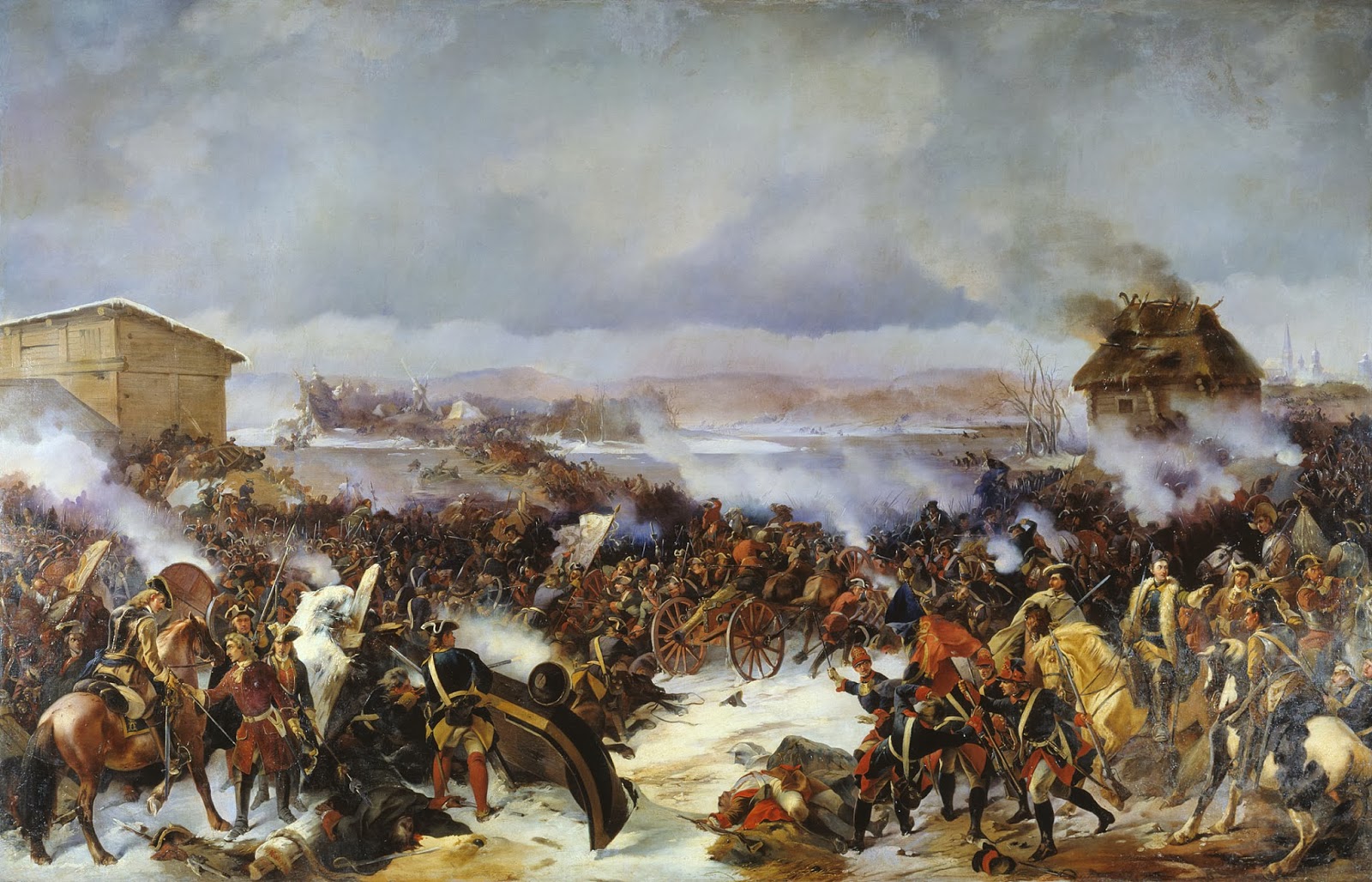
In 1700 the Great Northern War began when an alliance consisting of Denmark-Norway, Saxony-Poland-Lithuania (though Poland-Lithuania was officially neutral at first) and Russia launched an attack on Sweden (The Danish invaded first). The Polish, Danish and Russians had all suffered at the hands of the Swedish Empire, during its age of expansion. King Charles XII of Sweden, aided by the English and Dutch, rapidly forced the Danish into peace with the Peace of Travendal. During, the period when the Swedish and Danish were fighting. Augustus II the Strong of Saxony had invaded Livonia, but when Charles XII moved his army there ( from Denmark) Augustus swiftly withdrew his men. Charles XII then move to engage the Russians in Narva and Ingria. At Narva, Charles would prove that he was a skilled military commander when he attacked the Russian besiegers there. The Swedish had 10,000 men and were almost outnumbered by four to one by the Russians, however Charles XII of Sweden attacked under the cover of a blizzard and effectively split the Russian army in two. The battle was a great success for the Swedish, who only lost 667 men, while the Russians lost nearly 10,000 men. Charles then decided to campaign in Poland and by 1704 Stanislas Leszcznyski became the puppet King of Poland. During 1706, the Russians and Saxons were forced out of Poland and Augustus II recognised Stanislas as King of Poland. After so much success for the Swedish it is hard to see how the war ended with them no longer being a great power, the war's tide was about to change.

The Battle of Narva


While Charles XII had been campaigning in Poland, the Russians had made incursions into the parts of the Baltic controlled by Sweden and established St Petersburg. Charles XII wanted to permanently put an end to Russia being a threat to Sweden and so in 1707 his invasion of Russia began. However, Peter had reformed the Russian army, partially based on the Swedish army which it was about to face. After, winning the Battle of Holowczyn, Charles marched on Moscow, rather then trying to take St Petersburg. However, the Swedish were forced to march to Ukraine as harsh conditions set in. In 1709, the Swedish would face the battle that changed history, Poltava. The Ukrainian Cossacks aided Charles, as they sought independence. However, Charles had been wounded and was in a coma, so he could not lead the Swedish forces. The Russians decisively won the battle and they forced Charles into exile into the Ottoman Empire.

                                                                       Charles XII of Sweden 

Charles XII was unable to return to Sweden and so Sweden's enemies once again proved to be dangerous. The Danish were rebelled, but Russia continued to invade Sweden's Baltic lands and Finland. In Poland, Stanislas fled and Augustus returned. Charles was initially welcomed by the Ottomans and even provoked them into war with Russia. But, his scheming eventually made him into an unwelcome guest and he soon rode across Europe to Straslund, and then later moved on back to Sweden. In 1716 Charles invaded Norway, as part of his plan to attack Denmark. However, he failed to take the Akershus fortress, despite occupying Christiania and he was forced to retreat. He then invaded again and besieged Fredriksten, but once again he was forced to retreat. He lead one final invasion and once again besieged Fredriksten. On the 11th December 1718 Charles was struck in the head by a projectile and killed. It is unknown if he was killed by enemy fire or by one of his own men. The Great Northern War would end in 1721, with Sweden no longer being a great power and Peter the Great proclaiming Russia an empire. The Russian Empire was a great power following the end of the war.

Image Credit:
http://commons.wikimedia.org/wiki/File:Portrait_of_Charles_XII_of_Sweden.jpg
http://en.wikipedia.org/wiki/File:Victory_at_Narva.jpg
Sources: 
Greatly,
http://www.historylearningsite.co.uk/great_northern_war.htm