Tuesday, 22 April 2014

Cola di Rienzo: An Extraordinary Medieval Leader

Cola di Rienzo was born in Rome in 1313. He claimed to be the son of the Holy Roman Emperor, Henry VII. However, his origins were more humble, his father a tavern-keeper and his mother a washer-woman. His early years were spent at Anagni an he devoted his time to the study of the ancient Rome, in the ancient writers of Livy, Valerius Maximus, Cicero, Seneca, Boethius and the poets. This filled him with determination to restore Rome to its former greatness and power, this was only fuelled by his desire to avenge his brother who had been killed by a noble. He returned to Rome as a student at the age of 20 and in 1343 he was sent on an errand to Pope Clement VI at Avignon (it was the time of the Avignon Papacy/ the Babylonian captivity), where he fulfilled his duties with ability and success. He was eventually appointed notary of the Roman civic treasury by the Pope and returned to Rome in 1344. He then began to plot a revolution that would return the city of Rome to its former glory. After, three years of working towards his goal, including by gaining supporters, on the 19th May 1347, heralds invited the people to the Capitol (Capitoline Hill) and on May 20th, Whit-Sunday, the meeting was held, where he was given unlimited power and authority, a few days later Rienzo took the title of tribune.

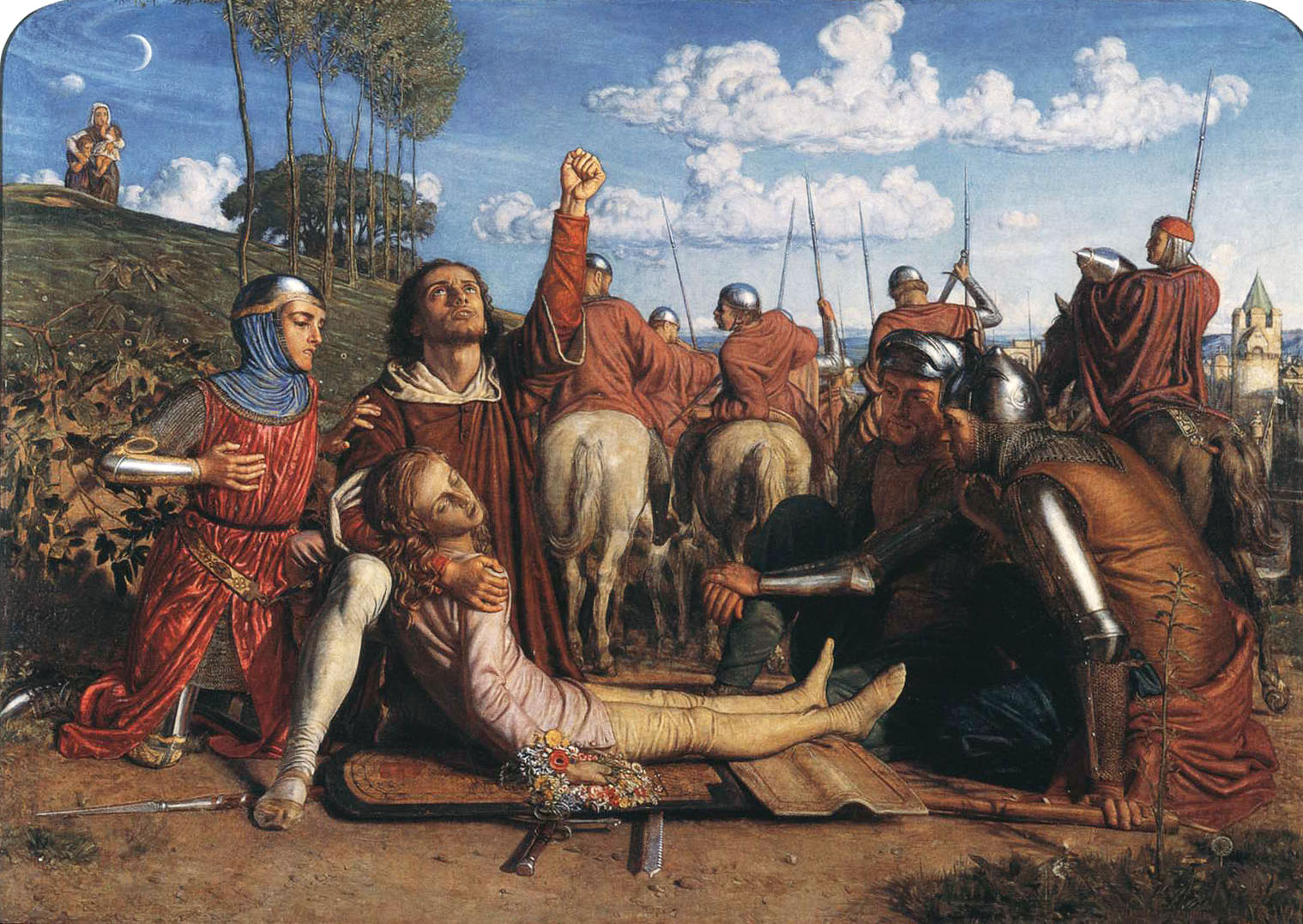
                                       Rienzo vowing to avenge the death of his younger brother

His authority was quickly accepted among most in Rome, his reign was immediately was marked with order and justice, compared to the previous disorder. In July, he proclaimed the sovereignty of the Roman people over the Empire and at first set himself with the task of restoring Rome's authority over the other Italian cities.  On August 1st 1347 he conferred Roman citizenship on all the cities of Italy and and proceeded to prepare for an election of a Roman Emperor of Italy the following year. On the following day the festival of the unity of Italy was celebrated. However, none of this had any political result. However, he was recognised by Joan of Naples, who and her bitter foe the King of Hungary asked for protection and aid. On August 15th he was crowned tribune.

However, his reign was soon to come to an end.. He then  seized and soon released Stefano Colonna and and some other barons. The Pope and the Emperor were both offended by his proposal to set up a new Roman Empire, and in October Clement gave power to a legate to dispose him. The exiled barons soon gathered troops and war began in the neighbourhood of Rome, but with aid from Louis I of Hungary and others, the rebels were defeated on the 20th November 1347. Although, he did not take part directly in the fighting, his most distinguished  foe , Colonna was killed. However, he was eventually declared a criminal, heretic and pagan by the Pope. He fled Rome and abdicated on December 15th 1347, following being terrified by a slight disturbance. He sought refuge in Naples, but quickly left and spent two years in an Italian mountain monastery.

Emerging from solitude, Cola journeyed to Prague in 1350, throwing himself on the protection of the Emperor Charles IV, denouncing the Pope's temporal power. Charles kept him prisoner for a year in the fortress of Raudnitz, then handing him over to Pope Clement. In August 1352, he appeared in Avignon and although he was tried by three cardinals and sentenced to death, the judgement was not carried out. When Clement died in December 1352, he had the chance to gain his freedom, when his successor Innocent VI saw him as a tool to strike at the baronial rulers of Rome. He was appointed the title senator and with a Papal legate he entered Rome in August 1354 and quickly regained his position and power. This term was to be even shorter than his first.

Having besieged the fortress of Palestrina, he returned to Rome where he treacherously seized the mercenary Giovanni Moriale and put him to death. Through this and other cruel and arbitrary acts he quickly lost the favour of the people. On October 8th 1354, Cola addressed some of the aroused people, but the building he was in was set on fire and as he tried to escape he was murdered by the mob.

Bibliography:
The Editors of Encyclopædia Britannica. "Cola Di Rienzo (Italian Leader)."Encyclopedia Britannica Online. Encyclopedia Britannica, n.d. Web. 22 Apr. 2014.
"Cola Di Rienzi." CATHOLIC ENCYCLOPEDIA:. N.p., n.d. Web. 22 Apr. 2014.

Image Credit goes to Wikipedia


Wednesday, 26 March 2014

Anglo-Saxon Kings of England: King Offa

King Offa (born 730) ruled Mercia from 757 until his death in July 796 and was the first known as 'King of the English'. When his cousin Aethelbard was assassinated he seized power during a period of civil war, after defeating Aethelbards' intial successor Beornred. Throughout his reign Mercia became  the most powerful Kingdoms in Anglo-Saxon England, he ruled over  Kent, Sussex, East Anglia and the Midlands. Furthermore, he married his daughters to the Kings of Northumbria and Wessex. He led a successful campaign against the Hestingi. The Anglo-Saxon Chronicle state he fought the inhabitants of Kent in 776 at Otford. Although, it does not state who won the battle it is presumably, the Mercians. There is no evidence for Offas's success over the Kentish until 785. Offa also lead a successful campaign against the West Saxons at Besington in Oxfordshire.

 During Offa's reign the English penny (silver) was introduced. Offa also had diplomatic relations with Charlemagne. The great European leader proposed that one of Offa's daughters marry one of Charlemagne's sons, However, diplomatic relations broke down when Offa also suggested that his son Ecgfrith should marry Charlemagne's daughter Bertha. Charlemagne, outraged, ended contact with Britain and forbid any English ships to dock at his ports. Eventually, diplomatic relations were restored, although they had not improved by the end of 790. Relations between Offa and Pope Adrian I were strong, in 792 he visited Rome itself to strengthen links with the Papacy. He granted the Pope more control over the church, while the Pope allowed the creation of the archbishopric of Lichfield, this temporary change freeing the Mercian Church from the authority of the Archbishop of Canterbury.

Offa was frequently in conflict with the various Welsh Kingdoms, a key result of this was the building of Offa's Dyke. It roughly follows the traditional boundary of England and Wales, running, although not continuously, from the Dee estuary in the north to the river Rye in the south. This frontier barrier (a ditch and bank) ran for 149 miles and is a legacy of the King who ruled a large portion of England..

                                                                         Offa's Dyke


Bibliography:

The Editors of Encyclopædia Britannica. "Offa (Anglo-Saxon King)." Encyclopedia Britannica Online. Encyclopedia Britannica, n.d. Web. 26 Mar. 2014.

"King Offa." King Offa. N.p., n.d. Web. 26 Mar. 2014

"Offa (r. 757-796)." The Official Website of the British Monarchy. N.p., n.d. Web. 26 Mar. 2014.

"Offa's Dyke." Offa's Dyke. N.p., n.d. Web. 26 Mar. 2014

Image credit goes to Wikipedia


Sunday, 2 March 2014

The Shortest War in History: The Anglo-Zanzibar War

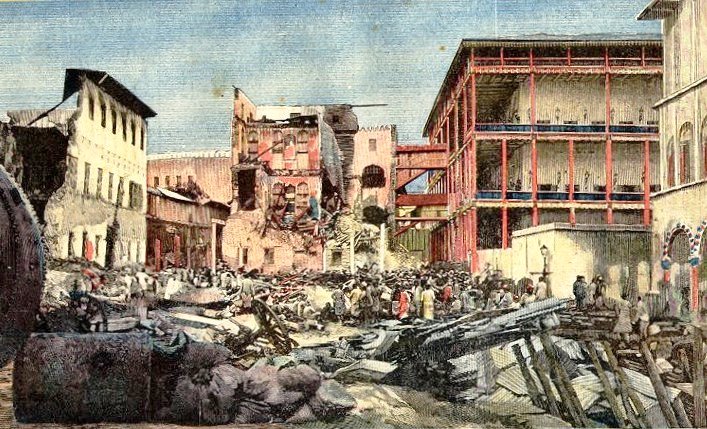
The Shortest War in History

The Anglo-Zanzibar, fought on the 27 August 1896, is thought to be the shortest war in history lasting around only 40 minutes. The war was a result of the death of the pro-British Sultan Hamad bin Thuwaini on the 25th of August. The sultans nephew Khalid bin Bargash seized power in a coup following his death. Bargash assembled 2,800 men to protect his position. The British however favoured Hamud bin Muhammad, who was more pro-British. On August 26th Bargash fortified the palace and. The HHS Glasgow, the Sultan's yacht, was anchored in the harbour nearby. The British quickly assembled five cruisers in the harbour. At 8.00 am on the 27th August an ultimatum was issued to the sultan, to leave the palace in one hour or hostilities would commence. With the situation unresolved, the British led by General Lloyd Matthews, began firing on the palace.

The British ships quickly sank the Glasgow. The sultan's artillery consisted of several Maxim machine guns, a Gatling gun, a 17th-century bronze cannons and 2 twelve-pounder field guns. However, the palace was pounded enough to force Bargash to flee. Bargash sought asylum in the German consulate. The British demanded that the Germans handed over Bargash. However, any international incident was avoided when Bargash escaped to sea on October 2nd 1896. With Bargash removed Hammud bin Muhammad was put into position as ruler, he was mainly a British puppet, who ruled until 1902 and ended slavery in Zanzibar. Bargash was finally captured by the British in 1916.

Image Credit:
http://upload.wikimedia.org/wikipedia/en/8/8a/Zanzibar_palace_after_low.JPG
Sources:
http://militaryhistory.about.com/od/battleswars1800s/p/anglozanzibar.htm
http://news.bbc.co.uk/dna/place-lancashire/plain/A19142282

Wednesday, 26 February 2014

Beowulf and the Battle of the Ice of Lake Vänern

The Battle of the Ice of Lake Vänern

Beowulf was a legendary Geatish hero, who had a Norse epic poem named after, he participated in this battle, which was not only referred to in the poem, but also in the Norse Sagas. The battle was the result of Eanmund and Eadgils, fleeing to Geatland to seek refuge after their father King Ohthere had died and his brother Onela had seized the Swedish throne. Ohthere is thought to have  been the first historical King of Sweden. As, Ohthere's sons had fled to Geatland, Onela attacked the Geats. Beowulf, decided to help Eadgils gain the Swedish throne after the Geatish King Heardred was killed. Originally, Beowulf had been offered kingship over Geatland by Queen Hygd, after King Higlac's death, but he had declined in favour of Heardred. However, now Heardred was dead Beowulf was named King. During the battle, Onela was killed and therefore Eadgils became King of Sweden.

                                                      The first folio of the poem Beowulf
The battle is most likely a historical event, as it is not only mentioned by the 3,000 line long poem, but it is also mentioned in several other Scandinavian sources, such as those of Snorri Sturluson. Beowulf itself is the longest poem in Old English.  During the battle, the combatants have been described as being mounted, however later Anglo-Saxon and Viking told that the legend was fought on foot. Finally, Beowulf is said to have ruled the Geats for 51 years in total.

Image Credit:
http://en.wikipedia.org/wiki/File:Beowulf_Cotton_MS_Vitellius_A_XV_f._132r.jpg
Sources:
http://www.bl.uk/onlinegallery/onlineex/englit/beowulf/

Sunday, 16 February 2014

Greatest Naval Battles

Greatest Naval Battles

Throughout, history there have been many times when man has took their conflicts onto the sea. Many of these battles have certainly had some influence on history and war, whether decisive or not. Below a brief overview of some of the greatest naval battles of all of history shall be given.

The Battle of the Delta                                                                         


Ramesses III and Egypt were in danger from the mysterious Sea Peoples. The Sea Peoples had plundered and destroyed the Hittite Empire's Capital Hattusha and their endeavours were leading to the collapse of the Bronze Age. After defeating them in a land battle in Syria, Ramesses returned to Egypt ready for the Sea People's attack. Ramesses lined the shores of the Nile Delta with archers and lured the Sea Peoples into the Delta, where ships also lay in wait to ambush. Archers from the ships and shore attacked the Sea Peoples, leading to their defeat. The battle (1178 BC or 1175 BC) secured Egypts future from the Sea People.

The Battle of Actium
The Battle of Actium was a decisive battle in the Final War of the Roman Republic, which  resulted in the formation of the Roman Empire and Octavius becoming the first Roman Emperor. When the senate declared war on Egypt, Marc Antony pledged his support to Cleopatra. The fleet loyal to Octavius consisted of  250 galleys, whereas the opposition's consisted of around 290 galleys. The battle (31 BC) ended when Cleopatra pulled her forces out (various reasons have been suggested, for example the tension created by the actual battle- as the Admiral Quintus Dellius, had defected to Octavius and revealed Antony's plans to him.). Antony then soon pulled out himslef, leaving 3/4 of his fleet behind. Regardless, this battle meant many of Antony's men deserted him. Ultimately, leading to his demise, the Roman annexation of Egypt and the first Roman Emperor.
The Battle of Lepanto


In 1571, the Christian powers in the Mediterranean had assembled a fleet to confront the powerful Ottoman Empire. The Holy League fleet included ships from Venice, Spain, Genoa, the Papacy and the Knights of Malta, Savoy, Tuscany and Urbino. The Holy League had 212 ships, whereas the Ottomans had 251 ships. The two flag ships soon found themselves in battle with each other and eventually Ali Pasha's ship was took with the Ottoman commander being killed in the process. Ali Pasha's death (against Don Juan's wishes) reduced the Ottoman's morale (his head was decapitated and ton a pike), eventually causing many of them to flee. The battle helped to stop the Ottoman influence in the Mediterranean growing.

The Battle of Tsushima 


During the Russo-Japanese War, The Russian Baltic fleet was sent to help relieve the blockade of Port Arthur , which the Japanese had besieged. However, on the 2nd January 1905 Port Arthur had fell, so the fleet tried to reach Vladivostok instead. The fleets would engage in the straits of Tsushima, The Russian ships were in poor condition, made even worse by the long journey ( the British had refused them access to the Suez Canal). Fouling had made the Russian ships less manoeuvrable, therefore Admiral Togo used this to his advantage. The Japanese won, losing only 3 torpedo boats (they had had 89 ships,  37 being the relatively small, but dangerous torpedo boats. The Russians lost 21 of their 28 ships. The battle was a humiliation, as a Asian nation had defeated a great European great power and along with the Siege of Port Arthur and the Battle of Mukden, it had ruined Russia's reputation. It could be argued all this parlty helped in causing the 1905 revolution, which boiled tension over into the 1917 revolution, which would forever change Russia's history.

Battle of Jutland

Th battle of Jutland is considered the only major naval engagement of WWI and is considered the largest naval battle ever in terms of tonnage.  In 1916 the British had effectively blockaded much of the German coastline, however. the Admiral von Poul was replaced by the more aggressive Admiral von Scheer.  In May, Scheer had had ordered  Adiral von Hipper to move along the Danish coastline,  Admiral Jellicoe in Rosyth saw this as a provocation and put the Grand Fleet to sea. On May the 31st the battle began. The British lost more ships (14 of 151 combat ships, whereas the German had lost less capital ships- however, in total they lost  11 of their 99 ships). Despite, the German successes they were never in a position during WW1 to threaten the North Sea again.

Image Credit:
http://en.wikipedia.org/wiki/File:Seev%C3%B6lker.jpg
http://en.wikipedia.org/wiki/File:Castro_Battle_of_Actium.jpg
http://zh.wikipedia.org/wiki/%E5%8B%92%E7%8F%AD%E9%99%80%E6%88%B0%E5%BD%B9
http://portsmouthpeacetreaty.org/process/war/images/44-tsushima-battleLg.jpg
http://en.wikipedia.org/wiki/File:HMS_Lion_(1910).jpg
Sources:
http://riversfromeden.wordpress.com/2011/08/11/the-battle-of-the-nile-delta-1178-b-c/
http://ehistory.osu.edu/world/articles/ArticleView.cfm?AID=16
http://militaryhistory.about.com/od/navalbattles14011600/p/lepanto.htm
http://www.navyhistory.org.au/the-battle-of-tsushima-1905/
http://www.historylearningsite.co.uk/battle_of_jutland.htm

Sunday, 2 February 2014

Byzantium's Secret Weapon: Greek Fire

Greek Fire

Throughout its existence, Byzantium faced many foes and challenges, pivotal in helping it to survive was the state weapon Greek Fire. Greek Fire was a sticky liquid flame that was helpful in both land and naval engagements. Methods of deployment vary, however primarily use were tubes which would be used to spray the fire. To enhance the effect of Greek Fire figureheads of animals were placed on ships, such as a lion's head, and it would appear as if they were spewing fire. Other methods of deployment, include a hand-held projector, comparisons could be made to a modern flame-thrower, and grenade-like deployment methods, possibly using a light catapult.
                                                                   Handheld method of deployment.

Though the precise ingredients for Greek Fire are unknown, suggestions for ingredients have included combinations of Pine Resin, naptha, quicklime, sulphur or niter. As the weapon was so powerful and gave them such an edge over their opponents, no foreigner could hope to learn the state secret and its importance also meant that it was a well guarded state secret. It was such a potent weapon, that it still burnt on water. This potency, however, also lead to safety measures for Greek Fire's use. Firstly, men who used the fire in battle, wore fireproof leather armour. Ships and equipment also remained fireproof by using a unique mixture of vinegar, alum and talc. City defences and building also received treatment to remain fireproof.

The origin of Greek Fire, has in some instances been attributed to Kallinikos, an engineer from Syria, which had been conquered by the Muslims. However, it is possible that chemists and alchemists in Constantinople may have discovered the weapon. However, despite it being a potent weapon, Greek Fire was not a super weapon. The Byzantines had to be careful to not burn their own men and the weapon also had a maximum range, and when enemies were used to the weapon, they could simply move around it. Also, the weapon could only be used effectively at sea with a calm sea and with favourable wind conditions. The Muslims also adapted to Greek Fire by protecting their ships by using methods such as felts of hides soaked with vinegar Furthermore, it should not be though it was only Greek Fire that allowed the Eastern Empire to survive so long, many factors contributed to its long survival. However, Greek Fire was certainly helpful in allowing the legacy of Rome, Byzantium, to survive for centuries.

Image Credit:
http://en.wikipedia.org/wiki/File:Hand-siphon_for_Greek_fire,_medieval_illumination_(detail).jpg
Sources:
http://neobyzantium.com/greek-fire-the-byzantine-secret-weapon/


Enemy at the Gate: The Second Arab Siege of Constantinople

The Second Arab Siege of Constantinople

After the failed Arab Siege of Constantinople (674-678), which the traditional view of events and even actual occurrence has been questioned, the Arabs launched another combined land and sea effort to take the capital of the Byzantine Empire later. This later effort would lead to the Second Arab Siege of Constantinople (717-718). An 80,000 strong army led by Maslama ,brother of Caliph Umar II crossed the Bosporus, while a fleet of around 1,800 ships sailed into the Marmara, south of the city. Emperor Leo III was able to use Constantinople's famed walls to his advantage, as it was. Meanwhile, the fleet failed to sail up the Bosporus, as the Greek fleet harassed it, using Greek Fire.

                                        The Siege depicted in the 14th century Bulgarn translation of  the Manasses Chroncle

The winter of of 717/718 was very harsh, and the Arab land forces were hit hard, due to shortages of supplies. However, Constantinople was supplied via the Black Sea, therefore the winter did not have an as large of an effect on the Byzantines. An Egyptian fleet of around 400 ships and an African fleet of around 360 ships arrived in the spring time and a fresh army started to march through Asia Minor. Many Christian Egyptians in the Arab fleets began to defect to the Byzantines. Furthermore, successive assaults on Constantinople could still not breach the walls. The Bulgarians who had established friendly relations with the Byzantines a year, came to the aid of Constantinople and in July the Arabs were devastated by a Bulgar attack. Contempraries report at least 30,000 Arabs died in the first Bulgarian attack. The attack was likely devastating due to the combination of starvation, disease and being demoralised due to multiple failed assaults on the city.

In August 718 the Arabs were forced to retreat in the face of the Bulgarian onslaught and the lack of successes against the city. Part of the Arab army tried to retreat through Anatolia, whereas the other half attempted to retreat on the remaining Arab vessels. A devastating storm hit the Arab fleet on the way back. All but 5 of the ships were destroyed and the retreating Arab forces on-board the ships were destroyed.

The failure to take Constantinople was a severe blow to Caliph Umar II and the Umayyad Caliphate's general expansion. If the city had fallen it is possible the Byzantine Empire would have disintegrated, opening Europe to Muslim incursions centuries before the Ottoman Empire and while Europe was in turmoil following the fall of Rome. The blow to the Caliphate's might led to Umar II contemplating an evacuation of recent Arab conquests, such as Transoxiana and Hispania and even abandoning the Arab conquests of some Byzantine territory. Although Umar's advisers persuaded him not to take such drastic actions, most Arab garrisons were withdrawn from Byzantine frontier districts. This battle can be compared to the Battle of Tours, as they both helped in halting Islam's expansion into Europe and in establishing Christian dominance on the continent.

Image Credit:
http://en.wikipedia.org/wiki/File:47-cropped-manasses-chronicle.jpg
Sources:
http://www.thelatinlibrary.com/imperialism/notes/constantinoplesiege.html
http://www.byzantium.xronikon.com/battle.php?byzbat=b8_02