Friday, 20 June 2014

The Battle of Lechfeld: Europe saved from the Hungarians

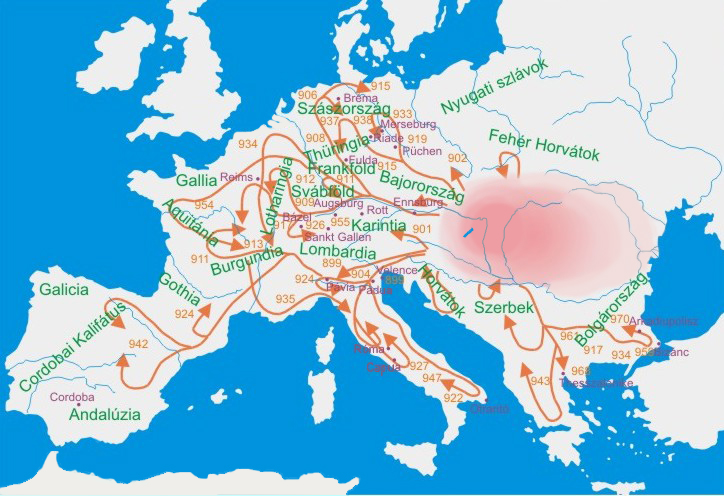
The Hungarian (or Magyar) invasions of Europe took place in the ninth and tenth centuries, at a time when Europe was experiencing attacks from not only the Magyars, but also the Vikings and the Arabs. The Magyar invasions had caused much devastation throughout Europe, reaching as far as the modern-day Spain. However , the Magyars power and raiding would be finally checked at the Battle of Lechfeld in August 955.

                                                       Magyar raids in the 10th century

In 936, Otto I was crowned King of the East Franks and Saxons, he considered himself as the successor to Charlemagne. But, in 1953 Otto's son Liudolf and Conrad, the son-in-law of Otto rebelled. The rebels asked for the help of the Magyars, who invaded Bavaria in 954, this campaign was a huge financial success for the Magyars and so another army tried to repeat it the next year. The Magyars established an encampment on the eastern side of the River Lech and several raiding parties set out to pillage the surrounding countryside. The Magyars also besieged the city of Augsburg, having an army of around 6000 to 8000 men. On August 8th 955, Berchtold, the Lord of Risinesburg warned the Magyars of Otto's approaching army of around 3500 men. The Magyars lifted the siege of Augsburg and prepared a plan based on a victory in 910 when the Magyars destroyed the army of Louis the Child at Lechfeld. However, the arrival of Conrad, the exiled Duke of Lotharingia, the son-in law of Otto, who had previously asked the Magyars for aid, to support Otto was heartening. Conrad would later lose his life during this conflict.

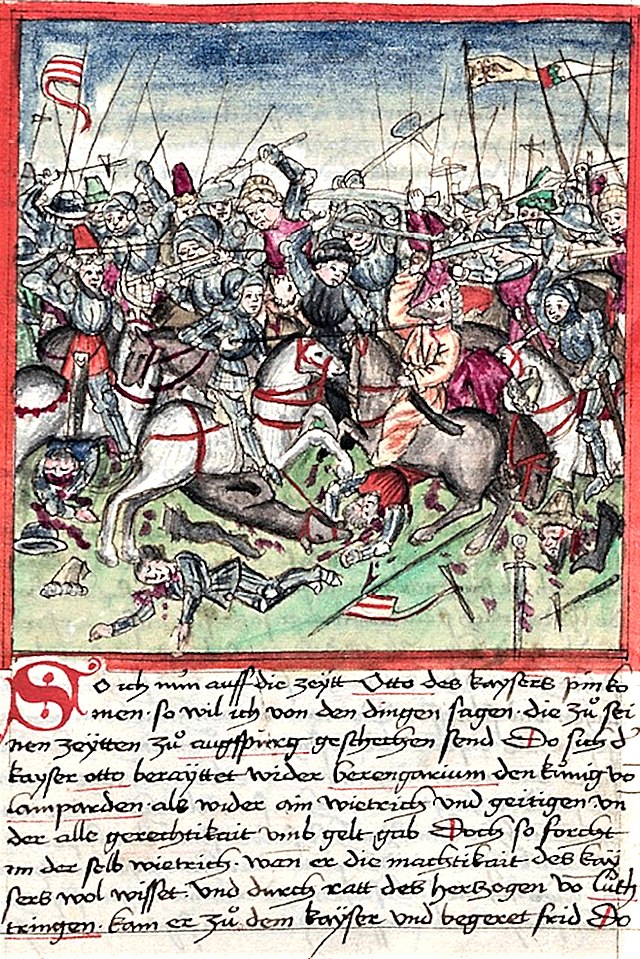
And so the battle began.The Hungarians crossed the river and immediately attacked the Bohemians and later the Swabian legions, but they later retreated after a short fight. When Otto learned of this attack, he ordered Conrad to recover the baggage train. Conrad succeeded and returned to the main army, this was when Otto decided it was time to attack the Hungarians. Otto's army smashed into the Magyar line, despite a volley of arrows being fired at them. Otto's army was able to engage the Hungarians in hand-to-hand combat, thus allowing no room for the nomads favoured shoot and run tactics.  Bulcsú, one of the Hungarian leaders, feigned a retreat, with part of his forces, in order to try and lure Otto's men into pursuit, so they would break their line. However, this failed and the Otto's men remained in formation and routed the Magyars. A pursuit of the Magyars followed for several days. On their return, the Hungarian Chieftains  Lél, Bulcsú and Sur were executed. Conrad was killed when he opened up his vest due to the summer heat, as a arrow struck his throat.


                       The Battle of Lechfeld as depicted in Sigmund Meisterlin's codex about the history of Nuremberg

The battle had several important outcomes, as it somewhat hindered Magyar dominance, helping to bring an end to almost 100 years of raids. After 955, the Magyars ceased all raids towards the West. However, its main significance probably lies in the German lords raising Otto in their shields, in the traditional Germanic manner and proclaiming emperor. A few years later, built on the strength on this, Otto travelled to Rome and had himself crowned Holy Roman Emperor by Pope John XII. The battle has also been viewed as a symbolic victory for knightly cavalry, which would define European warfare in the High Middle Ages, over the light, nomadic cavalry, which had characterised warfare in Central and Eastern Europe during the Early Middle Ages.

Bibliography:

"The Battle of Lechfeld." - All Empires. N.p., n.d. Web. 20 June 2014.

Cavendish, Richard. "The Battle of Lechfeld." History Today. N.p., n.d. Web. 20 June 2014.
Image credit goes to Wikipedia


,
Sunday, 8 June 2014

Edgar the Atheling, Part 3: After the Struggle with William

Edgar the Atheling was now a subject of William the Conqueror and in 1081 he accompanied him on expedition into South Wales. However, in 1085, disappointed with respect and recompense he had received from William, Edgar asked the King for permission to leave for the Norman lands in southern Italy and Sicily, with a retinue of 200 knights. It is likely that this expedition was unsuccessful as Edgar returned to England within a few years. However, in 1087 William died and although Edgar attended William Rufus' coronation, Edgar supported Robert Curthose, the eldest son of William, in his dispute with William II. However, Robert Curthose's war ended in failure in 1091 and as part of the settlement between the brothers, Edgar was deprived of lands given to him by Edgar, presumably in Normandy. Edgar once again returned to Malcolm in Scotland who was preparing to wage war against Rufus. However, the two Kings decided to negotiate instead of fighting and Edgar represented Malcolm, while Curthose represented William, who he had been reconciled with. With the resulting agreement there was a reconciliation between Edgar and Rufus, however Robert Curthose soon left for Normandy, discontent with William's failure to fulfil the pact between them. Edgar the Atheling left with Curthose, but once again returned to England and in 1093 Edgar was sent on a diplomatic mission for William to negotiate with Malcolm. The King of Scotland was dissatisfied with William's failure to fulfil the terms agreed upon in 1091. However, the dispute lead to war, when Malcolm invaded Northumbria, he was killed at the Battle of Alnwick. Donald III succeeded Malcolm as King of Scotland, he drove out the English and French retainers who had grown powerful under Malcolm's reign (and so some of the local aristocracy was jealous of them). This lead Scotland into another conflict with the King of England. William helped Malcolm's eldest son Duncan gain the throne of Scotland, Duncan had spent many years as a prisoner of William's father, but when he gained freedom from William II  he decided to stay at William II's court. However, Donald soon regained the Scottish throne and Duncan was killed after only reigning for 7 months.
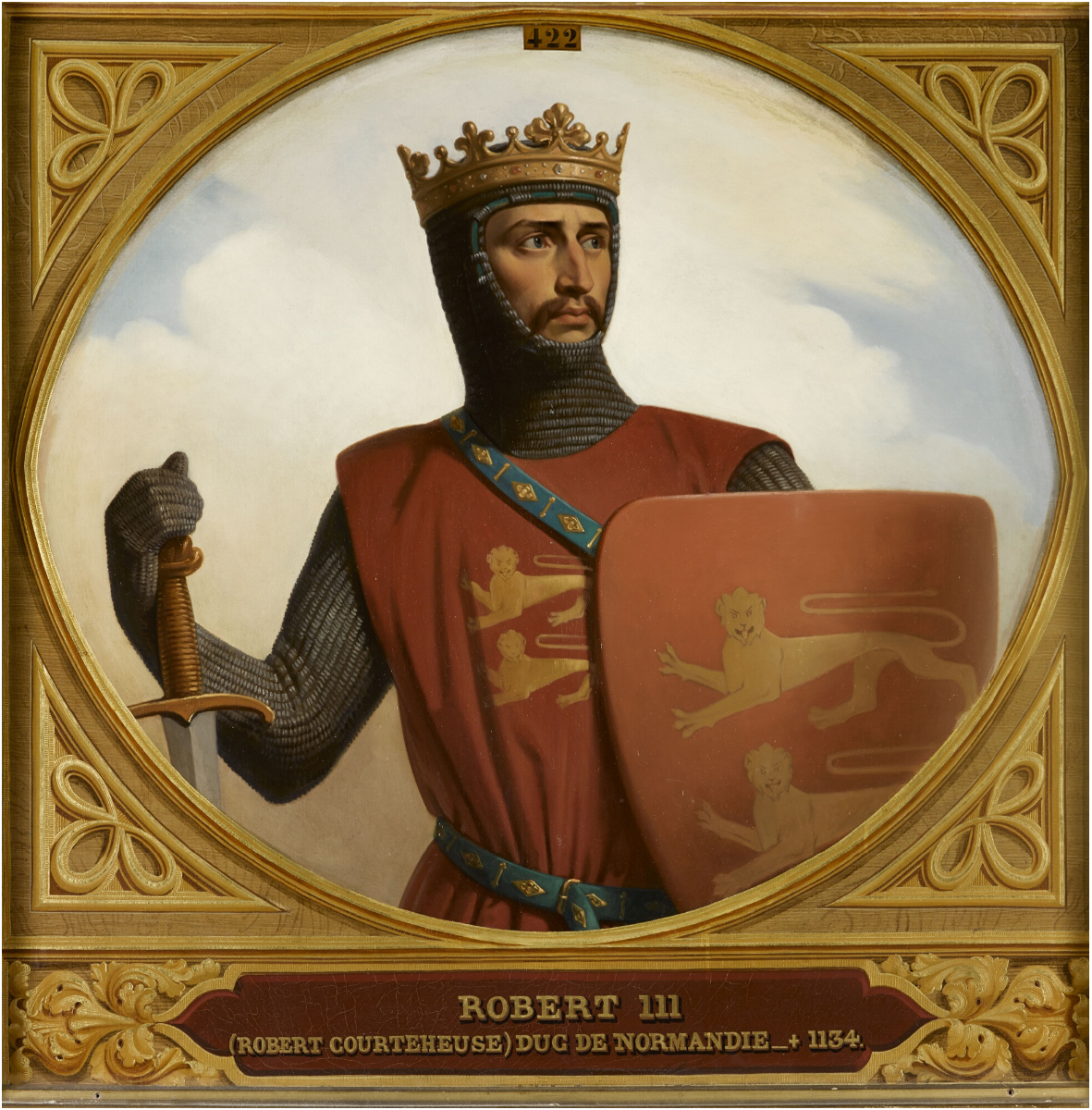
                                                                      Robert Curthose

In 1097, another expedition was sent to Scotland, with the interest of restoring Anglo-Norman influence once more, Edgar the Atheling lead the invading army, ousting Donald out as King of Scotland. Edgar, the nephew of Edgar the Atheling and son of Malcolm and Margaret was installed as King of Scotland. It is possible that Edgar the Atheling went on the First Crusade, after all Robert Curthose was one of the prominent figures on the First Crusade. However, it is unknown if Edgar was actually at any point with Robert on the crusade. Orderic tells that Edgar was the commander of a English fleet off the coast of Syria that was aiding the crusade, however this fleet is known to have arrived of the Syrian coast by March 1098, and had invaded Scotland in late 1097. This means it would have been almost impossible for Edgar to make the voyage in time, however Edgar could have joined the voyage on its way, in the Mediterranean. However, William of Malmesbury writes that Edgar went on pilgrimage to Jerusalem in 1102, so Orderic may have been confused with this later expedition. Some historians think Edgar may have served in the Varangian Guard of the Byzantine Empire at around this time, which was mainly composed of English exiles at this point, but evidence does not support this. Malmesbury states that when Edgar was on his way back from Jerusalem, he was given rich gifts by the Holy Roman and Byzantine Emperors, who offered him an honoured place at their courts. However, Edgar refused and returned back home.


                                               A 15th century potrayal of the Battle of Tinchebray

Edgar once again decided to take part in the internal struggles of the Norman dynasty, siding with Robert Curthose against Henry I of England (Curthose's youngest brother). However, Robert was defeated at the Battle of Tinchebray, resulting in him being imprisoned for the rest of his life. Edgar, however, was pardoned by Henry. His niece Edith (renamed Matilda), the daughter of Malcolm and Margaret had married Henry in 1100. Edgar is believed to have travelled at least one more time to Scotland, possibly around 1120. Edgar lived to see the  death of William Adeling, Henry's son and heir, from Margaret, at sea in November 1120. According to William of Malmesbury, who was writing at the time, Edgar was still alive in 1125, and the general consensus that he died then soon after, the location of his grave is unknown. However, there are two curious references to a 'Edgar Adeling' in the Magnus Rotulus Pipae Northumberland (pipe rolls) for the years 1158 and 1167. This could either be the same Edgar, aged around 110 years (though this is unlikely) or it could be a son or someone else known by this name. Howver, Edgar is not known to have ever been married or to have had any children.

Bibliography:

The Ayling Story | Edgar Atheling." The Ayling Story. N.p., n.d. Web. 8 June 2014

.Binns, Stewart. "Stewart Binns on Edgar the Atheling." Historical Novel Society RSS. N.p., n.d. Web. 8 June 2014.


"The House Of Wessex." English Monarchs. N.p., n.d. Web. 08 June 2014.

image Credit goes to Wikipedia


Thursday, 29 May 2014

Edgar the Atheling, Part 2: Enemy of William the Conqueror

With the death of Harold Godwinson following the Battle of Hastings, the Witan assembled in London and nominated Edgar king. Both Stigand, Archbishop of Canterbury and Ealdred of York, as well as the two brother earls, Edwin and Morcar (of Mercia and Northumberland, respectively) were there in London  However, as William approached London, Edgar's support started to disappear, with Stigand, Archbishop of Canterbury submitting at Wallingford. With the Conqueror getting ever closer to London, the members of the Witan still in London began negotiations with William, resulting in Edgar being handed over to William at Berkhamsted. Edgar and other English leaders went to William's court in Normandy in 1067. However, when they returned to England, he fled and his mother and sisters fled to the court of Malcolm Canmore III in Scotland. Margaret, a sister of Edgar, (who would become St Margaret) was married to the Scottish King. Malcolm promised to help Edgar gain the English throne. Edgar may have been involved in the failed rebellion of Edwin and Morcar in 1068, but with the Northern Rebellion in early 1069, William's reign over England was indeed threatened.

                                              Victorian depiction of Malcolm and Margaret

When rebellion broke out in Northumberland, Edgar along with other exile rebels, headed back to England from Scotland. Edgar was became the leader or at least the figurehead of the revolt. The rebellion was initially successful, but it was eventually defeated by William at York, causing Edgar once more to return to Scotland (the Anglo-Saxon Chronicle suggests these events happened in 1068, others 1069). In late summer ( most likely, in 1069) a Danish fleet set by Sweyn Estridsson arrived and some more rebellions were sparked. Edgar and some other exiles sailed to the Humber, where they met up with some Northumbrian  rebels and the Danes. They defeated the Normans at York and for a short time took control of Northumbria. However, a small seaborne raid led by Edgar into Lindsey ended in a disaster and he only escaped to with a few followers to rejoin the main army. William then marched into Northumbria and seized York, he bought off the Danes and then devastated the surrounding countryside and also eventually as far as north as the Tees (the notorious Harrying of the North). William, in 1070, took action against and defeated Edgar and some of his followers in a marshy region (perhaps, Holderness) forcing the Atheling once more to flee to Scotland. Edgar remained in Scotland until 1072, however when William invaded Scotland, Edgar was forced to leave, perhaps as part of an agreement. Edgar then took up residence in Flanders, whose count Robert the Frisian was hostile to the Normans. By 1074, Edgar was able to return to Scotland, but he eventually received an offer from Philip I of France, who was at odds with William. He offered him lands and a castle near Normandy, so he could raid the Duchy. He left for France, by ship, but a storm caused his ship to be shipwrecked. Many of Edgar's followers were hunted down by the Normans, however Edgar once more escaped to Scotland with the remainder of his followers. As a result, Malcolm persuaded Edgar to make peace with William and to return to England as William's subject, therefore ending any hope of him gaining the throne. However, this is  certainly not the ending of the Atheling's story.

Bibliography:

"The Ayling Story | Edgar Atheling." The Ayling Story. N.p., n.d. Web. 29 May 2014

.Binns, Stewart. "Stewart Binns on Edgar the Atheling." Historical Novel Society RSS. N.p., n.d. Web. 29 May 2014.

"Britannia: The AngloSaxon Chronicle." Britannia: The AngloSaxon Chronicle. N.p., n.d. Web. 29 May 2014.

Image credit goes to Wikipedia


Tuesday, 27 May 2014

Edgar the Atheling, Part 1: Before the Norman Conquest

When people think of the succession crisis in England in 1066, many only recall three of the claimants to the English throne: Harold Godwinson, Harald Hardrada and William of Normandy. Yet, one often forgotten was the closest blood relative to Edward the Confessor, his name being Edgar the Atheling (Atheling meaning belonging to a noble family). Edgar was even proclaimed, though never crowned King of England. Although this article will mainly be focused on Edgar, it would be ignorant  not to acknowledge another often forgotten, claimant to the English throne, Sweyn Estidsson of Denmark, who also had a relatively strong claim.

Edgar the Atheling was born in 1051 in Hungary, his father was Edward the Exile and his mother was Agatha, who was described as a relative to the Holy Roman Emperor. Edward the Exile, was the son of King Edmund II Ironside. Edmund had succeeded Ethelred the Unready as King of England when he died on the 23rd April 1016. However, Edmund was eventually defeated by King Cnut of Denmark and he died on the 30th November 1016 (the circumstances being unknown). John of Worcester suggests that Cnut sent Edmund's sons, Edward and Edmund, to Sweden, where his brother reigned, with the hope of them being murdered. However, the two children were spared and eventually ended up in Hungary. Edward eventually gave birth to Edgar, who he would return to England with in 1057 after being summoned to England in 1057 by Edward the Confessor. It is possible that Edward may have going to be name Edmund his heir, after all he had only recently gained knowledge of his nephew still being alive. However, soon after Edmund arrived in England with his son, he died under unknown circumstances. This left Edgar, Edmund's son as the closest living heir to Edward the Confessor, as Edmund (the son of Edmund Ironside) had died by 1054.Little is known of what happened to Edgar from this point until 1066.

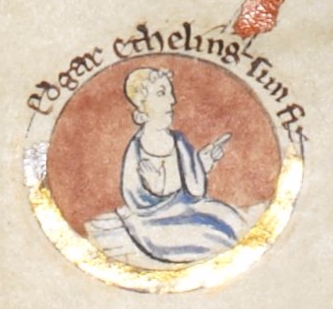
                                              Edgar in an illuminated family tree of Edmund Ironside

When the  Edward the Confessor died in January 1066, Edgar did not succeed him, despite being his closest blood relative (Edward did not have any sons). Instead, the Witenagemot ( an assembly of the ruling class) had elected Harold Godwinson as king. Harold Godwinson was the most powerful noble in England and had considerable military experience, while Edgar was only in his early teens when Edward died and therefore too young to be an effective military ruler. Previous, monarchs had became king at a similar age, such as Eadwig, Edward the Peaceful and Edward the Martyr and Ethelred the Unready had succeeded even at an age significantly younger to Edgar. But, the situation in 1066 was not normal, England faced possible invasions from Norway, Denmark and Normandy and therefore England needed a strong military leader. It then was no surprise that the Witan elected Harold Godwinson as King instead of the young Edgar (who one may assume was most likely considered at the least). However, with the death of Harold Godwinson at the Battle of Hastings in October 1066, Edgar the Atheling was once again a prime candidate for becoming King of England.

Bibliography:

"The Ayling Story | Edgar Atheling." The Ayling Story. N.p., n.d. Web. 27 May 2014

.Binns, Stewart. "Stewart Binns on Edgar the Atheling." Historical Novel Society RSS. N.p., n.d. Web. 27 May 2014.

"Edgar the Aetheling Claim." Edgar the Aetheling Claim. N.p., n.d. Web. 27 May 2014.

Image Credit goes to Wikipedia


Tuesday, 22 April 2014

Cola di Rienzo: An Extraordinary Medieval Leader

Cola di Rienzo was born in Rome in 1313. He claimed to be the son of the Holy Roman Emperor, Henry VII. However, his origins were more humble, his father a tavern-keeper and his mother a washer-woman. His early years were spent at Anagni an he devoted his time to the study of the ancient Rome, in the ancient writers of Livy, Valerius Maximus, Cicero, Seneca, Boethius and the poets. This filled him with determination to restore Rome to its former greatness and power, this was only fuelled by his desire to avenge his brother who had been killed by a noble. He returned to Rome as a student at the age of 20 and in 1343 he was sent on an errand to Pope Clement VI at Avignon (it was the time of the Avignon Papacy/ the Babylonian captivity), where he fulfilled his duties with ability and success. He was eventually appointed notary of the Roman civic treasury by the Pope and returned to Rome in 1344. He then began to plot a revolution that would return the city of Rome to its former glory. After, three years of working towards his goal, including by gaining supporters, on the 19th May 1347, heralds invited the people to the Capitol (Capitoline Hill) and on May 20th, Whit-Sunday, the meeting was held, where he was given unlimited power and authority, a few days later Rienzo took the title of tribune.

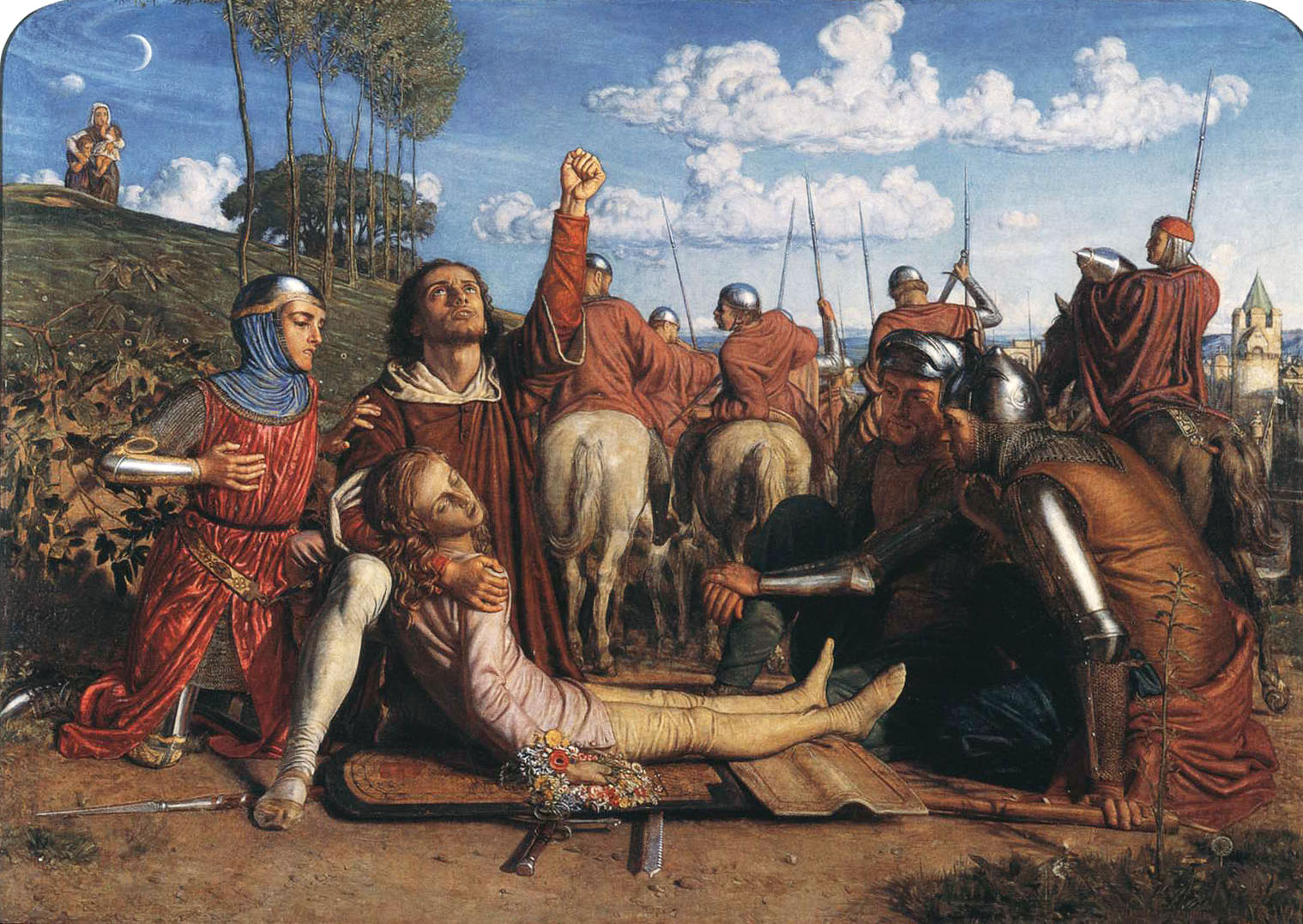
                                       Rienzo vowing to avenge the death of his younger brother

His authority was quickly accepted among most in Rome, his reign was immediately was marked with order and justice, compared to the previous disorder. In July, he proclaimed the sovereignty of the Roman people over the Empire and at first set himself with the task of restoring Rome's authority over the other Italian cities.  On August 1st 1347 he conferred Roman citizenship on all the cities of Italy and and proceeded to prepare for an election of a Roman Emperor of Italy the following year. On the following day the festival of the unity of Italy was celebrated. However, none of this had any political result. However, he was recognised by Joan of Naples, who and her bitter foe the King of Hungary asked for protection and aid. On August 15th he was crowned tribune.

However, his reign was soon to come to an end.. He then  seized and soon released Stefano Colonna and and some other barons. The Pope and the Emperor were both offended by his proposal to set up a new Roman Empire, and in October Clement gave power to a legate to dispose him. The exiled barons soon gathered troops and war began in the neighbourhood of Rome, but with aid from Louis I of Hungary and others, the rebels were defeated on the 20th November 1347. Although, he did not take part directly in the fighting, his most distinguished  foe , Colonna was killed. However, he was eventually declared a criminal, heretic and pagan by the Pope. He fled Rome and abdicated on December 15th 1347, following being terrified by a slight disturbance. He sought refuge in Naples, but quickly left and spent two years in an Italian mountain monastery.

Emerging from solitude, Cola journeyed to Prague in 1350, throwing himself on the protection of the Emperor Charles IV, denouncing the Pope's temporal power. Charles kept him prisoner for a year in the fortress of Raudnitz, then handing him over to Pope Clement. In August 1352, he appeared in Avignon and although he was tried by three cardinals and sentenced to death, the judgement was not carried out. When Clement died in December 1352, he had the chance to gain his freedom, when his successor Innocent VI saw him as a tool to strike at the baronial rulers of Rome. He was appointed the title senator and with a Papal legate he entered Rome in August 1354 and quickly regained his position and power. This term was to be even shorter than his first.

Having besieged the fortress of Palestrina, he returned to Rome where he treacherously seized the mercenary Giovanni Moriale and put him to death. Through this and other cruel and arbitrary acts he quickly lost the favour of the people. On October 8th 1354, Cola addressed some of the aroused people, but the building he was in was set on fire and as he tried to escape he was murdered by the mob.

Bibliography:

The Editors of Encyclopædia Britannica. "Cola Di Rienzo (Italian Leader)."Encyclopedia Britannica Online. Encyclopedia Britannica, n.d. Web. 22 Apr. 2014.
"Cola Di Rienzi." CATHOLIC ENCYCLOPEDIA:. N.p., n.d. Web. 22 Apr. 2014.

Image Credit goes to Wikipedia


Wednesday, 26 March 2014

Anglo-Saxon Kings of England: King Offa

King Offa (born 730) ruled Mercia from 757 until his death in July 796 and was the first known as 'King of the English'. When his cousin Aethelbard was assassinated he seized power during a period of civil war, after defeating Aethelbards' intial successor Beornred. Throughout his reign Mercia became  the most powerful Kingdoms in Anglo-Saxon England, he ruled over  Kent, Sussex, East Anglia and the Midlands. Furthermore, he married his daughters to the Kings of Northumbria and Wessex. He led a successful campaign against the Hestingi. The Anglo-Saxon Chronicle state he fought the inhabitants of Kent in 776 at Otford. Although, it does not state who won the battle it is presumably, the Mercians. There is no evidence for Offas's success over the Kentish until 785. Offa also lead a successful campaign against the West Saxons at Besington in Oxfordshire.

 During Offa's reign the English penny (silver) was introduced. Offa also had diplomatic relations with Charlemagne. The great European leader proposed that one of Offa's daughters marry one of Charlemagne's sons, However, diplomatic relations broke down when Offa also suggested that his son Ecgfrith should marry Charlemagne's daughter Bertha. Charlemagne, outraged, ended contact with Britain and forbid any English ships to dock at his ports. Eventually, diplomatic relations were restored, although they had not improved by the end of 790. Relations between Offa and Pope Adrian I were strong, in 792 he visited Rome itself to strengthen links with the Papacy. He granted the Pope more control over the church, while the Pope allowed the creation of the archbishopric of Lichfield, this temporary change freeing the Mercian Church from the authority of the Archbishop of Canterbury.

Offa was frequently in conflict with the various Welsh Kingdoms, a key result of this was the building of Offa's Dyke. It roughly follows the traditional boundary of England and Wales, running, although not continuously, from the Dee estuary in the north to the river Rye in the south. This frontier barrier (a ditch and bank) ran for 149 miles and is a legacy of the King who ruled a large portion of England..

                                                                         Offa's Dyke


Bibliography:

The Editors of Encyclopædia Britannica. "Offa (Anglo-Saxon King)." Encyclopedia Britannica Online. Encyclopedia Britannica, n.d. Web. 26 Mar. 2014.

"King Offa." King Offa. N.p., n.d. Web. 26 Mar. 2014

"Offa (r. 757-796)." The Official Website of the British Monarchy. N.p., n.d. Web. 26 Mar. 2014.

"Offa's Dyke." Offa's Dyke. N.p., n.d. Web. 26 Mar. 2014

Image credit goes to Wikipedia


Sunday, 2 March 2014

The Shortest War in History: The Anglo-Zanzibar War

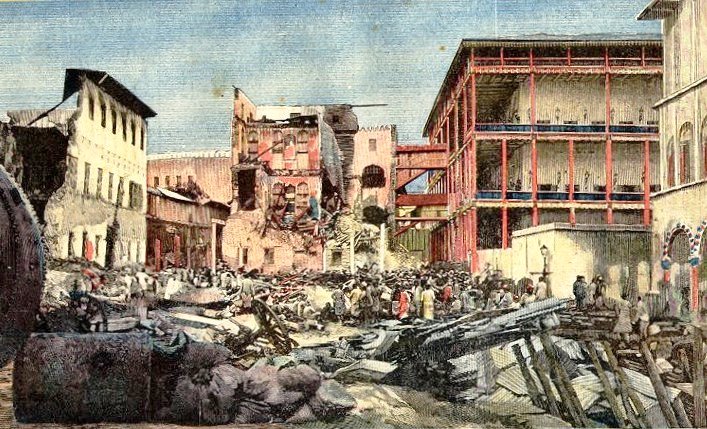
The Shortest War in History

The Anglo-Zanzibar, fought on the 27 August 1896, is thought to be the shortest war in history lasting around only 40 minutes. The war was a result of the death of the pro-British Sultan Hamad bin Thuwaini on the 25th of August. The sultans nephew Khalid bin Bargash seized power in a coup following his death. Bargash assembled 2,800 men to protect his position. The British however favoured Hamud bin Muhammad, who was more pro-British. On August 26th Bargash fortified the palace and. The HHS Glasgow, the Sultan's yacht, was anchored in the harbour nearby. The British quickly assembled five cruisers in the harbour. At 8.00 am on the 27th August an ultimatum was issued to the sultan, to leave the palace in one hour or hostilities would commence. With the situation unresolved, the British led by General Lloyd Matthews, began firing on the palace.

The British ships quickly sank the Glasgow. The sultan's artillery consisted of several Maxim machine guns, a Gatling gun, a 17th-century bronze cannons and 2 twelve-pounder field guns. However, the palace was pounded enough to force Bargash to flee. Bargash sought asylum in the German consulate. The British demanded that the Germans handed over Bargash. However, any international incident was avoided when Bargash escaped to sea on October 2nd 1896. With Bargash removed Hammud bin Muhammad was put into position as ruler, he was mainly a British puppet, who ruled until 1902 and ended slavery in Zanzibar. Bargash was finally captured by the British in 1916.

Image Credit:
http://upload.wikimedia.org/wikipedia/en/8/8a/Zanzibar_palace_after_low.JPG
Sources:
http://militaryhistory.about.com/od/battleswars1800s/p/anglozanzibar.htm
http://news.bbc.co.uk/dna/place-lancashire/plain/A19142282