Thursday, 14 April 2016

Julius Caesar and His Famous Quotes

Julius Caesar is perhaps one of the most famous people in History and one thing he is certainly famous for is his quotes, an awful lot of quotes and also misquotes. In this post I have chosen the ones that have stuck in my mind (randomly) over time and explain them, where they were said and the context of that (If indeed they were said at all). So lets just say this is the point of no return and Alea Iacta Est.


'The Die is Cast'- 'Alea Iacta Est'

You probably guessed from the end of the last paragraph that I was probably going to do this one first. 'The Die is Cast' refers to a point of no return, the die (singular dice) the action is irrevocable regardless of its consequences. This was attributed by the Roman historian Suetonius to Caesar as he crossed the Rubicon river in modern day northern Italy, from Cisalpine Gaul. Cisalpine Gaul, interestingly, was the part of Italy inhabited by Celts since the 13th century BC, even though the term is most associated with France, rather than the other parts of Gaul. This act was seen as insurrection and treason, laws were in place to prevent a coup and therefore even though Caesar only crossed with a single legion, Legio XIII, it was a virtual act of civil war.

Crossing the Rubicon resulted in Civil War (49-45 BC) with Pompey and the traditionalist Senate majority (the Optimates.) Caesar is said to have borrowed the phrase from his favourite Greek writer of comedy, Menander.

                                       Caesar pausing on the banks of the Rubicon

'I came, I saw, I conquered'- 'Veni, Vedi, Vici'

This famous phrase also originates from events mixed in with the Civil War with Pompey, Pharnaces II of Pontus (one of my favourite ancient realms, by the way) a client of Pompey was taking advantage of the Civil War. Caesar achieved a quick victory against Pharnaces II at the Battle of Zela and therefore the term refers to a quick, conclusive victory. According to the Roman historian (of Greek origin) Appian, Caesar used this phrase in a letter to the Roman Senate following his victory. Plutarch and Suetonius also mention this 'famous' quote.

                                Modern day Zile, Turkey, the site of the Battle of Zela.


'you too Brutus?'- 'Et tu Brute?'

The phrase 'you too, Brutus?' or 'and you,Brutus?' is most commonly associated with Caesar's last words. Brutus was a close an adopted close friend, yet nephew of Julius Caesar. The quotation is often used to signify the most unexpected betrayal, such as Brutus' betrayal of Caesar during the Ides of March (15 March) 44BC and his assassination.

Julius Caesar's last words are highly contentious among historians, but this phrase is perhaps mostly associated with Shakespeare's play Julius Caesar (1599) where it forms part of a macaronic phrase that finishes 'Then Fall, Caesar!'. Suetonius claimed that others had reported that Caesar's last words were 'you too child?' with the Greek phrase from which it originates having several translations. Some believe this points to Brutus being Caesar's illegitimate son. Suetonius notes that Caesar said nothing as he died, others say that he only said the phrase after recognising Brutus, meanwhile Plutarch also states Caesar said nothing and that he pulled his toga over his head after seeing Brutus as one of the conspirators.


The Death of Caesar by Vincenzo Camuccini from 1798

Julius Caesar is a man of many well-remembered words, whether he spoke them or not. Many of these phrases have entered modern lexicons, but they also tell us a lot about the man himself and his political career. Whether it is a point of no return, a statement of a swift and conclusive victory or a way to express the shock of a utmost betrayal, Julius Caesar's quotes shall remain in the human mind for some time to come,


Bibliography:
http://www.phrases.org.uk/meanings/358600.html
http://ancienthistory.about.com/od/vterms/g/Venividivici.htm
Image Credit goes to Wikipedia

Wednesday, 13 April 2016

Portugal's Complex Colonial Past: Lusotropicalism to Pluricontinentalism

On 25th April 1974 at 12:20 am Grandola, Vila Morena was played on Portuguese radio marking the beginning of the end for not only the Estado Novo regime, but also of one of the last significant European colonial empires. The Carnation Revolution, so named after its peaceful nature and the placement of the flower in muzzles and on the uniforms of armed men, was organised by the mainly left-leaning Armed Forces Movement (MFA). Much of the planning took place outside the country in African colonies such as Angola, Mozambique and Guinea-Bissau, countries that were to gain independence after the end of Portuguese Colonial War, a cause, but also a result of the coup. Following the revolution the MFA condemned Portugal's foreign policy under the Estado Novo, stating that they had been unable to achieve peace "between Portuguese of all races and creeds". This statement owes a lot to the ideas of Lusotropicalism and Pluricontinetalism, terms that are used to describe Portugal's unique colonial experience. Through this we can see how the Estado Novo legitimised its actions in Africa, far past the decolonisation by other European nations in the 1950's and 1960's.

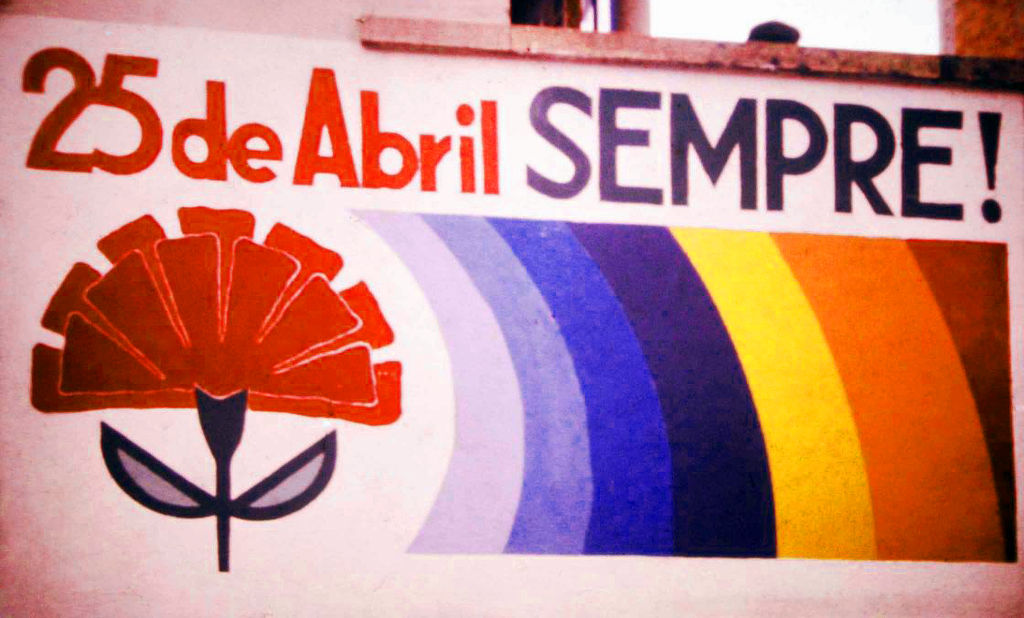
                                    A mural celebrating the Carnation Revolution stating '25 April Forever!'

Pluricontentinetalism embodies the concept that Portugal was not a colonial empire, but that its overseas possessions formed part of Portugal, rather than separate colonial possessions. The idea has its origins in the 14th century, but one of the most prominent examples was a result of the Napoleonic Wars. After Napoleon Bonaparte's invasion of Portugal in 1807 the Portuguese Prince Regent, the later King John VI decided to take refuge in Brazil. John (his mother Maria I of Portugal incapacitated) decided to implement several reforms on his arrival, including abolishing the Portuguese monopoly on Brazilian trade, opened harbours to the commerce of friendly nations and repealed laws that had prevented manufacturing in Brazil. Rio de Janeiro would act as effective capital, with institutions such as the Council of State, Supreme Court, exchequer and royal treasury being installed, as well as his ministry. With the defeat of Napoleon in 1815, some advocated the return of the monarchy to Lisbon, stating the colonial nature of Brazil, but John enjoyed much greater support and freedom then he did in Portugal and so he was not eager to return. However, Brazilian courtiers pushed for Brazil to be elevated from its colonial status, so they could be recognised as nationals of Portugal, furthermore Brazilian nationalists also supported this elevation, as to end its submissive relation.

Therefore, the scene was set, on December 16th 1815 Brazil was elevated to the rank of kingdom and by the same law, The United Kingdom of Portugal, Brazil and the Algarves was created. This transatlantic monarchy did not last long, John later succeeded his mother and was forced to return to Portugal due to radical revolts, on April 22 1821 he appointed his son as regent and two days later left for Europe. Due to growing antagonism between Portugal and Brazil, Pedro oversaw Brazil's transition to independence, becoming it's emperor.

This short-lived Kingdom may seem to diminish the idea of Portugal as a trans-continental state, but it only forms a small part of a complex colonial past, which can only be fully understood through the lens of another idea Lusotropicalism.


              A statue of John VI in Rio De Janeiro (top) and a map of the United Kingdom of Portugal, Brazil and the Algarves (bottom).

Lusotropicalism is most often associated with the Brazilian sociologist Gilberto Freyre. It embodies the notion that the Portuguese are better colonisers and better at miscegenation than other European nations. This in part due to mixed heritage of the Portuguese themselves, with the Celts, Romans, Visigoths, Jews and Moors all inhabiting the area and also due to the warmer climate of Portugal. Therefore, they are friendly, humane and adaptable. 

Though Freyre's Book 'The Master and the Slaves' book does explore the formation of Brazilian society and refutes the idea that the Brazilians are inferior due to 'race-mixing', the notion of Lusotropicalism is not explicit in this work, rather it is branded in his later works from the 1950's after his travels through the Portuguese Colonial Empire. Freyre himself commented on how he did not invent the myth of racial democracy (that Brazil had escaped racism) and that even though his books recognised the intense miscegenation in Brazil, they did not claim there was no racism or prejudice. 


Gilberto Freyre

In the 1930's, the time when 'The Master and the Slaves' was published, Portugal was ruled by António de Oliveira Salazar under the authoritarian Estado Novo regime. Due to the collapse of the Portuguese Empires under the monarchy, the east and India in the 16th and 17th centuries and Brazil in the 17th and 18th centuries, Portugal lacked the military, economic and demographic power to occupy its historic African territories.With the 'Scramble for Africa' by European nations taking place in the late 19th century, it was not until Salazar's reign that a proper colonial enterprise was set up in Africa, this being a colonial regime with genuine institutions and knowledge systems.

Also, around this time, in the 1920's and 1930's, much discussion focused on the colonies was still based on racist and racialist narratives. The majority of historians, anthropologists and intellectuals tried to distinguish the Portuguese as a 'white' race, rather than a mixed or 'Mediterranean'' race, furthermore to distinguishing the Portuguese to the Africans. Freyre's ideas were not popular, but the racialist narrative was slowly being replaced by another more universalist, humanist and evangelist, in regards to the expansion of the Catholic ecumene. The Estado Novo regime did not fully adapt Freyre's ideas in the 1930's and 1940's, they did admit for political reason the Portuguese's unique ability to colonise, but racialist policies were still prominent. Armindo Monteiro, Minister of the Colonies, was an adept of Social Darwinism, he did not believe that a brotherly relationship could be held with the natives, rather it was Portugal's  historic duty to civilise them and convert them to Christianity. These views were commonly held in the political and intellectual circles, to varying levels.

Portugal's unique abilities to colonise were at least from the late 19th century part of the national political and ideological discourse, despite the racialist views held. In this instance, the Portuguese's ability for tropical climates and unique relationships with the natives was was shown through history and anthropology which distinguished the behaviour of Portuguese colonists in Africa compared to their Northern European counterparts. Change was imminent after World War II due to to the condemnation of the projection of hegemony and racial purity of Nazi Germany. The United Nations Charter of 1945 set out the right of colonised people's to self-determination. The Universal Declaration of Human Rights also had an impact, establishing self-determination as a fundamental right and the UN also ascribed colonial powers with the task of preparing their colonies for independence. These actions began the large-scale decolonisation efforts of most European nations, even so Portugal's African colonies did not gain independence until the revolution in the 1970's.


                      "Portugal is not a small country", propaganda showing Portugal's African territories overlaid on Europe.


The UN and the growing pressure from the international community forced Portugal to legitimise it argument's to keep control of its colonial possessions, maintaining the status-quo. This required changes to legislation, doctrinal reformulation and large scale economic development in Angola and Mozambique. In 1951, in the reform framework of the Portuguese political constitution, Salazar proposed to annul the Colonial Act (which he himself introduced,even though it mainly regarded India), integrating it into the constitution with slight changes and differences in terminology. According to the government, the first goal to be achieved was the assertion of national unity, despite dispersion across multiple continents. The term 'Portuguese Colonial Empire' was banned because of its negative connotations, the term 'colonies' was replaced by the 'old' overseas provinces. In this narrative Portugal was a pluricontinental nation, therefore the Estado Novo was unaccountable to the international community in regards to its overseas provinces because they were not colonies, but part of the Portuguese nation.

Although, a tone of assimilation was developed following this, it was not reflected in the treatment of the indigenous populations, The Indigenous Statute, reviewed in 1954, was still denying Portuguese citizenship to the majority of the population in Angola, Mozambique and Guinea-Bissau. Whereas, other 'colonies' such as Cape Verde and India, during the effective occupation of the colonies in the 1940's and 1950's, faced different constitutions. Whereas, the former were seen as distinctly African, Cape Verde and India were seen as part of an ongoing process of miscegenation. India was seen as a completely different civilisation one that had met European Christianity, Cape Verde was seen as regional, rather than colonial and held special rights. 

António de Oliveira Salazar (pictured above) ruled Portugal from 1932 to 1968, he was succeeded briefly by Marcelo Caetono until the Carnation Revolution.

The African colonies were becoming important for Portugal's economy and self-representation, at the time the anti-colonial movements were emerging. Beginning in the early 1960's Portugal found itself at war in Angola, Mozambique and Guinea-Bissau until 1974's revolution. By now we can see how a developed ideology not only legitimised Portugal's military actions, but also developed a reason to hold onto to their overseas possessions. They were part of Portugal and the idea was that they were important to their continued independence, Portugal was in this narrative a country spread across continents, it was Pluricontinental.

Lusotropicalism did not prevent racialist narratives, through miscegenation took place in Brazil, Freyre himself denied the myth of racial democracy. The indigenous populations in colonies, especially on the African continent, were not treated as equals, in general. Nevertheless, Lusotropicalism, much like Pluricontinentalism legitimised political actions and it allowed Portugal to hold onto their overseas territories far beyond that of its European neighbours.


Bibliography:
http://www.britannica.com/place/Brazil/Independence#ref209354
http://adst.org/2015/04/the-carnation-revolution-a-peaceful-coup-in-portugal/
http://news.bbc.co.uk/onthisday/hi/dates/stories/april/25/newsid_4754000/4754581.stm
http://www.institutomillenium.org.br/artigos/a-importancia-de-gilberto-freyre-para-a-construcao-da-nacao-brasileira-parte-ii/
http://miguelvaledealmeida.net/wp-content/uploads/2008/05/portugals-colonial-complex.pdf
http://www.contramare.net/site/en/luso-tropicalism-and-portuguese-late-colonialism-part-1/

Image credit goes to:
Wikipedia
http://library.brown.edu/collections/skidmore/portraits/gilbertoFreyre.html
http://www.contramare.net/site/luso-tropicalism-and-portuguese-late-colonialism-part-2/

Sunday, 7 February 2016

Historical Book Review: Edge of Empires, A History of Georgia by Donald Rayfield

The history of Georgia and the Caucasus region in general, is not abundantly found in the English language, there is only a limited range of books on the subject and those that are available tend to focus on the latter days of the monarchies of Imeretia, Kartli and Kakhetia, even so some still focus only on post-Soviet history. Therefore, when a book that claims to cover the history of Georgia from the earliest linguistic traces to as late as 2012, it is a valuable commodity for those interested in this area.


Edge of Empires is therefore a broad sweeping history, one of the few options available on Georgia with such breadth. The book follows a relatively chronological pattern, however when in a large portion of instances Georgia is disunited, Rayfield tends to talk through each division (usually kingdom) rather than in strict chronology. The author defines the areas of land covered in this history as politically modern de jure Georgia and the historic borders of Georgia, but also geographically as 'the region of Transcaucasia between the Black Sea to the junction of the Iori and Ntkvari (or Kura) rivers, and between the high Caucasus around the lower reaches of the Coruh and the upper reaches of the Mtkvati (or Kura) rivers.' As suggested the historic borders of Georgia have in the past stretched beyond the contemporary nation Georgia, so the books remit covers parts of modern Armenia, Azerbaijan and Turkey, when appropriate.

What Edge of Empires certainly makes clear is that Donald Rayfield is an expert on Kartvelian languages, as he uses this at the start of the book to identify the earliest Kartvelians (Georgian is part of the Kartvelian language group.) This is also emphasised  through the wide knowledge of Georgian literature he displays, the most famous being the national epic The Man in the Panther's Skin. Although, it is a history of Georgia, it is not necessary always a history of the Georgian people Abkhazia and Ossetia have often been part of the Georgian state and so it can also be said to be sometimes a history of Abkhazians and Ossetians, as well as communities such as the Georgian Jews and Armenians, etc.

As the title suggests, Georgia was often an object of contention between various empires, the Iranian/Persian empires arguably matched only by more recent Russian influence. Although, those such as the Ottoman Empire have also had a profound effect. The disunity of Georgia at times is emphasised by Rayfield's narrative, sometimes even after just a small paragraph monarchs have either died or been usurped (in earlier instances, sometimes a sentence or two). This can make the book heavy reading, perhaps Rayfield did not intend Edge of Empires to be a highly readable narrative of Georgian history, but rather intended it to simply provide a clear history. Edge of Empires may also be more of a political history, but the often quick succession of monarchs, means the economic and cultural history in Edge of Empires often makes better reading.

The book is at its strongest when a monarch lives long enough for Rayfield to go in depth, as is the chronological structure of the book. This is more evident in chapters where a large portion of text is dedicated to particular monarchs such as Queen Tamar, Davit IV the Builder, Teimuraz I and Solomon II (often these form the name of the chapters.) Despite this, strong characters such as the Viceroy of the Caucasus, Mikhail Vorontsov, still emerge as colourful. In these instances, we often learn more about cultural and economic output. Vorontsov was the only foreign ruler of Georgia to be commemorated with a statue, although he did crush revolts, one of his most famous feats is establishing the Tbilisi theatre. It is instances such as these we learn more about permanent changes which are in contrast to the seemingly endless political upheaval (depressingly, Georgia has always seemed to have recovered, when more chaos emerges.)

Below we can see two maps that emphasise the politics of Georgia and the Caucasus region. The first map is under Queen Tamar and shows Georgia at its greatest geographical extent. It may initially  look complex along with, although nowhere near as much as, the second map from after the dissolution of a unified Georgian state (the map is from 1490, but the the dissolution had  been taking place earlier during the 15th century), but Queen Tamar's state acted more in unison most of the time, rather than the principalities and kingdoms which did not act in unison a large portion of the time after the dissolution.


Nevertheless, explanations of the political situation sometimes leave an impression of the importance, such as the Tratkat and the official division of Georgia between Persia and the Ottomans. However, the status of principalities such as Mingrelia and Guria could have been made more made more clear, whether they are de jure or de facto independent  from the Kingdom of Imeretia, in this instance. Furthermore, as Edge of Empires progresses closer to our own time it is inevitably more politicised, even the author himself has personally met with some of the figures (being an expert in the area, even at this time). This of course offers an interesting insight, but thankfully he maintains a distance as much as possible , most of the time.

Edge of Empires also contains a number of black and white images. The only criticism is that these are occasionally shown before  the character fully enters the stage. At the end of the book, we have complimentary maps and dynastic trees. The maps are useful, as the geography of Georgia is unfamiliar for many, though one may still find it hard to visualise more specific places instantly such as Tao or the city of Akhaltsikhe. A more general map could have been beneficial. There is also a timeline at the back, which is useful as a reminder. The timeline compares events in the wider world (that are relevant) to more localised events in the region.

In terms of practicality, is the expensive price, nearing at least £20 hardcover, but more often or not closer to £30. This is arguably justifiable due to the speciality of the topic and also the lack of other literature on Georgia of this breadth. Nevertheless,  if you have an interest in Georgia and the Caucasus in general and want to read in the area, Edge of Empires is a good option if you want breadth, especially in terms of politics. If you are looking for economic or cultural history, then you will find it a significant minority in this book, however it is no doubt a valuable resource and a comprehensive and mostly enjoyable reading on Georgian history.


Image credit goes to Amazon.co.uk and Wikipedia

Wednesday, 6 January 2016

Norman-Arab-Byzantine Architecture in 12th Century Palermo

The island of Sicily has a rich history of cultural variety blending together, the very epitome of this is Palermo, which in the 12th century under the de Hautevilles was experiencing an artistic movement  influenced not only by the Norman rule, but also by its Arabic and Byzantine heritage. This Norman-Arab-Byzantine movement, so to speak, was felt throughout the Kingdom of Sicily, but as Palermo was the Norman capital, as well as the Arabic capital for the presence in the area, I shall concentrate on it. There are numerous wonderful examples of the fusion of cultures in Sicily, but first I will start with a small bit of history that led to this situation.

The Romans controlled Sicily from around 218 BC to 468 AD, when it became under the control of the Vandals briefly (468-476) and then the Ostrogoths. It was in 535 that Sicily was occupied by Belisarius, as part of Justinian's ambitions to reconquer the Western Roman Empire, Byzantine rule persisted until the beginning of the Arab invasions in 827 and with the conquest of Palermo in 832 (though the Byzantines still had control of parts of Sicily even in the 12th Century). Norman control of Sicily began with Pope Nicholas II authorising the de Hauteville family in the 1050's (with the alliance made solid in 1052) to retake Sicily for Christianity, this authorisation being granted, as long as they did not recognise the power of Constantinople (the Normans were already in firm control in southern Italy).

Roger II, who was the first King of Sicily (from 1130 to 1154, before this the Norman rule was divided between various dukes and counts) established himself as one of the most powerful monarchs in Europe, also established a court for which he hired people of a wide multi-ethnic background, especially Greeks and Arabs as officials. Under Roger II, Sicily became a highly tolerant society. It should therefore come as no surprise, that in the 12th century, Palermo experienced the Arab-Byzantine-Norman artistic movement, which incorporated these aspects. Pictured below is Roger II in an Arabic style mosaic found in the Capella Palatina.


The first example of architecture that I shall look at is the aforementioned, The Capella Palatina is a royal chapel located within the Palazzo di Normani (Palace of the Normans) which was initially built as a palace for Arab emirs and their harems, based on a site which had earlier been used for Roman and Punic fortifications. By the time of Roger II, it had long been abandoned by the Arabs, yet by 1140 Roger II had built the chapel and it is adorned with various links to Sicily's diverse culture at the time.

The mosaics in the Cappella Palatina are strongly reminiscent of Byzantium, gold-laden as they are. The set-up of the chapel is like that of a traditional Roman basilica ( though traditionally a meeting place, the style later became associated with churches, especially important ones.) This is seen by the three-nave longitudinal body, which is divided by cipolin ( an light Roman marble, consisting of mica- a shiny silicate mineral) columns of the Corinthian order. However, the arches in the Cappella Palatina are of a Saracen style, with other Arabic influences apparent with the 10th century wooden honey-comb ceiling, which is not only painted with Biblical stories, but also with Arabic and Norman courtly life. Clusters of four eight-pointed stars, typical for a Muslim design, are arranged to form a Christian cross. The architectural features of the Capella Palatina are so rich and varied, but it is far from the only example of this artistic movement in Palerme. Below you can see the Saracen-style arches and the Byzantine mosaicsand Arabic Muqarnas (honeycomb vaults for the ceiling) in the second picture.


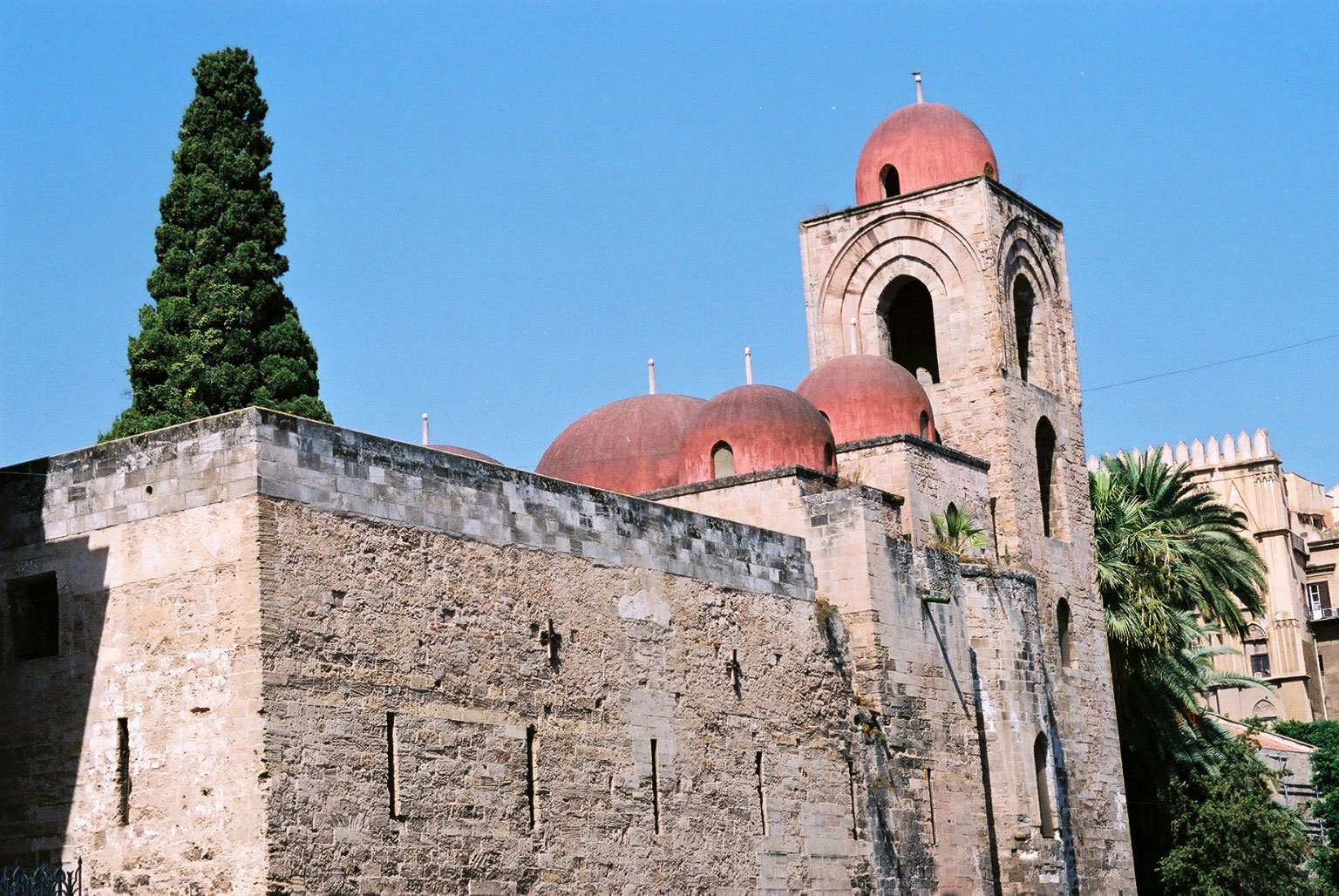
Another example, of Arabic influence on architecture in 12th Century Palermo is the San Giovanni degli Eremiti ( St. John of the Hermits) which is actually near the Palazzo di Normani. The most striking feature of this building is its five red domes built on cubic towers, built at the time of its restoration in the 12th century. Originally, it was built around the time of the 6th century and it was later turned into a Mosque after the Arab conquest. In 1136, returned to Christians under Roger II, it was entrusted to the Benedictine monks of Saint William of Vercelli. Sadly, the red colour of the domes is not original, as at the end of the 19th century an architect found pieces of red plaster on them and so decided to paint them red.


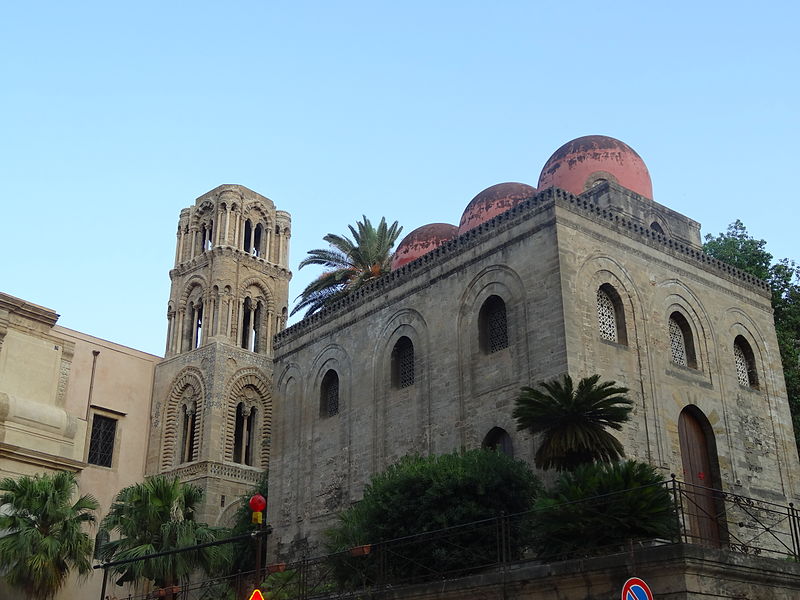
The Chiesa di San Cataldo also has red domes in a similar style, founded in 1160, bearing also merlons in an Arabic style (the solid upright section in a battlement or parapet).


Finally, we shall look at the Cathedral of Monreale, built under William II of Sicily, it was begun in 1174 and as a church it was made into a Cathedral in 1182 by Pope Lucius III. Monreale, though in the province of Palermo, is actually 9 miles from the actual city and the commune itself has a population of roughly 30,000. Arguably, it is one of the finest examples of Norman architecture and is a exemplar of the Norman-Arab-Byzantine movement.

Strangely, after the Arabs forced the Bishop of Palermo to move this area, the modest church of Aghia Kiriaki became an ecclesiastical centre. Palermo was eventually conquered by the Normans, but its temporary importance may have encouraged William II to build his masterpiece here.

From the outside, you can the Norman twin-towered facade, but once you enter it gives way once again to Byzantine mosaics and decorative art in an Islamic style, which cover virtually all the walls, apart from the ground level, to two metres up (which arguably seem in contrast to the outside, which has been described as rather 'normal'.) The marble floor is geometrically patterned and is in-laid with mosaics of a Middle-Eastern influence. This floor supports two rows of columns in Corinthian style, with lancet arches (narrow with a pointed crown, also visible.)


The cloisters, outside of the cathedral, are the only part of the monastery to survive. They are remarkably preserved, once again mainly created by North African craftsmen, they are also decorated in an Arabic style. The cloisters were built in 1200 as part of the cathedral abbey and we can still see the influence of the craftsmen through the 108 pairs of marble columns, which have Arabic arches, on them are carved Biblical figures, mythological scenes, Arab warriors and Norman knights and also floral motifs and fauna (each column is uniques in some way.) In the south-west corner of the cloisters, is a almost mini-cloister within it,in which there is a Arab fountain surrounded by a four-sided colonnade. According to legend William often washed his face in this mountain (he sometimes lived in a small palace next to the cathedral.)

The archiepiscopal palace and the monastic buildings on the south side were once surrounded by a massive precinct wall, occasionally interrupted with one of 12 towers. However, only ruins remain, in particular, some of the towers are still visible, as are the monk's dormitory and the dining area (frater). The aforementioned cloister is the best preserved part of this area.

Monreale is also home to some royal tombs, a 16th century white marble work for William II is present, as well as his father's tomb( William I), which is deep read and porphyry, this is likely the original, as it dates to the 12th century.) William II's mother, Margaret of Navarre, also has her tomb in Monreale.

Below the pictures show the exterior (top) the interior of the cathedral (middle) and the cloisters, with the Arab style fountain in the background.


Norman Sicily in the 12th century was experiencing its Golden Age, this can be seen through its cultural output, as well as its military exploits. However, one of the best pieces of evidence for this is seen in the unique architectural style that was encompassed by the Norman-Arab-Byzantine movement, it shows a wealth monarchy, a high level of tolerance and combination of cultures, through its magnificence and splendour in design and decoration.


Bibliography:

http://www.thethinkingtraveller.com/thinksicily/guide-to-sicily/sicilian-history/a-unique-architectural-fusion.aspx
http://www.atlasobscura.com/places/cappella-palatina
http://www.sacred-destinations.com/italy/palermo-cappella-palatina
http://www.lonelyplanet.com/italy/sicily/palermo/sights/religious/cappella-palatina
http://www.sacred-destinations.com/italy/palermo-san-giovanni-degli-eremiti
http://www.bestofsicily.com/monreale.htm
http://www.thethinkingtraveller.com/thinksicily/guide-to-sicily/towns-and-cities-in-sicily/monreale.aspx

Image credit goes to Wikipedia

Saturday, 14 November 2015

Film Review: God Loves Caviar/The Pirate

Beware spoilers from the start!

'God Loves Caviar', or 'The Pirate' as it seems to be called on Amazon, is a 2012 Greek film that follows the life of Ioannis Varvakis, who could be seen as a national hero of Greece. Ioannis rises from a pirate who raids Ottoman ships to an international caviar millionaire and to his eventual capture by the British. From the beginning we know his eventual fate, due to the fact that the film is being told by two people, his trustworthy servant and his sort of friend-enemy, just after he is sent to a sanitorium.


Where to watch?

Trying to avoid sounding like an advertisement, I watched it on Amazon Prime Instant Video, on which, at least in the UK, it is titled the Pirate. You might be fooled for thinking this an action film by looking at the cover on Amazon, which sadly I can find a high enough quality of image to show you, but there are probably less than two or three minutes of violence. The image below probably portrays the film a bit better. It appears you can also buy the DVD on Amazon, but not under the same banner as the Prime video (the cover below is of the DVD version.)


The story is quite interesting and he feels like a Greek (and actually not fictitious) version of James Onedin. Starting with his piracy against the Ottomans, Ioannis lend his helps to the Russians, in the Russo-Turkish war of 1768-1774, specifically in the Orlov Revolt. This makes him a hero and it does not take long for him to arrive in the court of Catherine the Great after even though his journey there is far from easy, where he is welcomed as a hero. The pace of the film perhaps slows here, previously it had been rapid fire, but even now it is fast. He now travels to the Caspian Sea, in the service of Catherine the Great, where he becomes a merchant (though not a caviar one at this point) and charts the sea. The issues of pace still remain here because I do not think enough time was given to explain why he was sent to Astrakhan, I also did not know he was charting it until he finished.

Like many dramatic characters he seems to have a rampant love life, so his relationships especially with his second and third wives are a quite important component of the film. But, Ioannis still comes across as genuine most of the time, even if at times the portrayal is idyllic, he is certainly human a lot of the time. However, sometimes his fervour for Greece's independence and the film's seems to turn into blind rhetoric against the Turks, as if they are the only people to have committed war crimes. This would be one of my few criticisms of the film.

Another is the pace, as I suggested, and as we reach the end this becomes clear and his role in the Greek War of Independence is barely glossed over. Though, seriously this is a great film and this is only a small criticism. In fact, the story is great and I feel like just under two hours is not enough to tell this eventful historical tale well enough. It would have been better as a 3 and half hour epic (or at least 3 hours) or TV Series that would somehow be ensured of not being cancelled until the whole story is somehow transmitted.


Theological themes are also present in the film, as the title 'God Loves Caviar' suggests, this is done well and adds an extra dimension to the film. The philosophy of a pirate like Ioannis, is also evident, the idea of the sea representing freedom, he is certainly not like a stereotypical pirate, in terms of plundering. It is important to note that despite the alternate title of 'The Pirate', he is only a pirate in proper terms for the first part, then he is really in service, although he retains his identity as a pirate.

A final, sort of criticism, is the fact that in the film Ioannis becomes part of the Order of St Anne (and receives at least another title) and is awarded this by Catherine the Great. After the briefest research I found this to be incorrect, Alexander I give him this reward and although Alexander is mentioned in the film, I understand Catherine was probably used as she is more well known throughout the world.

The film obviously had a limited budget, but most of the time you could barely tell this. There was the occasional use of bad CGI, but to be honest a low budget did not affect my enjoyment of the film. The acting was good, if not at least decent. The film, despite being Greek, was mainly spoken in English, although sometimes it felt dubbed, even though I am sure it was not.

The best part of the film was the story though and as I have hinted, he is truly an interesting character, even if we took some of the things that might have been added for dramatic effect. Towards the end the film gets quite emotional, as you feel Ioannis is slowly fading away into history in a slow decline, despite his re-energising  in terms of  involvement in the Greek War of Independence, the emotions stirred are those of a last gasp breath. A real painting of the hero's film can be seen below.


To summarise, God Loves Caviar, is a drama film that has a solid plot, that falls into the constraints of timing (as a lot of modern films do). He is certainly an interesting historical character and this film seems to do him justice. Despite, the criticisms posed I would certainly recommend watching it, a surprise when I put it on, for I was perhaps expecting over-cheesy action due to the front cover on Amazon which certainly does not do the film any favours, but I guess when I first looked at the film I was inspired to watch it by the description of the film rather than the advertisements. Sadly, it seems it's rebranding as 'The Pirate' was for non-Greeks, but at least it was not a cut down production. Unlike that  film about an admiral during the Russian Civil War, which is a cut down 10 episode TV Series. Because this film is good and enjoyable and because changes that go down in terms of quality and quantity annoy me, I wished other foreign productions would stop being hacked down, because it really puts me of watching them, rather than persuading me to watch them (that sounded a bit moany.) But anyway to end on a positive note, I thoroughly recommend the film.


Image Credit:
http://www.imdb.com/title/tt2181959/
http://www.altcine.com/movie.php?id=1535
https://en.wikipedia.org/wiki/Ioannis_Varvakis#/media/File:Ioannis_varvakis.jpg


Tuesday, 13 October 2015

Rome's Greatest Enemies : Mithridates VI and the Rise of Pontus

It seems I am getting a bit classical, for a long time I have wished to do a post on Pontus, especially under its arguably greatest ruler Mithridates VI, but this has came at a time I find myself wanting to do a post on the Galatians and then I remembered I wanted to do a post on Zenobia and Palmyra a long time ago! Oh, bother, there are a lot of posts I wish to do and it seems that they have been lost in the trail of time, I remember writing in another post that I wanted to write a post on the Battle of Ayn Jalut! Well, I hope I will do all of these, but I have decided to start on Pontus. I must warn you though, that this topic would require a book to describe it fully and so yes I will most certainly miss out details, but I hope it inspires you to find out more!


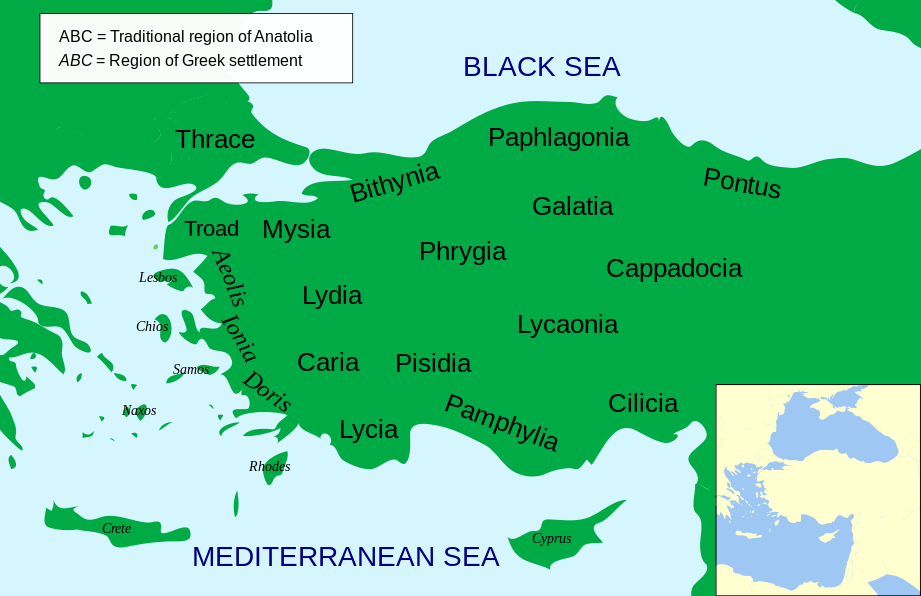
Pontus is a historical Greek designation for a region that is now found within the Black Sea Region of Turkey. This historical region ( I must stress though that the Black Sea Region encompasses far more than just historic Pontus) not only includes its coastline, but also up the hinterland to the Pontic Alps. Throughout history the exact boundaries of this region have varied, but it generally extended from Colchis (a western part of modern day Georgia) to Paphlagonia to the west, separating it from Bithynia. Basically, what the maps show. The one below is actually interesting as it shows a proposed Pontic state for after WW1 and it seems quite an interesting topic, alas it is not the focus of this post. It is key to understand these varying definitions of the region of Pontus and so I hope for the sake of this I have defined its general location well enough (for those who do not know already). There are also different names for the region and it was actually only caused Pontus at a certain point, but this article shall not delve into this.


Mithridates I founded the Kingdom of Pontus in 281 BCE which lasted until its conquest by the Roman Republic in 63 BCE. The focus of this article, Mithridates VI, is renowned for not only his conquests, but also his challenge to Roman power in Asia Minor. Mithradates succeeded his father in 120 BCE, you can probably guess his father's name. Mithradates was a popular name at the time for rulers in Anatolia and literally means 'gift of the god (Mithra)'.  To distinguish himself from Mithridates Euergetes, his father,he was surnamed Eupator or Dionysus. 

Euergetes was actually an ally of Rome, ironic considering his son's actions and he helped them during the Third Punic War. This alliance proved beneficial for the Kingdom of Pontus, allowing him to expand his power from the shores of the Black Sea to the Central Anatolia, where he fought against King Ariarathes VI of Cappadocia. He also forced the Paphlagonian ruler Pylaemenes to bequeath his realm to Pontus. Sinope was Euergetes'  which had a Hellenistic court and he liked to present himself as the champion of Hellenistic culture within Anatolia. In 120 BCE however he was murdered and left his Kingdom to his wife, a Seleucid princess named Laodice, and his two sons. One of them being our Mithridates (Eupator) and the other being Mithridates Chrestus (I did say Mithridates was a popular name.) Chrestus was Laodice's favourite and Eupator may have avoided several plots against hum.

Both of them were young and their mother was able to postpone the inevitable conflict. It seems at some point Eupator was able to seize control from his mother. She may have been put in prison. Not long after these events Chrestus disappears from the scene and it appears Mithridates Eupator became undisputed King of Pontus. It is a possibility that the Seleucid Empire may have wished to intervene on behalf of Laodice, but they were facing a civil war under their leader Antiochus VIII Gryphus. With Mithridates VI now the sole ruler of Pontus, he would continue his father's expansionist policy.


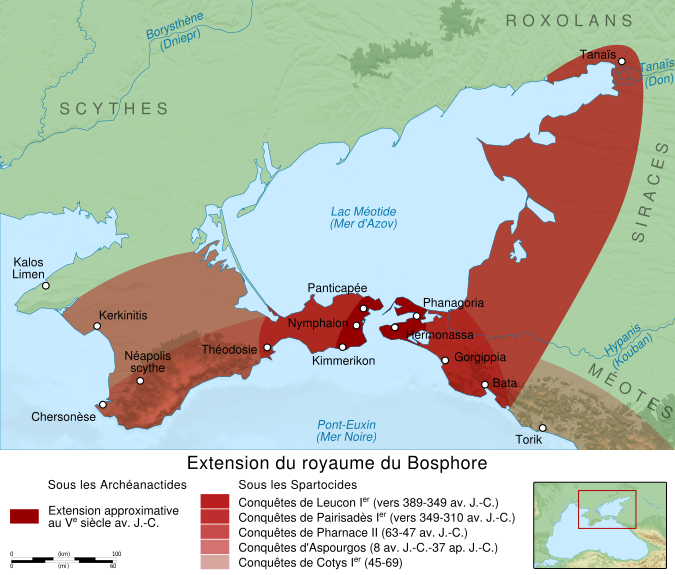
The picture above shows Mithridates VI, the man who only now would become renowned for his military exploits. These conquests included Colchis which it seems he took via military expeditions. But, he also gained land through other means, the Greeks of the Cimmerian Bosporus and of the Tauric Chersonese ( these certainly include the Bosporan Kingdom itself) across the Black Sea, were by far willing to give up independence in return for protection against their old enemy, the Scythians. Who were defeated, with the lands Mithridates aided becoming protectorates of Pontus. The map below shows the early expansion of the Bosporan Kingdom before it became under the control of Mithridates VI.


Mithridates was to now to turn his attention to Anatolia, where Pontic control had weakened after his father's death. Paphlagonia had freed itself, whereas Phrygia had been linked to the Roman province of Asia. He conspired with Nicomedes III of Bithynia to partition Paphlagonia and Galatia between themselves, but they soon fell out over Cappadocia and because it seemed Nicomedes was steering his lands into anti-Pontic alliance with the Romans. Two times in 95 and 92 BCE he was intially successful against Nicomedes, but was deprived of success by the Romans. It soon became clear, if Mithridates VI wanted to carry on expanding his Kingdom, a Roman-Pontic war would become an inevitably. 

While initially appearing to not be too concerned, he soon tried to depose Nicomedes IV of Bithynia, who was completely subservient to Rome. This effort was in vain and soon instigated by the Romans, Nicomedes IV attacked Pontic territory. Mithridates protested, once again in vain, against this towards the Romans. In 89 BCE, a combined Roman and Bithynian army was defeated by Mithridates and they were flung back to the coasts of the Aegean and the Propontis. Much of the western part of the province of Asia welcomed Mithridates, allying with him, but some such as Rhodes held out against him, which he failed to siege. In 88 BCE Mithridates had carried out a massacre of around 80,000 Roman and Italian settlers in Anatolian cities, which nearly wiped out the Roman presence. 

Mithridates had been seen as a champion of Hellenism and so it comes as no surprise that many cities in Greece, including Athens, took his side, welcoming his armies onto the mainland. He also made an alliance with the King of Armenia, Tigranes the Great, who married one of his daughters, Cleopatra of Pontus. As mentioned above, he had Rhodes besieged, but as I should say by his fleet, though I still assume it was unsuccessful in the long run. But, nevertheless, the Romans did respond by sending an army under Lucius Cornelius Sulla.


The map above shows the Kingdom of Pontus. The dark purple shows the Kingdom before his reign, the purple his early conquests and the pink his conquests as part of the First Mithridatic War. Furthermore, the green shows his Armenian ally. Maps like these show you the great extent of his power, but his story is far from over. Sulla drove Mithridates out of Greece proper, but he was forced to rush home, due to the threat of his rival Gaius Marius, therefore peace talks were completed, which were not only lenient, but also never ratified by the Senate. Although, Lucius Licinius Murena, was left to command the Roman forces in Anatolia, the situation allowed Mithridates to recoup his forces.
In 83 BCE Murena attacked Mithridates and so began the Second Mithridatic War, however this ended with a victory for Pontus and peace was quickly signed again. However, disputes were common place and it was not long before the Third Mithridatic War broke out, which would be the longest of the wars between Mithridates VI's Pontus and Rome. This was caused by a Roman attempt to annex Bithynia (which was bequested to Rome by it's last king) which Mithridates attacked with an even larger army. 

During this war, Mithridates defeated Marius Aurelius Cotta at Chalcedon, but was defeated by Lucius Licinius Lucullus at Cyzicus (73 BCE). Lucullus drove him to take refuge with Tigranes in Armenia, who was his son-in-law. Lucullus spent much time in Armenia, with there being two important battles at Tigranocerta (69 BCE) and Artaxata the following year. However, before Lucullus could finish the job he was superseded by Pompey ( Pompey the Great), perhaps due to political moves against him. 

After Pompey defeated Mithridates in 63 BCE, he fled with a small army from Colchis over the Caucasus Mountains to Crimea, where he made plans to raise yet another army to take on the Romans. However, he was betrayed by his son Machares (his eldest living) who was viceroy of Cimmerian Bosporan, who refused to help him fight. Mithridates had him killed and he took the throne of the Bosporan Kingdom for himself. It was then that Mithridates ordered the conscriptions and preparations for war.


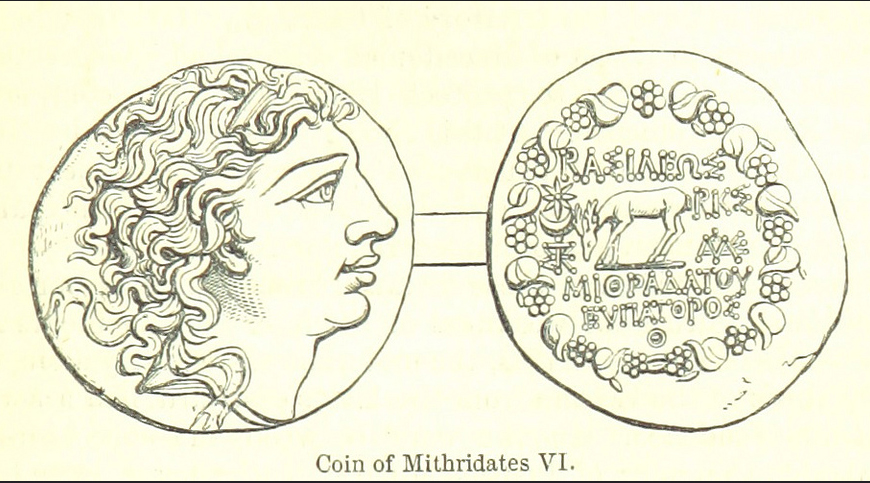
The coin above shows Mithridates, the man who for so long, had troubled the Romans, during the age of other troublemakers such as Spartacus. And yet he was soon to meet his end, in 63 BCE, one of his sons Pharnaces II of Pontus, with a core of Roman exiles, led a rebellion against him. Mithridates fled to the citadel in Panticapaeum, where he sadly committed suicide. Pompey buried Mithridates in the rock-cut tombs of his ancestors in Amasya, the old capital of Pontus.

After the Mithridatic Wars, part of Pontus was incorporated into the Roman Republic as the province of Bithynia et Pontus, whereas the eastern part survived as a client Kingdom. I have no doubt that Mithridates was a genuine fear of Rome, for not only because of the trouble he caused, but because of his possible championing of the Hellenistic/Greek cause. Although, there is no evidence to suggest this championing was a belief he personally held, I think it is though more often that it was simply a political tool, even so he was a genuine threat to Roman superiority. Mithridates was also a harsh ruler, as seen by the aforementioned massacred, but also by his leniency towards the Greeks becoming a harshness after the First Mithridatic War, against which he used deportation, murders and the freeing of slaves (that last crime is terrible!) Therefore, was he really a champion of Hellenism at all? Even, Pontus (at least the royal lineage) may have been of Persian and Greek heritage. Though his campaign in Greece as part of the First Mithridatic War, was only helped by Sulla who helped his troops to sack the city of Delphi.

So there we have it! What do you think, was Mithridates VI a champion of Hellenistic culture or a simply someone who saw a political savvy way to expand his kingdom? Share your opinion in the comments section if you want to!


Image credit goes to Wikipedia

Bibliography:

http://www.britannica.com/biography/Mithradates-VI-Eupator
http://www.livius.org/articles/person/mithridates/


Thursday, 24 September 2015

Film Review : Alexander Nevsky (1938)

Beware this review will contain spoilers from the start!

Alexander Nevsky is a 1938 film directed by Sergei Eisenstein in association with  Dmitri Vasilyev, it is concerned with the Teutonic Knights invasion of Novgorod in the 13th Century and there defeat by the titular hero. The film bears many marks of the contemporary political climate, with strikingly anti-Nazi propaganda and communist and anti-religious sentiment. Most of the film is composed of the Battle of the Ice, a highly influential battle scene, that is also regularly confused with actual historical fact.

Where to watch?

The best place is to watch is here http://cinema.mosfilm.ru/. It is completely legal and free, as Mosfilm recently began uploading its old films in order to counter piracy, so if you want Soviet and post-Soviet Russian films, this is the place to go. It is effectively a Youtube video and the films can also be found on Youtube itself. The website is in Russian, but you can just translate the page (at least you can on Chrome, I am not sure about other browsers) and you can also turn on English subtitles for this film and a lot more (I think.)

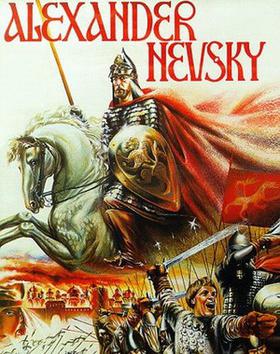
                             DVD Cover (though at least one release has quality issues in the UK I have heard.

From this point on expect even BIGGER spoilers. The film starts with Alexander Nevsky fishing in a seemingly rural area. When the Mongols of the Golden Horde arrive, offering Nevsky the position of a commander,he is already a famed and skilled warrior, an interesting spin in my opinion, after defeating the Swedes. At the beginning we hear a lot of patriotic singing and you should expect a lot of this throughout the film.

We then head to Novgorod, where we hear about the fall of Pskov, it is at this point more of the main characters are introduced, Vasili Buslai and Gavrilo Oleksich are two famous warriors from Novgorod who are also friends, they are competing for the affections of Olga Danilovna and her hand. This competition will decided by the bravery they show at the Battle of the Ice.

In Pskov, we see absolutely horrendous acts committed by the Teutonic Knights, including babies being thrown into fire (I did say horrific) and the slaughter of innocents! Although, disturbing, it is not as disturbing as it would have been in a modern film, due to the age of the film.

The film proceeds (though to be fair, I can't remember if this happens earlier or not) with Alexander Nevsky gathering an army of peasants who are in stark contrast to the knightly Teutonic Order. He enters Novgorod itself where gathers mass support , though he faces the opposition of the boyars and merchants there who are urged on by the monk Ananias. One of those who joins Nevsky's swelling ranks is Vasilisa, a daughter of boyar killed in Pskov by the Order and she takes pivotal combat role.

                                                     It does get pretty hectic sometimes!

I presumed the army of Nevsky now headed towards Pskov, when the vanguard is attacked we quickly change to a lengthy battle scene, which is the Battle of the Ice. It seems Nevsky has a plan here and I interpreted it is as him putting men on the left flank, so the centre and right could hit. But after trying to become clear by looking at a article from the Guardian and after watching the battle itself, I still unsure whether this was the plan. For the majority of the film (it at least felt like that) there is a chaotic battle, impressive considering the time it was made, I was left confused by the actual strategy, despite noticing Nevsky's flanking manoeuvre, the climax is predicted before, the armour of Nevsky's enemies is too much and you can guess what happens, when they are on ice, though  to me they Order seemed to be already on the retreat(though interestingly it seems this did not happen in real life).

After the battle, we see the scenes of the aftermath, almost as if after the frenzy we come to poignant scene about the costs of war, as we see a lot of cinema and television. We then head back to Novgorod (I think, perhaps Pskov) for final scenes of judgement, mourning and celebration and the conclusion of the romance story at the beginning, perhaps in a semi-expected way but with a twist.

Though this is a point I must make, due to watching using a translation, I feel part of my confusion for some of the time, was the English. So if you are fluent in Russian, it is certainly the better way to watch it!

                                          An innovative shot for the main battle scene.

I thought about talking about Marxist (Stalinist) themes in this film, but I feel looking at the history of the film and its innovation are perhaps deserving of a different post or two, rather then stuffing them into an over bloated article, though I would like to know your opinion on this, please comment if you prefer longer or shorter articles (and whatever is best for my SEO, that is a semi-joke.)

So this a review right ?

I enjoyed the film, albeit a little bit of confusion, I dare say this is time of film you would enjoy more if you have done Film Studies or just have a general interest in cinema history. 'For it's time' is a bit of a cliche I admit, but I have seen many modern films with less impressive battle scenes. The propaganda is strong, but it is in this century is well, it is just less subtle. This should not spoil your enjoyment of the film. The soundtrack by Sergei Prokofiev is catchy and epic, but is a bit repetitive, it is nice to know he reworked and that although it has degraded significantly many people have watched the film with music played by an orchestra.

So should you watch this ? I would say yes if you are in it for nostalgia and a general interest in the Soviet period, it is a fine historical film in itself. And although the plot is thin and I wish the film could be longer, it in a way avoids the awful trappings of modern cinema. Therefore, I would recommend it, although not perfect it, I can value its worth in innovation and as a classic piece of cinema.


Bibliography:
The Guardian
http://www.second-reel.com/annex/choruslines/olivier-nevsky.shtml