Friday, 3 August 2018

Dissertation Journal #1: Introduction and Analysing Social Networks in Ostrogothic Italy

For the purpose of keeping a record and for my own satisfaction, I have decided to start a journal for my third-year undergraduate dissertation on this blog. Naturally, I checked that this complies with my university's assessment guidelines and I am happy to say that I am free to go ahead with it. The first post will inevitably be introductory, however the format of following ones may vary. For example, some may be updates if I make an interesting discovery or on a relevant piece of primary or secondary material. These posts will also likely be in a less formal prose, due to the nature of a keeping a journal. For my dissertation, I am carrying out a Social Network Analysis (SNA) of Ostrogothic Italy using Cassiodorus' Variae. This post will therefore act as a way to introduce some relevant concepts and ideas

Social Network Analysis

Social Network Analysis is a methodology used to investigate social relationships within a group. In its simplest terms, looking at how people are connected and what defines those relationships. While visualisation via a graph (such as the example below showing a social media network) forms a key part of SNA, the methodology also comes with a range of metrics to examine a social network. A couple of examples include: centrality (used to measure the importance of an individual) and clustering coefficient (referring to the tendency for cliques or groups to form in a network). SNA is therefore a technique with a rich set of measurements to analyse connections and as Scott points out a well developed history.
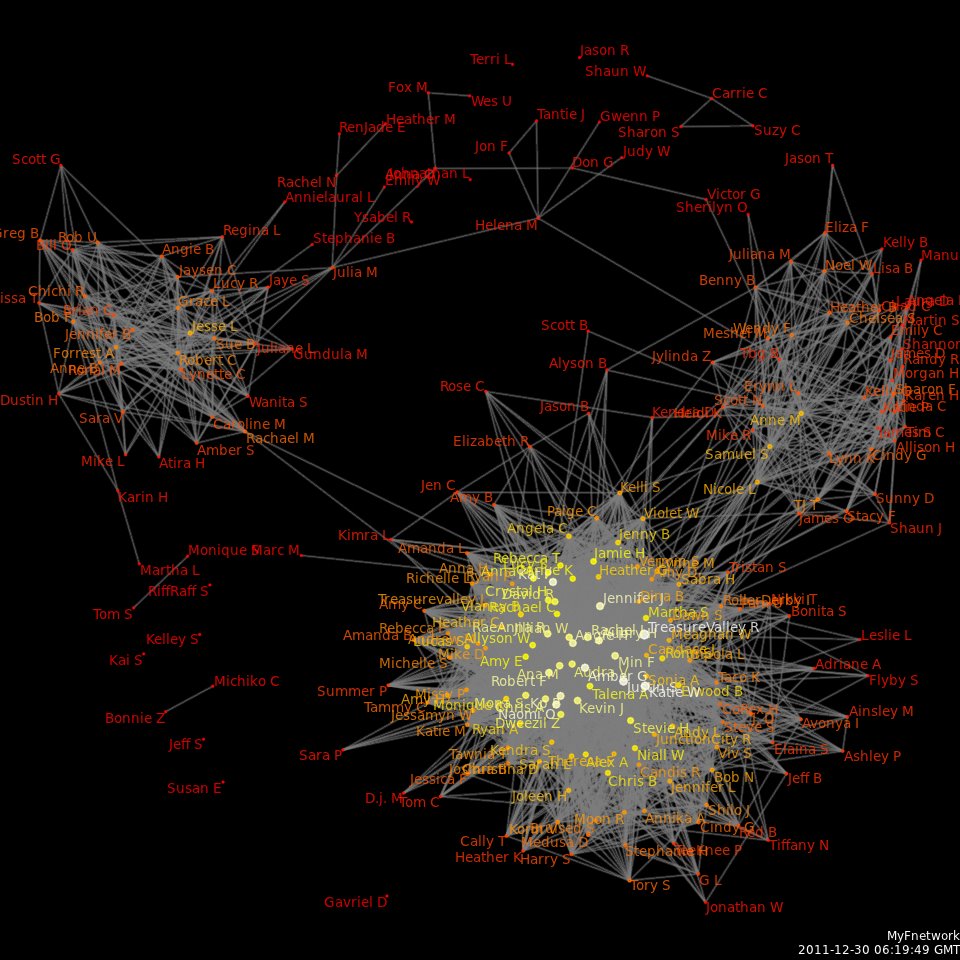


While SNA developed from sociology, its used in other disciplines is increasingly prominent. Perhaps, unsurprisingly to the interdisciplinary nature of some parts of modern academia. Previous attempts at its use in History have included a study of four Anglo-Saxon texts, as well as early eleventh century Holy Roman princes. It has not however been applied to the Variae of Cassiodorus and I will outline later why I think it should be.

To carry out Social Network Analysis, one firstly needs to construct a database, using a program such as Microsoft Excel. There will at least be two sections for this: one for the 'nodes' or individual actors within a network and one for the 'wedges' the connections or lines between people. The nodes section contains 'labels'- these are simply characteristics of individuals. The best way to explain this is by describing the ones I am using to analyse the Variae. For example, I am tracking whether the name of an individual is Gothic or Roman (using two prosopographies as a reference) their gender, location and status or profession. These labels will be important in the final analysis at it allows you to examine the characteristics that define connections within a network. For example, are Romans more connected to other Romans than Goths? Do prominent politicians such as Faustus and Agapitus have a stronger network? Once the database is finished I will import it into a visualisation and metrics software such as Gephi. This is in order to identify patterns and make measurements relevant to the technique. While SNA does not need to be carried out using a computer, it is much easier to use one.

The Variae and Ostrogothic Italy

The Variae and sixth-century Italy are promising for Social Network Analysis for a number of reasons. The letters of Cassiodorus has a large literature of qualitative historiography, however a statistical analysis of them has not yet been undertook. This important as the source has been used to support a range of assumptions, such as that Goths were mainly soldiers and Romans civilians. Patrick Amory's suggestion is that the Variae were used to promote an ideology of civilitas, that Goths and Romans were distinct but harmonious parts of society is one of many arguments based on a qualitative analysis that can be examined using SNA.

This inevitably raises the question in how one should approach the Variae. Thomas Hodgkin, in his valuable 1886 translation of the Variae, treats them as empirical resource into the Ostrogothic chancery, providing exact and mostly accurate information about the running of the kingdom. However, more recent scholarship has tended to emphasise the literary qualities of the Variae more. Shane Bjornlie suggests that Cassiodorus later revised these documents, likely during his stay in Constantinople from 540 until 554 or leading up to it. This a result of the Gothic Wars, was an attempt to rehabilitate the Italian elite and allow them to keep their positions under Justinian by trying to show that they were not serving a 'barbarian' regime under Theodoric.

Although I am carrying out a quantitative analysis, I cannot simply ignore these literary qualities. However, this does not necessarily need to be problematic, the Variae is likely a mixture of data and technique. Bjornlie himself admits this. Therefore, the information I collect can be used for looking at the textual nature of the letters and as a window into the Ostrogothic Kingdom itself. Looking at what defines relationships during Theodoric's reign, with the Variae as a source, will therefore be beneficial in multiple ways.


Conclusion

Hopefully, this post has served to introduce some of the ideas and concepts that are relevant to my dissertation. It has certainly helped my clarity on the subject to try and write up and explain it. As I build my database more and more, I am already starting to identify patterns more and more and this will be fruitful when I start using the metrics available in Social Network Analysis for my study. I am sure it will be provide an interesting way to look at connections within sixth-century Italy.

Primary Sources:

  Cassiodorus, Variae translated in The Letters of Cassiodorus: Being A Condensed Translation Of The Variae Epistolae Of Magnus Aurelius Cassiodorus Senator translated by Thomas Hodgkin. London: Henry Frowde, 1886.

     Secondary Sources:

  Amory, Patrick. People and Identity in Ostrogothic Italy, 489-554. Cambridge; New York: Cambridge University Press, 1997

  Bjornlie, Shane. Politics and Tradition between Rome, Ravenna and Constantinople: A Study of  Cassiodorus and the Variae, 527-544. Cambridge: Cambridge University Press, 2013.

  The Prosopography of the Later Roman Empire, Vol 3 edited by Arnold Jones, John Martindale and John Morris. Cambridge: Cambridge University Press, 1992.

  Gramsch, Robert, Máirín MacCarron, Pádraig MacCarron, and Joseph Yose. "Medieval Historical, Hagiographical and Biographical Networks." In Maths Meets Myths: Quantitative Approaches to Ancient Narratives, edited by Ralph Kenna, Máirán MacCarron and Pádraig MacCarron, 45-69. Cham: Springer International Publishing, 2017.

  Scott, John. Social Network Analysis: A Handbook. 2017 ed. Thousand Oaks, California: SAGE Publications, 1991.

Friday, 15 June 2018

A Historiographical Conundrum?: A Commentary on the Debate Surrounding the Barbarian Settlements

The debate surrounding the settlement of the barbarians in the Western Roman Empire is one of the most hotly contested issues of the Late Antique and Early Medieval periods. This has been particularly apparent since the publication of Walter Goffart's 1980 book Barbarians and Romans, A.D 418-584: The Techniques of Accommodation. Before this, the consensus on the settlement of the barbarians was mainly based around the Roman quartering system of Hospitalitas. This consensus, developed from Gaupp's 1844 work, stated that barbarians received shares of land that had been divided into three. This was an extension of a law from the Theodosian Code describing the practice of billeting Roman troops on civilian land (Hospitalitas). Consequently, this implied that the settlements involved a physical transfer of land. Goffart, starting with Ostrogothic Italy, offered a radical departure to this, suggesting that instead of receiving land barbarian settlers were given a third of the usual tax revenues, specifically put aside for them. This was based on two key terms found in Cassiodorus' Variae. The first being illatio tertiarum, previously this had been considered as a tax paid by those who were not currently hosting a Goth. He now argued this must be understood as referring to the aforementioned diverted and general tax revenue.The second term was millenarrii which Goffart believed referred to a unit of tax assessment that funded the payments made to the Goths, before this most interpretations thought this term referred to a commander of 1000 men.  Goffart was therefore arguing that barbarians were not given or rewarded with a share of land, but instead with a share of the normal tax revenues of the state.

With this article I hope to show that the large difference between the 'land' and 'tax' views in the debate can mainly be ascribed to the highly scant and inconclusive nature of the evidence. In essence, it is a historiographical conundrum that raises questions about how the historian should interpret and use evidence. This is not a new point, Goffart himself saw the implications of his argument for historians when he wrote 'what is at stake in all this not one's sympathy or antipathy towards barbarians, Germans or Goths, rather a conception of how history on the modern marvel may be legitimately be assembled and written'. However, I believe it is a seriously underdeveloped part of the discussion surrounding the settlements. Secondly, by doing this it will become clear that this debate is too centered around finding a single explanatory model for the barbarian settlement. It is often in danger of becoming mechanistic by trying to apply a single model to different geographic and political contexts. More nuanced interpretations of the barbarian settlements do exist, for example Halsall has already made the case for moving beyond the 'land' vs 'tax' debate. In fact, Goffart himself sought to address some of the issues present in his argument when he returned to the debate in 2006, for example stating that 'land' could have had multiple meanings. I will extend this discussion of the historiographical aspect of this debate in three sections, by focusing on successively on the settlement of the Ostrogoths, Visigoths and Burgundians in the Western Empire.


Settlement of the Ostrogoths in Italy

Goffart, when working out the technicalities of barbarian settlement, started with Ostrogothic Italy. This was because, he argued, that the evidence for this area was the most contemporary and detailed. One of his first steps was to try and demolish the evidence for a landed allotment found in Procopius' History of the Wars. This is a key step, as if Procopius is taken at face value a 'landed' arrangement is shown quite clearly.  Procopius states 'by giving a third part of the land to the barbarians, and in this way gaining their allegiance more firmly, he [Odoacer] held the supreme power for nearly ten years'. This of course is referring to the predecessor in Italy to the Ostrogothic king Theodoric and a supposed grant of land. Goffart proposes a number of reasons to distrust this statement. Firstly, that Procopius was from the Eastern Roman Empire and wished to describe Odoacer as a tyrant, with him also respecting Theodoric. The handing over of lands to the barbarians of course being seen as a negative act. Secondly, he also suggests another possibility, that Procopius is criticising the Roman practice of co-operating with barbarians. These criticisms of Procopius are quite valid and even some of Goffart's major opponents such as Sam Barnish distrust this statement as evidence of a landed settlement. Some such as Peter Heather, in an article on Gothic ideology, have suggested we should not be too quick to dismiss Procopius as a source. The debate around whether we should trust Procopius is in essence historiographical, raising the question about how much trust we should put in a source, and how literal we should take it.

Goffart then, as shown in the introduction, goes to use Cassiodorus' Variae to develop his theory for the mechanics of barbarian settlement. Overall, his thesis is supported very well by the evidence found in these letters. Goffart's strongest piece of evidence is perhaps Variae 2:17, in which Theodoric instructs the local authorities of Trent to cancel the taxes for land given to the Priest Butila. According to Goffart, this letter states that prior to the assignment to Butila, the land was subject to ordinary taxation, but once he received it became tax free. Now in a possession of a Goth, the tax revenue, the illatio usually set aside for the Goths, was no longer necessary. Goffart also uses Variae 5:27 to support his thesis for the settlement of Italy. Hodgkin's translation states that it orders the captains of the thousands of the men of Picenum and Samnium, suggesting that Gothic soldiers who served in the field should not lose their reward. Goffart takes a different interpretation of this passage suggesting that the term millenae refers not to a captain of the thousands, but the collective term to which all the Goths in these provinces are referred to as part of the process of receiving an annual tax revenue. The Variae can therefore be used to support Goffart's thesis and yet at same doing so leaves us with even more questions about how we should approach the sources for the settlement of the Goths.

Different viewpoints in the Hospitalitas debate can often hinge on an interpretation of a single term or sentence in sources such as the Variae. This of course can be problematic, should we take the meaning of the texts literal? Likewise, can a word mean something completely different in the context of another source? Furthermore, Goffart seems to place more trust in Cassiodorus than Procopius, but is his reasoning valid? As shown by Patrick Amory the Variae themself often had an ideological purpose. What I am wanting to show by raising these questions here is that the debate on barbarian settlement, as it is based on technicalities and often small pieces of evidence, acts as a focal point for discussion on how history should be carried out.

While Procopius and the Variae may be considered as direct pieces of evidence on the settlement of the Ostrogoths in Italy, there are a number of practical reasons and pieces of external evidence to suggest that a landed settlement in Italy is unlikely. If a landed assignment was made in Italy, the aristocracy would have deprived themselves of their own land and also their wealth. There is little evidence for this or any unrest and the idea that a landed allotment would have been favourable to the aristocracy if a land grant was the case does not seem reasonable. Furthermore, the fact that we can say barbarians owned land does not necessarily prove that they received it as part of a settlement agreement. Settlers could have used their income from the tax in order to buy land. This once again raises a historical issue. In the context of Italy, Goffart's thesis seems the most practical in contrast to the greater harm a landed settlement could have caused to the aristocracy. However, these assumptions are based on the absence of evidence or pragmatism, they are speculative even if it appears there are good reasons to believe in them.. Once again, the debate over the settlement of the barbarians in the Western Roman Empire forces us to encounter questions about how we should approach  evidence and whether there is room for inferences 'around' or 'outside' the sources.

Settlement of the Visigoths

Whereas, a tax based reward seems more likely for the settlement of the Ostrogoths in Italy, it is harder to prove this for the settlement of the Visigoths in Southern Gaul. Halsall suggests that the restricted reading for their settlement (and also for the Burgundians) makes Goffart's thesis more plausible. This is where I would make a departure and suggest that the absence of evidence actually makes a landed settlement more likely. Nevertheless, I still aim to avoid a general or 'mechanistic' view of settlement in the Roman Empire, emphasising a landed settlement in this instance only because of the particular context of the Visigothic settlement.

One of the major sources for Visigothic settlement is the fifth-century Code of Euric, which is only accessible through the seventh-century Visigothic Code. One can immediately identify that this poses lots of problems about whether we can trust the source and it is easy to see why Goffart leaves it to after his discussion of Italy. Nevertheless, there are a number of statements here that imply a landed settlement over a tax-based solution, even if they do so in a sketchy fashion. In 1:1:17 the code describes the process of returning land to Romans from which they had been deprived, this seems to imply physical ownership rather than a unit of tax assessment. 10:1:8-9 presumes that disputes would arise over land ownership, but there is an absence of any specific references to differences between Romans and barbarians. 8:5:5 refers to the fact that travellers may used land that has not been closed in and could be making a reference to the Roman system of hospitalitas. The Code of Euric and the Visigothic Code are therefore highly problematic when it comes to discussing the settlement of the Visigoths in Gaul, even if there are hints at a landed settlement. With the evidence being so scarce, we are forced to ask if the external context and evidence can be used to try and understand the mechanics of barbarian settlement.

Perhaps, the most convincing reason to believe that a landed settlement would have been likely in Gaul is because the disadvantages of doing so would not have been as prominent, in comparison to Italy. Most historians agree that the area the Visigoths settled in was experiencing some sort of crisis. Kulikowksi suggests the settlement of the Visigoths in in Aquitania II meant that the areas that had recently supported usurpation were flanked by the Imperial capital, Arles and the Goths. Burns suggests the settlement must be understood in the context of Constantius trying to stabilise Gaul and Spain. The use of combined Roman and Gothic garrisons in the latter proved to be a bad idea, so the Visigoths, according to Burns, were settled back in Southern Gaul. Nixon has also used a range of literary sources to show the turmoil present in this area at the time. Therefore, while historians do not agree on what exactly happened, it is clear that Gaul during the period of Visigothic settlement was experiencing some sort of political crisis. A landed settlement of the Visigoths in Southern Gaul therefore makes sense as a means of trying to bring the area back into the fold of the Imperial administration. This was perhaps short-sighted, for example the Visigothic King Theodoric II would later support Avitus in his bid to become emperor. Nevertheless, a landed and physical settlement might have been seen as a politically viable move at the time to recover a 'lost' territory.

This of course once again raises the question of whether we should use indirect evidence- that which does not mention the terms or mechanics of barbarian settlement specifically- to help solve our historical conundrum. As we can see very different conclusions can be made from this sort of evidence when we compare the settlement of Gaul to the settlement of Italy. This problem is made more difficult by the number of references in Gallic sources of the period that could be used to imply a landed settlement, such as those in the works of Sidonius Apollinaris and the Gallic Chronicle of 452. We must be careful when using these as they usually detail individual disturbances or settlements.  All this forces to ask whether it is possible and to collate fragmentary and ambiguous pieces of evidence to create a wider narrative about the barbarian settlements. As can be seen much of this will come to down to how the individual historian decides to approach the question of settlement and their choice of what is and what is not worthy evidence. Perhaps, what we can learn from all this historiographical pondering is that discussing the settlement of the barbarians does not have an easy answer and that trying to apply a mechanistic solution risks being overly simplistic.

Settlement of the Burgundians

The settlement of the Burgundians in the Western Empire equally raises many questions about how should approach the Hospitalitas Debate. Once again here, like the settlement of the Visigoths, the evidence is once again sketchy. The main source for a landed settlement in this instance comes from the Burgundian Code, in particularly titles 54 and 55 which belong to the Liber Consitutionum of 417. Much like the evidence from the Visigothic code, some of the titles imply a landed settlement quite heavily. Title 54 states 'It was commanded at the time that the order was issued whereby our people should receive one-third of the slaves, and two thirds of the land'. The use of slaves concurrently suggests the reference to land in this instance could imply physical ownership. It is difficult to identify the idea of a tax revenue instead of land here, when there is also a clause containing information on a 'physical property' such as a slave. In title 54 there is also a reference to barbarians and 'which hospitality assigned him'. This is using the language of hospitalitas, which is mostly not present in the evidence found in Cassiodorus' Variae. Similarly, this clause also states that land should not be taken contrary to the 'gift'. The language used here suggests it was a 'one-off' gift and it is difficult to suggest that this could mean a permanent tax revenue.

Title 55 also mentions the law of hospitality. Which once again raises the question of whether this should be interpreted as meaning temporary or permanent settlement. Perhaps, one of the strongest indicators of some sort of land based arrangement comes with the statement 'let the guests of the contestants not be involved in the quarrel'. Once again it is difficult to see how this language of guests or hospitality could be interpreted meaning as something other than a land settlement. However, there is not much to go on within the code to show if this is arrangement permanent or temporary. We are also faced with another dilemma, can we put trust in the source that what it is saying is accurate? Like the Visigothic code titles 54 and 55 of the Burgundian text survive in much later copies. At the same time it provides some of the most detailed evidence on the process of settlement for the Burgundians. This of course, once again shows, how the debate surrounding barbarian settlement brings is ultimately of historiographical concern, ultimately about how one should approach the evidence that is available.

A number of writers and chroniclers also point towards the possibility of a landed settlement. Propsper of Aquitaine and Hydatius describe the handing over of land. Wheareas, The Gallic Chronicle of 452 describes how Sapaudia was given to the remnants of the Burgundians , who had been defeated by Aetius, to be divided with the  native inhabitants. Wood has highlighted a number of problems with this source, for example its chronology is misplaced and the exact location of Sapaudia is unknown. Therefore, much like with the Visigothic settlement of Gaul evidence external to the law codes is fragmentary and is difficult to use when trying to discuss the settlement of the Burgundians. However, we should be careful in making direct analogies between these two settlements, despite the evidence initially appearing quite similar and with it leaning towards the 'land' side of the Hospitalitas debate.The evidence found in the Burgundian Code is quite different to that found the Visigothic Code, titles 54 and 55 more directly refer to the settlement of the Burgundians, whereas the Visigothic Code tends to only refer to the process of settlement by implication. The point of course here is that we should be careful when approaching evidence and trying to find an easy 'fit-all' solution to barbarian settlement.

Conclusion

This post has not necessarily tried to solve any of the problems regarding the settlement of the barbarians in the Western Roman Empire, but it has tried to show how the debate has a historiographical aspect. It forces the historian to question how they approach and how they should use the sources at their disposal, as vastly different interpretations have derived from a limited base of evidence, due to the different ways it has been approached. Secondly, it has shown that because of these varied problems it would be wrong to develop a 'copy and paste' mechanism in trying to understand the settlement of the barbarians. We cannot simply create a general explanation for barbarian settlement with the evidence available and so focusing on the individual contexts of the Ostrogothic, Visigothic and Burgundian accommodations is not only a necessity, but also good historical practice. 

Bibliography:

Primary Sources:

Cassiodorus, Variae translated in The Letters of Cassiodorus: Being A Condensed Translation Of The Variae Epistolae Of Magnus Aurelius Cassiodorus Senator translated by Thomas Hodgkin. London: Henry Frowde, 1886.

Chronica Gallica of 452 in From Roman to Merovingian Gaul: A Reader translated by Alexander C. Murray. Letchworth: Broadview Press, 2000.

Lex Burgundionum in The Burgundian Code: Book of Constitutions or Law of Gundobad Additional Enactments translated by Katherine F. Drew. Philadelphia: University of Pennysylvania Press, 1972.

Lex Visigothorum in The Visigothic Code translated by Samuel P. Scott. Boston: The Boston Book Company, 1910.

Procopius, The History of the Wars translated by H.B Dewing. Accesed 15/06/2018 at http://www.gutenberg.org/files/20298/20298-h/20298-h.htm.  

Secondary Sources:

Amory, Patrick. People and Identity in Ostrogothic Italy, 489-554. Cambridge; New York:                              Cambridge University Press, 1997.

Barnish, Sam. J. B. "Taxation, Land and Barbarian Settlement in the Western Empire." Papers of the British School at Rome 54 (1986): 170-95.

Burns, Thomas S. "The Settlement of 418." In Fifth-century Gaul: A Crisis of Identity?, edited by John Drinkwater and Hugh Elton, 53-63. Cambridge: Cambridge University Press, 1992.

Goffart, Walter. Barbarian Tides The Migration Age and the Later Roman Empire. Philadelphia: University of Pennsylvania Press, 2006.

Goffart, Walter A. Barbarians and Romans, A.D. 418-584 : The Techniques of Accommodation. Princeton: Princeton University Press, 1980.

Halsall, Guy. "The Technique of Barbarian Settlement in the Fifth Century: A Reply to Walter Goffart." Journal of Late Antiquity 3, no. 1 (2010).

Halsall, Guy. Barbarian Migrations and The Roman West, 376-568. Cambridge: Cambridge University Press, 2005.


Heather, Peter. "Merely an Ideology? Gothic Identity in Ostrogothic Italy." In The Ostrogoths from the Migration Period to the Sixth Century: An Ethnographic Perspective, edited by Sam Barnish and Federico Marazzi, 31-80. Woodbridge, Suffolk: Boydell Press, 2007.

Kulikowski, Michael. "The Visigothic Settlement in Aquitania: The Imperial Perspective." In Society and Culture in Late Antique Gaul: Revisiting the Sources, edited by Raplh W. Mathisen and Danuta Shanzer, 26-38. Aldershot: Ashgate, 2001.

Nixon, Charles E.V. "Relations between Visigoths and Romans in Fifth-century Gaul." In Fifth-century Gaul: A Crisis of Identity?, edited by John Drinkwater and Hugh Elton, 64-74. Cambridge: Cambridge University Press, 1992.

Wood, Ian. "Ethnicity and the Ethnogenesis of the Burgundians." In Typen der Ethnogenese unter besonderer Berücksichtigung der Bayern : Teil 1 : Berichte des Symposions der Kommission für Frühmittelalterforschung, 27. bis 30. Oktober 1986, Stift Zwettl, Niederösterreich, edited by Walter Pohl and Herwig Wolfram, 53-70, 1986.

———. "The Barbarian Invasions and First Settlements." edited by Averil Cameron and Peter Garnsey, 516-37. Cambridge: Cambridge University Press, 1997.

Monday, 2 April 2018

Review: People and Identity in Ostrogothic Italy, 489-554 by Patrick Amory

The 1997 book 'People and Identity in Ostrogothic Italy' by Patrick Amory  is one of many books to tackle the issue of identity, especially ethnicity,  in the 'transition' from the late Roman west to the early medieval period. Amory attempts to tackle this issue through two main lens: by looking at the relationship of individuals to a given community and by examining the often poltically motivated ideological tools that could be used to shape these ties. Amory's approach is ultimately insightful and at times highly nuanced, coming to the conclusion that the boundaries between 'Roman' and 'Goth' were far from static. however there a number of gaps left by the scope of his work.


The first chapters, as of reading now, discuss many themes and issues that will be familiar to those who have studied early medieval ethnicity before. The historiography of ethnic interpretations, the complexity of  labels such as 'Roman' and 'barbarian', are all issues you expect to be present and they certainly are. Therefore, while not always covering new ground, the beginning of the book acts as a useful preamble to the rest of Amory's arguments. The opening section of the book is also aided by a list of vocabulary, which is of a great benefit in what can often be a highly theoretical work.

Amory's initial argument is that Theodoric tried to perpetuate different ideologies on ethnography. Using sources, such as Cassiodorus' Variae and the Edictum Theoderici, he shows that this often over time. Theodoric's civilitas ideology consisted of promoting the idea of  the 'Romans' and the 'Goths' as two harmonious peoples. The 'Goths' being defined by military status, the 'Romans' being civilians. However, in the 520s this changed to an ideology of Gothic superiority, based on strength and the legitimacy of the Amal dynasty. He argues this may have been a a result of the the political upheaval in this part of his reign, such as his actions against Albinus, Pope John and Boethius. Under Theodoric's successors, ethnographic propaganda varied between these two ideas.

The argument here is made better by the point that the promotion of an ideology does not necessarily reflect reality. The changes shown in the texts show an attempt to change ethnic thought, but do not actually represent it in reality. This approach avoids any problematic assumptions with the sources. However, Amory could have made it more clear how these texts with ethnographic connotations were disseminated. Only throwaway references to studies on early medieval literacy, such as those by Rosamond Mckitterick, tackle this problem. It would have been good to see more space dedicated to this, particularly within the context of sixth-century Italy, when it forms an important part of his argument.

Amory also shows how the ideologies of the Gothic kings was only one of many competing discourses in sixth-century Italy. One was the idea of renovatio, the idea of a return to to a golden past, as promoted by the Emperor Justinian. Naturally, this took on the most importance during Justinian's attempt to reconquer the Italian peninsular and it aimed to appeal to the sensibilities of conservative Roman aristocrats. These competing ethnographic ideas could used be used politically by both sides in the context of the Gothic Wars.

                                          Theodoric the Great, as depicated in a medallion.

The other dichotomy tackled by Amory in this book is that of the Arian-Catholic divide. The traditional assumption is that Arianism was inherently 'Gothic', whereas 'Catholicism' was 'Roman'. A large amount of space is dedicated to undermining  the idea that these divisions were anything as simple as the labels suggest. For example, although some Popes may have been driven by an idea of a universal Christian Empire, the day-to-day practical implications of this were often affected by the working relationship the Papacy had with the Arian Ostrogothic Kings. Amory also suggests that individuals could change and adopt their 'faith' to suit political circumstances, as such the 'Arian' and 'Christian' divide were as fluid as other ethnographic ideologies in sixth-century Italy.

One of the other major parts of the book, and perhaps the most impressive, is the massive prosopography attached to the appendix. This is a study of all people who can possibly be identified as a Goth in sixth-century Italy- 379. Outside the work of Procopius, there are only a few people directly named as 'Goth'. Therefore, Amory approaches this section with the flexible criteria found in the rest of the book. This could be problematic for those wishing to use it as a simple factual resource, however as Amory suggests it is reflective of the numerous meanings 'Goth' actually had for various people and groups.

The prosopography also must be understood in the wider content of Amory's work. As a study of 'Gothic' individuals, it cleverly connects to the wider arguments of the book about identity and community by showing the wide range of individuals that can be classed under the aforementioned label. 

There are also a range of other articles attached to the appendix, which all relate to the wider theme of identity in Ostrogothic Italy. Including an inquiry into Gundila's property, which swapped hands during the Gothic Wars. An essay that expands on the 'Germanic' culture as a scholarly construct adds to some of the discussion found earlier in the book. The rest of the appendix covers some of the evidence that is noticeably absent in the main section of the book, such as archaeology and dress. All of these are insightful and well placed here as they are relevant, but not critical to the main thrust of Amory's arguments. 

                                        The mausoleum of Theodoric in Ravenna

To conclude, People and Identity in Ostrogothic Italy is a valuable contribution to discussion about early medieval identity. Its argument that identities such as 'Gothic' and 'Arian' were more complex in reality than how they were portrayed in ethnographic propaganda is persuasive. However, the scope of the work also leaves a couple of unanswered questions, for example how were ethnographic texts disseminated and is it possible to measure their effectivness? Such issues are critical to some of the points made in the book and it would have been good to see more time spent on them. Nevertheless, the book is a nuanced addition to the wide range of scholarly works on early medieval identity.


Thursday, 8 March 2018

Between Barbarity and Belief: An Analysis of Gregory of Tours' Depiction of King Clovis

Book II of Gregory of Tours' Ten Books of Histories (also known as the History of the Franks) forms one the main narrative sources for the reign of the late fifth and early sixth century, Frankish King Clovis. Gregory's depiction of him has provoked much discussion. This is inevitable, due to the fact Clovis' reign predated the text by half a century  and yet remains our most complete source on him. Furthermore, the historiography on the account have long portrayed it as inaccurate and being influenced by the context of Gregory's wider rhetorical aims regarding faith.  Many of these studies have been concerned with finding the 'real' Clovis behind the layers of Gregory's narrative. This can be seen in an article by William Daly which reconstructed Clovis using more contemporary sources, such as the letters of Remigus of Rheims and Avitus of Vienne. These efforts are honourable, but it has meant that Gregory's depiction of Clovis has always been studied with the aim of uncovering facts about its subject. It has not been studied in its own right as written and literary account. This post aims to address these problems by suggesting that the account can also tell us a lot about Gregory and the uneasy position Clovis occupies in his mind, as a key figure in the formation of early Merovingian power and as a convert to Catholicism.

To achieve this, it is first important to explain why the account of Clovis in the Histories have been considered inaccurate. Daly argues that twentieth-century historians of Clovis saw him as barbaric, due to too much reliance on Gregory. According to this viewpoint, Gregory sought to demonise Clovis due to the fact he had been an Arian Christian, rather than Catholic. His portrayal is of a brutal and savage barbarian. Interestingly, Daly's idea of negative discrimination against Clovis in Gregory's account contradicts the judgement made by a number of other scholars. Halsall and Van Dam suggest the portrayal of Clovis in Book II is in fact positive, he is compared to Old Testament Kings. In these instances, Clovis is shown as moral figure. While these approaches all fundamentally agree that Gregory's account is unreliable they differ on what makes this so.

I argue that this is because there are tensions in the Histories regarding Clovis, he is neither fully 'barbaric' nor  'civilised'. He is instead in between these categories, Gregory does not portray him as fully one or the other. This is due to the fact that these definitions or labels are fluid, they contain a set of ideals which can never be fully realised in real or in this case literary form. When writing his account of Clovis, Gregory may be attempting to portray him as one or the other, but he simply cannot due to the openness of the concepts of 'barbarity' and 'civilisation'.


                                                   Ninth-century depiction of Clovis' baptism.
Clovis and the Bishop

One such instance can be identified when Gregory describes plundering following the defeat of 'Syagrius, the King of the Romans', a ruler of Roman origin in the north of Gaul ( His II.27). Apparently, 'many churches were plundered by the troops of Clovis, for he still held fast to his pagan idolatries.' The beginning of this episode appears at first to be polemical. Clovis is shown to be carrying out a negative act due to his paganism. However, as the account goes on it becomes more complex.

The soldiers under the command of Clovis stole a large ewer and other works from a Church. The bishop of which sent messengers to the King to beg for its restoration to the Church. Clovis' response is contradictory, it is both pagan and yet at the same time shows respect for the bishop. He states 'Follow me to Soissons, where all the objects which we have seized are to be distributed. If this vessel for which your bishop is asking falls to my share, I will meet his wishes.'

Far from being unashamedly positive or negative, Gregory's account of Clovis seems to have a level of nuance. The King is seen as unwilling to abandon the idea of sharing loot from warfare. This may be the result of the fact that this practice persisted into Gregory's era,  while being 'barbaric' in origin, plundering was still important in the sixth-century Merovingian kingdom. Therefore, Clovis' use of it is simultaneously civilised and uncivilised. To Gregory, Clovis' actions are somewhere between these two labels. This can also be seen by the fact that he is willing to give his share back to the Bishop.

A more interesting dynamic opens in the passage as we move on, Clovis demands that he is given above his normal share as King, in order for him to return the ewer. This is unexpected, he is not completely violating tradition, but is demanding an exceptional case because of the need to return the bishop's stolen goods. Only one man opposes this saying that he is shall nothing but his fair share. Clovis later strikes this man down with his axe, upon recognising him on the parade-ground a year later.

The contrast between Clovis and this agitator can also help us understand how Clovis is neither fully barbaric or civilised. The latter is described  as 'feckless, fellow, greedy and prompt to anger', matching many of the Classical barbarian stereotypes. Clovis instead shows traits that differ from these, he 'hid his chagrin under a pretence of long-suffering patience'. Clovis is therefore portayed as being more emotionally restrained. However, it is important to note that this  was also a pretence and that he struggled to do this, suffering while remaining patient. He shows behaviour which falls between the stereotypes of barbarity and Romaness.

These levels of nuance in the text do not exist because Gregory is an objective reporter, but because they are rather a reflection the uneasy space Clovis occupies in his mind. In fifth-century Gaul there were competing ideas regarding identity that could not easily fall into the binary ideas of 'Roman' and 'barbarian'. Gaul itself still had a strong Gallo-Roman identity. There were competing ideas of kingship: Christian, Roman, Pagan and the symbolic 'Long-Haired' ideology. Clovis himself was an Arian Christian, rather than a Catholic, before his conversion.

My assertion is that when Gregory approaches writing his account of King Clovis, his account is contradictory because labels such as 'Roman' and 'barbarian' are too simplistic to reflect the actual complexity of the era he is writing about. Therefore, while one may argue Gregory's account aims to portray Clovis as barbaric or the opposite - a moral figure, the text itself shows him to be fully neither. Whatever Gregory's intended meaning was, there are ideas in the text that run counter to it, due to the concepts of 'Roman' and 'barbarian' being open and fluid. It is impossible for Gregory to write about Clovis without these contradictions- even if sometimes they are almost unnoticeable.


Leading up to the Conversion

The faith of Clovis is also problematic for Gregory. According to him, Clovis converted directly from paganism to Christianity, when in reality he had already adopted Arianism before his baptism. This has previously been explained as a direct conversion making Clovis look more like an Old Testament king. Ian N.Wood has tried to argue that in the Histories, Clovis' military successes are directly tied to his Catholicism.

However, the Histories also shows tensions regarding this- Clovis is once again neither fully 'barbaric' or 'civilised', with faith having an important role to play in this. This is most apparent leading up to his conversion. Clotild, the wife of Clovis, wanted their first son baptised. However, 'no sooner had he received baptism than he died in his white robes' (His II. 29).  Clovis reproaches Clotild for this, saying if he had been born under the pagan gods he [the son] would have survived.  This is intriguing, as this seems to directly contradict what you would expect in account by Gregory- the Christian baptism, not a pagan one leads to the child's death.

Further on in this passage, Clovis and Clotild bear a second son, called Chlodomer. He also began to ail once baptised as a Christian, however this time Clotild prayed for the son and he recovered. There seems a contradiction here; Chlodomer starts to die when baptised, but then also recovers through prayer. Two acts of Christian faith seem to have opposite effects. What can explain this?

I argue it originates from Gregory's simplification of religion in the age of Clovis. As mentioned, Clovis is shown as a pagan, when in reality he was an Arian Christian. Religion like 'barbarity' was also fluid in fifth-century Gaul. Gregory is unable to simply use the labels of 'Christian' and 'Pagan' when describing Clovis without tensions arising in the text. Contradictions emerge because while trying to represent Clovis he encounters the difficulty of representing him in such static terms, which do not match the actual openness and fluidity the had in the fifth-century.

After the Conversion

After his conversion to Catholicism, Gregory writes about Clovis' wars. Wood argues this emerges from an attempt to portray Clovis as the champion of Christendom, as seen by his wars a number of Arians within Gaul. Two of these were the brothers Gundobad and Godigisel who ruled over the territory between the Rhône and the Saône. Both 'like their subjects belonged to the Arian sect' (His II, 32). It may come as a suprise then that Clovis decides to ally with one of them.

'Godigisel heard of the victories won by King Clovis' and so 'he sent envoys to him in secret'. Clovis 'gladly accepted the offer'. Clovis in this instance seems quite practical, he is willing to be in alliance with an Arian if it helps him to defeat other heretics. This could have been a temporary, but it nevertheless shows a willingness and flexibility that one might not expect from a moralising text.

Not much later in the text Clovis shows a lesser degree of tolerance: 'I find it hard to go on seeing these Arians occupy a part of Gaul' he states (His II.37). Clovis now wants to take them over 'with God's help'. Once again we face two contradictions in Gregory's portrayal of Clovis, a flexible figure who is willing to ally with an Arian if it suits his current situation and a less tolerant man who wishes to drive all Arians out of Gaul.

Why do these contradictions exist? This is once again because the language of being civilised and uncivilised, of barbarity and belief, is inadequate to deal with the actual actions of Clovis in the account. As argued, these terms are in reality very open and do not have a fixed definition. Gregory's military action here can be seen in both or a mixture of these terms. Therefore, regardless of the way he is trying to portray Clovis- simple or not, Gregory encounters difficulty in doing so without a level of contradiction in the text.

Conclusion

This article has shown that Gregory's account of King Clovis is worth studying beyond its ability to accurately reflect the fifth-century king. While it may have been intended to demonise or moralise Clovis, the account does not show him in such simple terms. It has tensions within in it, Clovis neither appears fully barbaric or civilised. This is because dichotomies such as these are highly problematic and suggest a degree of conformity within the definitions which does not exist. To conclude,  Gregory's account is therefore contradictory, as he is unable to express his account of Clovis without being trapped by these closed and simple terms.

Bibliography:

Primary Sources:

Gregory of Tours, Ten Books of Histories (593-94) translated by Lewis Thorpe in The History of the Franks. London: Penguin, 1974.

Secondary Sources:

Daly, William M. "Clovis: How Barbaric, How Pagan?". Speculum 69, no. 3 (1994): 619-64.

Halsall, Guy. Barbarian Migrations and The Roman West, 376-568. Cambridge: Cambridge University Press, 2005.

Van Dam, Raymond. "Merovingian Gaul and the Frankish Conquests." In New Cambridge Medieval History, Vol.1,  edited by Paul Fouracre, 193-231. Cambridge: Cambridge University Press, 2005.

Wood, Ian N. "Gregory of Tours and Clovis." Revue belge de philologie et d'histoire 63, no. 2 (1985): 249-72.


Saturday, 30 December 2017

Archaeology and Long-Distance Trade in Viking York: An Assessment

G.G Astill has identified that studies on urbanism in England between the seventh and ninth century have tended to focus on two aspects in regards to the economy. Firstly, long-distance trade and the quality of goods in the trade network with the second aspect, regional trade, superseding these in more recent studies. This post aims to assess whether it is still possible for any meaningful conclusions to be derived from evidence for long-distance trade in Early Medieval England by focusing on Viking York.  Following the conquest of York in 866-867 by the Great Heathen Army a succession of Viking Kings was established. This political rule lasted until the expulsion of Eric Bloodaxe in 954, with periodic interruptions by English reconquests. A range of archaeological evidence suggests that York in this period was well-connected in regards to trade. This post suggests two main problems arise while interpreting it. Firstly, that due to the nature of the evidence speculation plays an important role in making any judgement on long-distance trade. Secondly, that the evidence exists and that despite it being a lot more problematic than evidence for regional trade it cannot be entirely dismissed.


Context

The first barrier to long-distance trade, was naturally the geographic space any physical goods had to travel. This was not necessarily a problem in the context of Early Medieval Europe and the North Sea. Inland waterways in Viking York were highly accessible. Ships such as the Sutton Hoo or Skudelev II type could have accessed the Ouse’s river system as far as York and Ripon, even with modern water levels which are shallower when compared to the levels of the Early Medieval Period due to modern agricultural practices. Therefore, travel to inland areas by boat was not only feasible, but also allowed the Viking rulers of York full access to the economy of maritime trade and therefore helping York grow as economic centre in turn benefitted their own trade routes. Travel distance by ship whether oar or sail-powered in the period of Viking rule was significantly quicker than overland travel. It would have taken five days to reach Jarrow from Bamburgh overland (75 miles apart), yet in the same time it a person could have sailed to Francia from the same place (400 miles apart). Therefore, overseas trade via boat was not only practical, but also more beneficial as it allowed access to a wider range of goods at quicker pace than regional trade. 

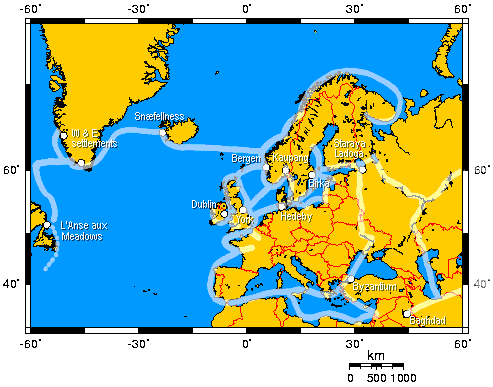
The possibility of long-distance trade could also be understood in the context of Viking expansion. Kurild-Klitgaard and Svendsen theorise that the Vikings moved from plundering to settling and conquest, due to the eventual decline in income caused by overplundering and the greater potential gains in income from the more sustainability of profit and permanence of settling and conquest. The establishment of more permanent political entities or economic connections has often resulted in talk of Viking trade networks, as shown in the map above. If such a view is to be taken, Viking York could be seen a having been at the centre of a long-distance trade network connecting it as far as Central Asia. Through Scandinavia it would have had access to the furs, slaves, wax and honey from Russia, onwards from this the Vikings had access to the so-called ‘Silk Road’ across the Caspian Sea via the ports of Itil and Gorgan, possibly even granting them access to goods from the Far East. 

However, suggesting York was connected to these different ports relies on some assumptions. Firstly, it risks viewing the Vikings as a homogeneous entity or people. This is often still apparent in scholarly literature. However, we cannot simply assume that Vikings in York would have felt any connection to other parts of the Viking world, such as  Kievan Rus. The idea of a 'Viking World' itself can be dangerous and can often result in assumptions that distant geographic areas had any economic connections or common feelings. Furthermore, if goods did travel between different areas of Viking influence it is unlikely the trade was direct. Rollason has argued that the dirhams found in York probably originate from Sweden rather than Central Asia, due to the frequency of their discovery in the former. As such if goods from Asia did reach York it was more likely through short, closer and different stages of trade rather than a single movement of goods from one side of the 'Viking World' to another.

Long-Distance Trade


A number of luxury goods have been discovered in excavations in York from the Viking Period. The discovery of silk in the Coppergate dig suggests that townsmen, at least those of a higher standing, were wealthy enough to buy a luxury material.  A cap made out of silk also discovered in York seems to further attest to this.  The Eastern Roman Empire, was the nearest area which produced a significant amount of silk, however there is no evidence to suggest that it may not have derived from further afield, such as China and India, a possibility considering the Viking’s access to the ‘Silk Road’. It could also be presumed that other luxury goods such as oils and spices may have reached York via its trade connections to Byzantium and Asia. These leave no traces, but as we have evidence of other luxury goods from these areas, it is possible that these could have also been found in Viking York.

Further evidence for York being part of a long distance trade network could be derived from biological archaeology. Within the Coppergate dig one discovery was the a seashell of the cowrie Cypraea pantherina, a species endemic to the Red Sea and the Gulf of Aden, thus implying a visitor in York from this area. The dyeplant club moss was found during the Coppergate Dig, which was also not endemic to York, this is likely to be from Scandinavia or Germany, the location of its natural habitat.  Biological evidence in this instance proves that York had numerous foreign visitors or least visitors with overseas contact. 

From the evidence shown so far a number of points can be made. Firstly, that some forms of evidence for long-distance trade require more conjecture than others. In terms of luxury goods such as silk we can identify that these goods physically existed in Viking York, but we are left to guess how they got there. Perishable goods may have also been traded, but this cannot be fully proven or disprove. While evidence which is less direct, such as remains of non-endemic animals or plants, may suggest that there may have been travel between distant areas, it does not reveal whether this because of trade or not. Even if trade makes the most sense in terms of travelling in Early Medieval Europe.

                                                    Silk Cap from the Coppergate Dig

Numismatics


Numismatic evidence can perhaps provide more hopeful evidence on the trade of York in the Viking Period.  Coins can be useful  as evidence as they can not only show the quality of coinage, but also the distance they have circulated. A recurring find in multiple hoards are dirhams from Samarkand, suggesting coinage from Central Asia circulated as far as York. Firstly, 15 of these can be identified in the Vale of York Hoard.  Whereas, multiple dirhams were also found in the Bossall Hoard.  Furthermore testimony to this is a coin found in the Coppergate dig which bears an inscription in Arabic marking that it was minted for the Arab Caliph Isma’il Ibn Achmad also in Samarkand. These coins appear quite frequently, but are still less apparent than coins originating from England itself. Furthermore, they could say more about the trade power of the Samanids and other parts of the Islamic World than the trade connections of Viking York itself.

A potential meaningful conclusion can be made from comparing the frequency of dirhams in hoards of the Viking period compared to those from periods of English control. Not a single dirham has been found in an English hoard later than the reign of King Athelstan, furthermore following the collapse of the Viking kingdom no dirhams have been identified in any hoards at all. This could suggest long-distance contact with the Islamic World was dependent on Viking control of York. However, this still requires a level of speculation and does not necessarily explain why this was the case.

Numisatics can also tell us more about the prosperity of Viking York. A Carolingian denier which ended production in 877 could correlate with the years leading up to the end of Viking York. Furthermore, the quality of coinage can also tell us a lot about the Viking’s positive influence on York’s economy. The coins of  9th century pre-Viking Northumbria mostly consist of poor quality  stycas made of copper.  However, after the Viking conquest we see a clear difference in quality. For example, a hoard of coins discovered at Cuerdale on the banks of the River Ribble in Lancashire contains many silver pennies minted in York in the names of the Viking kings Siefred and Cnut. Succeeding these and up until King Athelstan’s temporary reconquest of the city in 927, we also have the ‘St Peter’s Pence’, silver pennies also minted in York. The increased quality of coinage under the Vikings is evident. However, it is difficult to show that whether  their political control itself was responsible for the injection of silver bullion into the economy of York or whether or other economic factors played a role.

Conclusion

The debate over whether long-distance trade and how it should be treated in regards to the Early Medieval economy raises an even more important question in regards to historiography and archaeology. The role of conjecture and hypothesis in academia. If we were to take a hard empiricist view with regards to long-distance trade it would be impossible to say anything conclusively apart from the fact that goods and currencies physically existed in York from areas that are geographically distant. However, this in itself is not the sole purpose of any academic enterprise, making wider conclusions always requires interpretation of the evidence available, which is never fully complete. However, this certainly does not gave someone free reign to conjecture without thought. It is clear that in some instances speculation is much more possible than others and this can certainly be said in regards to long distance trade in Viking York. The evidence for it certainly exists, but it is hard to identify any wider patterns due to its scarcity in contrast to the evidence for regional trade. As such, as always it remains important for the scholar to remain aware of the difference between evidence and interpretation, especially when the line between them can be fine.

Bibliography:

Primary Sources:

Carolingian Denier, 840-877 AD, Vale of York, YORYM : 1999.27.
Coins of the Samanid Empire, 899-924 AD, Vale of York, YORYM: 2009.55.679-93.
 Silk Cap, 900-950 AD, York, YORYM : 1980.7.8129.

Secondary Sources:

Astill, Grenville. G. "Towns and Town Hierarchies in Saxon England." Oxford Journal of Archaeology 10, no. 1 (1991): 95-117.

Dolley, R.H.M  ‘A Neglected But Vital Yorkshire Hoard’, British Numisatic Journal 28, (1955-57): 13-14.

Ferguson, Christopher  “Re-evaluating Early Medieval Northumbrian Contacts and the ‘Coastal Highway,” in Early Medieval Northumbria: Kingdoms and Communities, AD 450-1100, ed. David Petts and Sam Turner, 283-303. Turnhout: Brepols Publishers, 2011.

 Hall, Alan and Harry Kenward, “Settling people in their environment: plant and animal remains from Anglo-Scandinavian York” in Aspects of Anglo-Scandinavian York, 372-426. York: The Council for British Archaeology, 2004.

Hall, Richard A, D.T Evans, K.Hunter-Mann and A.J Mainman.  Anglo-Scandinavian Occupation at 16-22 Coppergate: Defining a Townscape. York: Council for British Archaeology, 2014.

Hall, Richard. The Excavations at York: The Viking Dig. London: The Bodley Head, 1985.

Haywood John, The Penguin Historical Atlas of the Vikings. London: Penguin Group, 1995.

Kurrild-Klitgaard, Peter and Gert Tinggard Svendsen, “Rational Bandits: Plunder, Public Goods, and the Vikings.” Public Choice, 117 no.  3/4, Essays in the Memory of Mancur Olson (2003): 255-272.

Rollason, David. Northumbria, 500-1100: Creation and Destruction of a Kingdom. Cambridge: Cambridge University Press, 2003.

Image Credit goes to:

Wikicommons
http://www.historyofyork.org.uk/themes/viking/viking-silk-cap
http://www.hurstwic.org/history/articles/daily_living/text/Towns.htm


Tuesday, 17 October 2017

Bush v. Gore: The Role of Law in Government and the United States Presidential Election of 2000

The U.S Presidential Election of 2000 remains one of the most controversial in history, however its significance lay in how it brought to the surface tensions of the role that law should play in the functioning of government. The entire Florida recount incident and the intervention of the U.S Supreme Court via Bush v. Gore has meant that it has remained a popular subject for scholars to explore. This post aims to evaluate the dispute in terms of its impact on legal and constitutional discussion.  A number of themes came to the fore by : including partisanship, state and federal rights and the method of interpreting law. It then hopes to coalesce these different issues to offer reasons why the relationship between law and government remains contested.


Context to the 2000 Election

The most obvious reason why the 2000 Presidential Election remains so controversial is because of the impact the Florida situation had on the selection of the next President of the United States of America. The main contenders in this election were, the Democratic Party nominee Al Gore and the Republican Party nominee George W. Bush. The Presidential Election is often seen as important due to the perceived influence the winner has on domestic and international affairs for the duration of their term. In fact, Herbert M.Kritzer has suggested that knowledge of the U.S Supreme Court increased as a result of the legal disputes of the 2000 election because of the public's general interest in who would become the next President. For example, before Bush v. Gore in Kritzer's research only 16.0 % of people knew the name of the Chief Justice, after it 31% of people knew the name of the Chief Justice. This fits in with Anthony Musson's idea of 'legal consciousness' in Late Medieval England, a person's knowledge of the law grows when they have a vested interest in it or a personal  experience relating to it. It makes sense that due to the intensity of media coverage and the fact that the public are stakeholders in an election, that public knowledge of law increased as part of the Florida disputes.

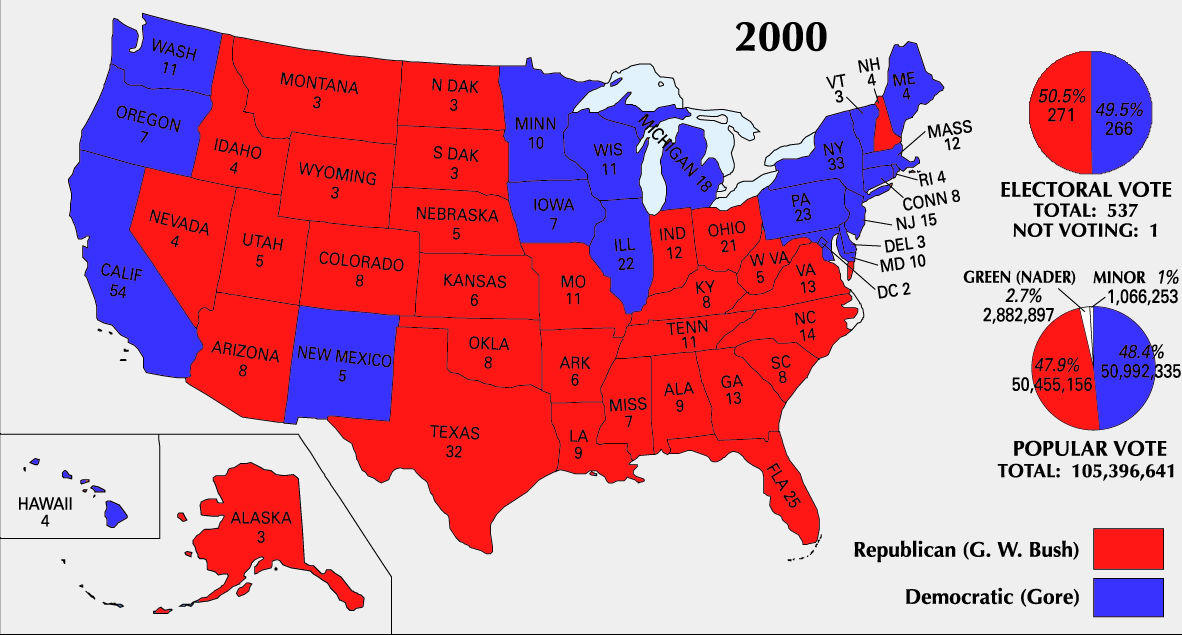
The Florida disputes were important in deciding the next President of the United States because Al Gore and George W. Bush were short of 270 electoral college votes required to win. Florida with its 25 electoral votes would have been enough for either of them to win the presidency. Although many networks had declared George W. Bush the winner of the State of Florida, as the counting continued his lead dwindled to a point where a mandatory recount was required under state law. This machine recount alongside overseas ballots arriving late reduced Bush's lead in Florida to 930 votes (with 6 million be cast). The result of this was that the Florida Democratic Party filed protests on Gore's behalf in four counties: Broward, Miami-Dade, Palm Beach and Volusia. The choice of counties would be somewhat problematic in later legal proceedings, as they were mainly Democratic leaning. The Canvassing Boards in these counties determined that there had been error enough to affect the election. They however filed a request to be allowed to file late returns as they could not complete the manual recount within the seven-day deadline. The Florida Secretary of State, Katherine Harris decided that she could only waive the deadline if the problem requiring a recount consisted of fraud or an act of God. Harris therefore declared that returns from the four counties would not be permitted and certified George Bush the winner of Florida. The Florida Democratic Party and Gore filed a lawsuit to force the secretary to accept amended returns. The trial court denied their appeal, but the Florida Supreme Court accepted an expedited appeal and ruled that the secretary had abused her discretion by refusing to accept late returns and extended the recounting deadline until November 26.

The decision to take this to the U.S Supreme Court by George W. Bush's lawyers, resulted in a ruling on December 4 that the case should took back to the lower court- the state court until they clarified the basis for their decision. This resulted in another round of rulings, Judge Sauls ruled against Gore on every issue before the Florida Supreme Court reversed them by a 4-3 margin. On the 8 December the Florida Supreme Court ruled again sending the case back to the trial court for a statewide recount of undervotes. The lawyers of Bush filed an emergency application asking the U.S Supreme Court to file a 'stay', temporarily preventing the enforcement of this ruling. The U.S Supreme Court then had to decide whether to allow the recounting process to start again. The court ruled 5-4 that recounting could not be complete by the 'safe harbour' deadline of December 12, usually used to ensure that the upcoming Electoral College proceedings would run smoothly. The length and complexity of these legal proceedings can attest to the number of tensions brought to the surface as a result of Bush v. Gore.


Partisanship and the Interpretation of Law

One of issues that the debate and rulings over the Florida recounts brought to the surface was the idea of the law, specifically the judges in the Supreme Court, being partisan. This was primarily advanced by Democrats who accused the ruling of being ideologically motivated rather than a direct interpretation of the law. This view is somewhat understandable as the majority of the Supreme Court was conservative and had been part of a legal revolution concerning civil rights and state autonomy. The Justices were therefore accused of going against the precedent they had set for themselves by directly interfering in the state law of Florida. This is one of the reasons the decision in Bush v. Gore has sometimes been considered an affront to federalism. Another argument advanced in this favour can be seen in the first set of proceedings in the Supreme Court, via the writ of certiorari the Supreme Court could have rid itself of the case without requiring an explanation. This would have allowed the court to avoid a politically contaminated case which had a large bearing on the Presdiential Election.

Undoubtedly, the decision in Bush vs. Gore was influenced by ideological factors (much like any legal case). However, leaving this as the sole explanation oversimplifies the complex web of legal proceedings and interpretations that preceded the final decision. There was precedent for the Supreme Court becoming involved in issues of paramount public importance, including recent ones such as Clinton v. Jones. The fact that the election was still unresolved six weeks after polling day with it increasingly becoming closer to date on which the Electoral College would nominate the next President, has been used to suggest that the Supreme Court's intervention ended an increasingly worse constitutional crisis. While these views have some validity, they are not wholly satisfactory as alternative explanations for the decision in Bush v. Gore. Instead, by focusing on the relationship between the legal officials and the relevant body of law itself it becomes clear that the decision was based on a range of factors affecting interpretation.

In law, countless theories have been advanced the statutory interpretation and it remains a contested issue. In most courts multiple methods are used depending on the context. One method is to interpret a statute in its 'plain language' where possible. Kramer has suggested that from this point of view the Florida Supreme Court's first decision regarding the Katherine Harris and her discretion with the recount is problematic. Section 102.111 of the Florida statutes says 'all missing counties shall be ignored' if their votes have not been received on the seventh day following the election. Section 102.112, which establishes penalties, also plainly states that returns must be filed on the 7th day following the general election. However, the court identified some ambiguities with this, the command that states that late filings should be ignored in 102.111 contradicts 102.112 which restates the seven-day deadline but the provides that the returns 'may be ignored'. The use of 'may' is problematic as it does not in plain language state that they must be ignored. Another way of interpreting law is to bring an assumption that in the drafting process anything contrary was considered. Therefore, unless the law explicitly makes an interpretation impossible, that interpretation of the law is legal. This method is frequently employed by the U.S Supreme Court, which for example assumes U.S Federal Law only applies on U.S soil despite the absence of any clear language stating this. The purpose of these points is to show that interpretation of law is a two-way process between the justice and the language of statutes, one cannot wholly depend on plain language to make a decision. In the context of the 2000 election this is important as it shows there is a space between the judge and the written law where a series of interpretations affect the decision that is made.

Another example in the Supreme Court as part of Bush v. Gore also shows how such problems could arise especially regarding state and federal law. When Bush first approached the Supreme Court its petition set forward three questions for review, they agreed to hear two. The first was whether the Florida court had changed Florida election law in a way inconsistent with Clause 5 of Title 3 of the United States Code and the second being had the decision made 'below' been made in violation of the requirement of Article II of the U.S Constitution that presidential electors be appointed by each state in the manner as the legislature thereof may be direct. Kramer suggests the first argument was ineffective as it was based on the idea that Florida had to follow law enacted prior to the election day, Bush's lawyers arguing that the process of recounting had not been established before the election day. However, this was faulty as Florida's process for these situations was to follow the judicial process, therefore the series of  legal proceedings to resolve the dispute followed their state law.  The second argument rested on Bush's assumption that that the Constitution invests state legislators with absolute authority to regulate the choosing of electors, the Federal government cannot intervene in this selection.  Kramer argues this violates the founding principles and ideas of the Republic that led America to declare independence- that the electors power rests on popular sovereignty. They only have that power because it is invested in them by the people. This scenario like in the Florida Supreme Court shows the influence interpretation of law that is not explicit can have on a decision. A judge must negotiate with context, different bodies of law, and legal language to come to a conclusion. To simplify the Supreme Court's decision in Bush v.Gore to purely ideological terms is to understate the plurality of processes that take place in making a legal interpretation and decision.


                                                             U.S Supreme Court

Election Laws and the Equal Protection Clause

With the interaction between the individual and the interpretation of law in mind, what issues did the specific circumstances of a general election bring to the fore in Bush v.Gore? One of the biggest at the forefront of debate was the Equal Protection Clause, which states no state shall 'deny to any person within its jurisdiction the equal protection of the laws'. This does not state anything about voter rights as such, but by the 1960s it increasingly became associated with the idea that all votes in a state should be treated equally. In the context of this, it is important to note here that the individual citizen actually does not have a federal constitutional right to vote for the President of the United States unless a state decides statewide election as its means to appoint members to the Electoral College (a citizen does have federal rights for Congressional elections.) The Equal Protection Clause therefore formed a way for the Supreme Court to intervene in elections. If a citizen should have equal protection of the law and a state has elections to appoint its delegates to the Electoral College, the state therefore has a duty to ensure all citizens are treated equally in such a process. The argument being here that in a state with a 'One Person, One Vote' system, the Supreme Court has the right to maintain that all individuals are treated equally under it.

In Bush v. Gore the Equal Protection Clause formed a pivotal part of the Supreme Court's final decision. Their first argument was that the Florida Supreme Court failed to provide specific standards or uniform rules to maintain the intent of the voter. The Supreme Court saw this in several instances, including the fact that Palm Beach County used different counting methods at different stages. They began the process of counting votes by following a 1990 guideline which precluded counting completely attached chads and then switched to a rule that considered a vote to be legal if any light could be seen through a chad. After this they switched back to the 1990 rule only to abandon any pretense of a uniform standard, only for a court to order that the county consider dimpled chads legal. The Supreme Court argued that in this instance it was clear that individual's votes had been being treated differently throughout the counting and recounting processes. This therefore violated the right under the Equal Protection Clause for all citizens to be treat equally under a state's law. The second issue that the Supreme Court saw was that the manual recounts conducted in Broward, Volusia, and Palm Beach counties were not limited to undervotes, but included all ballots. The Supreme Court argued that this would affect the equal treatment of voters in a number of ways. One example being that a citizen whose ballot was not read by a machine, may be accepted in a manual recount because it may be readable to the individual recounting it. This naturally created complications, as in the Florida counting there was a chance that each individual's vote was not being treated equally. The Equal Protection Clause therefore allowed the Supreme Court to argued that the counting and recounting process in Florida was not treating citizens as equals under state law.

Conclusion

The U.S Election of 2000 reveals the way law and government can interact with each other, particular in a period of uncertainty. This article has focused on the interaction between law and government in the Florida dispute, but it does not deny that other factors, such as voter suppression and the infamous 'butterfly' ballots played a role in the process through which the state's electoral votes were assigned. By focusing on the interaction between law and government it has hoped to show how these sometimes seen as distinct bodies interact with each other, both influencing each other. The legal system is never isolated from what it interacts with.  Although, the final decision in Bush v. Gore likely had ideological implications, to use this as the sole explanation is to simplify a long and complex legal process and to not take into account the series of interpretations when a legal official uses a statute. The Equal Protection Clause shows how a central government and justice can become involved in the election process by suggesting it has a duty to ensure all members of a state are treated equally under the state's law. These examples show how different levels of government and law interact with each and show that it can be a contentious issue, as complex decisions such as in the Florida dispute can rarely be made based on the 'plain language' of the law. This essentially allows doubts over the legitimacy of a decision to develop, where the law might otherwise might not be questioned. The U.S Election of 2000 was naturally of such a magnitude and this is why it has remained so controversial.


Bibliography:

Balkin, Jack M. "Bush v. Gore and the Boundary between Law and Politics." The Yale Law Journal 110, no. 8 (2001): 1407-58.


Karlan, Pamela S. "Equal Protection: Bush v. Gore and the Making of a Precedent." In The Unfinished Election of 2000, edited by Jack. N. Rakove, 159-201. New York: Basic Books, 2001.


Kramer, Larry D. "The Supreme Court in Politics." In The Unfinished Election of 2000, edited by Jack N. Rakove, 105-59. New York: Basic Books, 2001.


Kritzer, Herbert M. "The Impact of Bush v. Gore on Public Perceptions and Knowledge of the Supreme Court." Judicature 85 (2001): 32-39.


Musson, Anthony. Medieval Law in Context: The Growth of Legal Consciousness from Magna Carta to The Peasants' Revolt. Manchester: Manchester University Press, 2001.


Image Credit goes to:
Wikicommons
https://ic.pics.livejournal.com/kensmind/1278588/1195381/1195381_600.jpg